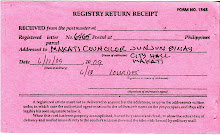
customer advisory vs. Ayala Center Makati
Office of Makati City Administrator accepted
complaint vs. Ayala Center Makati
Evidence that the Office of the City Administrator of Makati accepted my complaint vs. Ayala Center Makati is a letter identified as originating from a source identified as Marjorie A. De Veyra Acting City administrator and dated October 6, 2009.
Prior to what was described as a robbery incident at Rolex store at Greenbelt 5, Ayala Center, Makati, security lapses repeatedly occurred at entrances to different shopping areas at said center. Because of said security lapses I could repeatedly have brought deadly weapons into said areas, to the detriment of customers inside said areas.At the Glorietta, Ayala mall, Ayala Center, Makati, there was a defect in the enclosure for the handicapped.After I entered said enclosure, I had difficulty . in getting out of said enclosure. I had to kick several times the door of said enclosure before I was able to exit. The person in charge of said enclosure was identified as Francisco Diola.On August 4, 2009, a person, identified as Madel Enriquez, allegedly from the Concierge at said Glorietta, received my complaint regarding said defective enclosure. Said complaint was addressed to Patrick Avila of Glorietta. Up to October 30, 2009 no one from Ayala Malls Group has provided me with an apology for said incident. I have evidence that persons, identified as Myrna Cruz-Fernandez Assistant Vice President Ayala Malls Group, Mina C. Domingo Operations Officer Ayala Malls Group, Patrick John C. Avila Operations Officer Ayala Malls Group were aware of said defective door,
Friday, October 30, 2009

Thursday, October 29, 2009
I have seen Belkin brand products being sold locally.
Belkin International Inc. Recalls SurgeMaster™ Surge Protectors Due to Shock Hazard
http://www.cpsc.gov/cpscpub/prerel/prhtml10/10024.html
NEWS from CPSC
U.S. Consumer Product Safety Commission
Office of Information and Public Affairs Washington, DC 20207
FOR IMMEDIATE RELEASE
October 27, 2009
Release # 10-024 Firm's Recall Hotline: (800) 952-1465
CPSC Recall Hotline: (800) 638-2772
CPSC Media Contact: (301) 504-7908
Belkin International Inc. Recalls SurgeMaster™ Surge Protectors Due to Shock Hazard
WASHINGTON, D.C. - The U.S. Consumer Product Safety Commission, in cooperation with the firm named below, today announced a voluntary recall of the following consumer product. Consumers should stop using recalled products immediately unless otherwise instructed.
Name of Product: SurgeMaster™ Surge Protectors
Units: About 68,700
Importer: Belkin International Inc., of Compton, Calif.
Hazard: The molding of the plastic 360 degree rotating plug, which allows for easy cord movement, can crack or detach from the plug assembly, posing a shock hazard to consumers.
Incidents/Injuries: Belkin has received seven consumer complaints about cracking of the plug molding. No injuries were reported.
Description: This recall involves the SurgeMaster™ Surge Protector, models F9G930-10, F9G930v10, F9G930-10-W and F9G930-10-SN, all manufactured in 2003. The model number and date of manufacture are located on the underside of the unit. Grey models F9G930-10-GRY and F9G930fc10G-CL are not a part of this recall.
Sold by: Independent distributors nationwide and the internet by www.belkin.com from September 2003 through December 2007 for about $50.
Manufactured in: China
Remedy: Consumers should stop using these power strips immediately and contact Belkin for a new replacement unit.
__________________________________________________________________________________________________________________________________________________
I have seen Coby products sold locally.
Coby Electronics Recalls Rechargeable Batteries Sold with Portable DVD_CD_MP3 Players Due to Fire Hazard
NEWS from CPSC
U.S. Consumer Product Safety Commission
Office of Information and Public Affairs Washington, DC 20207
FOR IMMEDIATE RELEASE
October 22, 2009
Release # 10-019 Firm's Recall Hotline: (877) 305-2629
CPSC Recall Hotline: (800) 638-2772
CPSC Media Contact: (301) 504-7908
Coby Electronics Recalls Rechargeable Batteries Sold with Portable DVD/CD/MP3 Players Due to Fire Hazard
WASHINGTON, D.C. - The U.S. Consumer Product Safety Commission, in cooperation with the firm named below, today announced a voluntary recall of the following consumer product. Consumers should stop using recalled products immediately unless otherwise instructed.
Name of Product: Rechargeable batteries sold with portable DVD/CD/MP3 players
Units: About 19,600
Importer: Coby Electronics Corp., of Lake Success N.Y.
Hazard: The rechargeable batteries can overheat, posing a fire hazard to consumers.
Incidents/Injuries: Coby Electronics has received 10 reports of batteries overheating, including eight reports of fires resulting in property damage. No injuries have been reported.
Description: The recall involves Coby DVD/CD/MP3 players with an 8 ½ inch screen and product number TF-DVD- 8501. The rechargeable batteries sold with the DVD players have serial numbers that begin with “HY.” The serial number can be found on a white sticker affixed to the battery. “Coby” is printed on the front cover and the product number is on the bottom of the unit.
Sold at: Discount, electronics, music, toy, office supply stores and distributors of electronic products nationwide from January 2007 through September 2009 for between $140 and $275.
Manufactured in: China
Remedy: Consumers should immediately remove the recalled batteries from the unit and contact Coby Electronics to receive a free replacement battery. Consumers can continue to use the DVD/CD/MP3 players with AC or DC power adapters.
Consumer Contact: For additional information, contact Coby Electronics toll-free at (877) 305-2629 between 8 a.m. and 5 p.m. ET Monday through Friday, or visit the firm’s Web site at www.cobyusa.com
_______________________________________________________________________________________________________________________________________________________________________________________________________
FDA New Online Guide to Hearing Aids
http://www.fda.gov/ForConsumers/ConsumerUpdates/ucm185723.htm
_______________________________________________________________________________________________________________________________________________________________________________________________________
Sony Recalls Computer AC Adapters Due to Shock Hazard
http://www.cpsc.gov/cpscpub/prerel/prhtml10/10027.html
NEWS from CPSC
U.S. Consumer Product Safety Commission
Office of Information and Public Affairs Washington, DC 20207
FOR IMMEDIATE RELEASE
October 28, 2009
Release # 10-027 Firm's Recall Hotline: (877) 361-4481
CPSC Recall Hotline: (800) 638-2772
CPSC Media Contact: (301) 504-7908
Firm’s Media Contact: (858) 942-2905
Sony Recalls Computer AC Adapters Due to Shock Hazard
WASHINGTON, D.C. - The U.S. Consumer Product Safety Commission, in cooperation with the firm named below, today announced a voluntary recall of the following consumer product. Consumers should stop using recalled products immediately unless otherwise instructed.
Name of Product: Sony VAIO Computer AC Adapters
Units: About 69,000
Manufacturer: Sony Electronics Inc. of San Diego, Calif.
Hazard: Insulation inside the AC adapter can fail over time, posing an electrical shock hazard to consumers.
Incidents/Injuries: Sony has received four reports of adapters short circuiting. No incidents occurred in the United States. No injuries have been reported.
Description: The recalled AC adapter model is the Sony VGP-AC19V17, which was supplied for use with the following Sony products:
Product Types Using the AC Adapters Product Models Using the AC Adapters
All-in-one VAIO Desktop Computers VGC-LT series and VGC-JS2 series
VAIO Docking Stations VGP-PRBX1 and VGP-PRFE1
Sold at: The SonyStyle stores and Web site, authorized electronics retailers and authorized business- to- business dealers nationwide from September 2005 through October 2009 for between $900 and $3300 for desktop computers and $250 and $300 for docking stations.
Manufactured in: China
Remedy: Consumers should turn off their computer, unplug it and stop using the recalled AC adapters immediately and contact Sony to arrange for a free replacement of the affected AC adapter.
Consumer Contact: For more information, contact Sony toll-free at (877) 361-4481 anytime, or visit the firm’s Web site at esupport.sony.com/ac19adapter
________________________________________________________________________________________________________________________________________________________________________________________________
The National Library of Medicine's Household Products Database.
http://hpd.nlm.nih.gov/
What's under your kitchen sink, in your garage, in your bathroom, and on the shelves in your laundry room?
Learn more about what's in these products, about potential health effects, and about safety and handling.
Browse by category:
Auto Products
Inside the Home
Pesticides
Landscape/Yard
Personal Care
Home Maintenance
Arts & Crafts
Pet Care
Home Office
Browse A to Z:
Product Names
Types of Products
Manufacturers
Ingredients
Support pages
About the Database
FAQ
Product Recalls
Help
Glossary
___________________________________________________________________________________________________________________________________________________________
Unilever Issues Allergy Alert on Wheat in a Limited Number of Tubs of Breyers® Ice Cream (Fri, 23 Oct 2009 14:11:00 -0400) Unilever United States, Inc., of Englewood Cliffs, NJ, in cooperation with the U.S. Food and Drug Administration (FDA), is voluntarily recalling a limited number of tubs of Breyers® ice cream because it was mispackaged and may contain undeclared wheat. People who have an allergy or severe sensitivity to wheat run the risk of allergic reaction if they consume this product...
http://www.recalls.gov/recent.html
Belkin International Inc. Recalls SurgeMaster™ Surge Protectors Due to Shock Hazard
http://www.cpsc.gov/cpscpub/prerel/prhtml10/10024.html
NEWS from CPSC
U.S. Consumer Product Safety Commission
Office of Information and Public Affairs Washington, DC 20207
FOR IMMEDIATE RELEASE
October 27, 2009
Release # 10-024 Firm's Recall Hotline: (800) 952-1465
CPSC Recall Hotline: (800) 638-2772
CPSC Media Contact: (301) 504-7908
Belkin International Inc. Recalls SurgeMaster™ Surge Protectors Due to Shock Hazard
WASHINGTON, D.C. - The U.S. Consumer Product Safety Commission, in cooperation with the firm named below, today announced a voluntary recall of the following consumer product. Consumers should stop using recalled products immediately unless otherwise instructed.
Name of Product: SurgeMaster™ Surge Protectors
Units: About 68,700
Importer: Belkin International Inc., of Compton, Calif.
Hazard: The molding of the plastic 360 degree rotating plug, which allows for easy cord movement, can crack or detach from the plug assembly, posing a shock hazard to consumers.
Incidents/Injuries: Belkin has received seven consumer complaints about cracking of the plug molding. No injuries were reported.
Description: This recall involves the SurgeMaster™ Surge Protector, models F9G930-10, F9G930v10, F9G930-10-W and F9G930-10-SN, all manufactured in 2003. The model number and date of manufacture are located on the underside of the unit. Grey models F9G930-10-GRY and F9G930fc10G-CL are not a part of this recall.
Sold by: Independent distributors nationwide and the internet by www.belkin.com from September 2003 through December 2007 for about $50.
Manufactured in: China
Remedy: Consumers should stop using these power strips immediately and contact Belkin for a new replacement unit.
__________________________________________________________________________________________________________________________________________________
I have seen Coby products sold locally.
Coby Electronics Recalls Rechargeable Batteries Sold with Portable DVD_CD_MP3 Players Due to Fire Hazard
NEWS from CPSC
U.S. Consumer Product Safety Commission
Office of Information and Public Affairs Washington, DC 20207
FOR IMMEDIATE RELEASE
October 22, 2009
Release # 10-019 Firm's Recall Hotline: (877) 305-2629
CPSC Recall Hotline: (800) 638-2772
CPSC Media Contact: (301) 504-7908
Coby Electronics Recalls Rechargeable Batteries Sold with Portable DVD/CD/MP3 Players Due to Fire Hazard
WASHINGTON, D.C. - The U.S. Consumer Product Safety Commission, in cooperation with the firm named below, today announced a voluntary recall of the following consumer product. Consumers should stop using recalled products immediately unless otherwise instructed.
Name of Product: Rechargeable batteries sold with portable DVD/CD/MP3 players
Units: About 19,600
Importer: Coby Electronics Corp., of Lake Success N.Y.
Hazard: The rechargeable batteries can overheat, posing a fire hazard to consumers.
Incidents/Injuries: Coby Electronics has received 10 reports of batteries overheating, including eight reports of fires resulting in property damage. No injuries have been reported.
Description: The recall involves Coby DVD/CD/MP3 players with an 8 ½ inch screen and product number TF-DVD- 8501. The rechargeable batteries sold with the DVD players have serial numbers that begin with “HY.” The serial number can be found on a white sticker affixed to the battery. “Coby” is printed on the front cover and the product number is on the bottom of the unit.
Sold at: Discount, electronics, music, toy, office supply stores and distributors of electronic products nationwide from January 2007 through September 2009 for between $140 and $275.
Manufactured in: China
Remedy: Consumers should immediately remove the recalled batteries from the unit and contact Coby Electronics to receive a free replacement battery. Consumers can continue to use the DVD/CD/MP3 players with AC or DC power adapters.
Consumer Contact: For additional information, contact Coby Electronics toll-free at (877) 305-2629 between 8 a.m. and 5 p.m. ET Monday through Friday, or visit the firm’s Web site at www.cobyusa.com
_______________________________________________________________________________________________________________________________________________________________________________________________________
FDA New Online Guide to Hearing Aids
http://www.fda.gov/ForConsumers/ConsumerUpdates/ucm185723.htm
_______________________________________________________________________________________________________________________________________________________________________________________________________
Sony Recalls Computer AC Adapters Due to Shock Hazard
http://www.cpsc.gov/cpscpub/prerel/prhtml10/10027.html
NEWS from CPSC
U.S. Consumer Product Safety Commission
Office of Information and Public Affairs Washington, DC 20207
FOR IMMEDIATE RELEASE
October 28, 2009
Release # 10-027 Firm's Recall Hotline: (877) 361-4481
CPSC Recall Hotline: (800) 638-2772
CPSC Media Contact: (301) 504-7908
Firm’s Media Contact: (858) 942-2905
Sony Recalls Computer AC Adapters Due to Shock Hazard
WASHINGTON, D.C. - The U.S. Consumer Product Safety Commission, in cooperation with the firm named below, today announced a voluntary recall of the following consumer product. Consumers should stop using recalled products immediately unless otherwise instructed.
Name of Product: Sony VAIO Computer AC Adapters
Units: About 69,000
Manufacturer: Sony Electronics Inc. of San Diego, Calif.
Hazard: Insulation inside the AC adapter can fail over time, posing an electrical shock hazard to consumers.
Incidents/Injuries: Sony has received four reports of adapters short circuiting. No incidents occurred in the United States. No injuries have been reported.
Description: The recalled AC adapter model is the Sony VGP-AC19V17, which was supplied for use with the following Sony products:
Product Types Using the AC Adapters Product Models Using the AC Adapters
All-in-one VAIO Desktop Computers VGC-LT series and VGC-JS2 series
VAIO Docking Stations VGP-PRBX1 and VGP-PRFE1
Sold at: The SonyStyle stores and Web site, authorized electronics retailers and authorized business- to- business dealers nationwide from September 2005 through October 2009 for between $900 and $3300 for desktop computers and $250 and $300 for docking stations.
Manufactured in: China
Remedy: Consumers should turn off their computer, unplug it and stop using the recalled AC adapters immediately and contact Sony to arrange for a free replacement of the affected AC adapter.
Consumer Contact: For more information, contact Sony toll-free at (877) 361-4481 anytime, or visit the firm’s Web site at esupport.sony.com/ac19adapter
________________________________________________________________________________________________________________________________________________________________________________________________
The National Library of Medicine's Household Products Database.
http://hpd.nlm.nih.gov/
What's under your kitchen sink, in your garage, in your bathroom, and on the shelves in your laundry room?
Learn more about what's in these products, about potential health effects, and about safety and handling.
Browse by category:
Auto Products
Inside the Home
Pesticides
Landscape/Yard
Personal Care
Home Maintenance
Arts & Crafts
Pet Care
Home Office
Browse A to Z:
Product Names
Types of Products
Manufacturers
Ingredients
Support pages
About the Database
FAQ
Product Recalls
Help
Glossary
___________________________________________________________________________________________________________________________________________________________
Unilever Issues Allergy Alert on Wheat in a Limited Number of Tubs of Breyers® Ice Cream (Fri, 23 Oct 2009 14:11:00 -0400) Unilever United States, Inc., of Englewood Cliffs, NJ, in cooperation with the U.S. Food and Drug Administration (FDA), is voluntarily recalling a limited number of tubs of Breyers® ice cream because it was mispackaged and may contain undeclared wheat. People who have an allergy or severe sensitivity to wheat run the risk of allergic reaction if they consume this product...
http://www.recalls.gov/recent.html
Tuesday, October 27, 2009
Customer advisory vs. National Book store branch at Robinsons Ermita. Because of lax security at street entrance to said store, I could have, on October 27, 2009,
have brought deadly weapons into said store and into different areas of Robinsons
Ermita.
Customer advisory vs. SM mall at San Lazaro, Manila. Because of lax security at entrance to said mall, on October 27, 2009, I could have brought deadly weapons
into said mall,including SM Supermarket The employee at the package counter
of said store allowed me to deposit said luggage at said area without
first inspecting the contents of said luggage. Said luggage was large enough to contain deadly weapons.
Warning vs. employees at Jollibee store at SM San Lazaro, Manila.Said employees were identified as "Effren" and "Rosette" On October 27, 2009, I saw said Effren
sweeping the floor at the dining area of said store while customers were eating
at said store. So the dust stirred up by said sweeping could land on the food
the customers were eating. Said Rosalyn gave me a hot dog sandwich with cheese when I ordered a hot dog sandwich with only a hot dog and bread. The person who received my payment and my order was identified as Rosette
and the official receipt issued was identified as #377539..
have brought deadly weapons into said store and into different areas of Robinsons
Ermita.
Customer advisory vs. SM mall at San Lazaro, Manila. Because of lax security at entrance to said mall, on October 27, 2009, I could have brought deadly weapons
into said mall,including SM Supermarket The employee at the package counter
of said store allowed me to deposit said luggage at said area without
first inspecting the contents of said luggage. Said luggage was large enough to contain deadly weapons.
Warning vs. employees at Jollibee store at SM San Lazaro, Manila.Said employees were identified as "Effren" and "Rosette" On October 27, 2009, I saw said Effren
sweeping the floor at the dining area of said store while customers were eating
at said store. So the dust stirred up by said sweeping could land on the food
the customers were eating. Said Rosalyn gave me a hot dog sandwich with cheese when I ordered a hot dog sandwich with only a hot dog and bread. The person who received my payment and my order was identified as Rosette
and the official receipt issued was identified as #377539..
Wednesday, October 21, 2009
Lax security on October 21, 2009 at entrances to the following areas at Ayala Center, Makati City.
From U.S. FDA web site re General Mills Cheerio claims
http://google2.fda.gov/search?q=Cheerio+claims&x=20&y=20&client=FDAgov&site=FDAgov&lr=&proxystylesheet=FDAgov&output=xml_no_dtd&getfields=*
[PDF] General Mills, Minneapolis, Minnesota. Warning Letter response. 05 ...
... The statements on the Cheerios® label about lowering ... is disallowed under the health
claim regulation at ... regulation, FDA explained that the claims should "not ...
www.fda.gov/downloads/AboutFDA/CentersOffices/ORA/ORAElectronicReadingRoom/UCM167463.pdf - Text Version
___________________________________________________________________________________________________
Childhood Lead Poisoning Prevention
http://www.cdc.gov/Features/LeadPoisoning/
Lead poisoning is entirely preventable. The key is stopping children from coming into contact with lead and treating children who have been poisoned by lead. Learn more about preventing childhood lead poisoning and National Lead Poisoning Prevention Week activities.
Childhood Lead Exposure
Young children often place their toys, fingers, and other objects in their mouth as part of their normal development, this hand-to-mouth activity may put them in contact with lead paint or dust.
The most common sources of lead exposure for children are chips and particles of old lead paint. Although children may be directly exposed to lead from paint by swallowing paint chips, they are more commonly exposed by swallowing house dust or soil contaminated by leaded paint. This happens because lead paint chips become ground into tiny bits that become part of the dust and soil in and around homes. This usually occurs when leaded paint becomes old or worn or is subject to constant rubbing (as on doors and windowsills and wells). In addition, lead can be scattered when paint is disturbed during destruction, remodeling, paint removal, or preparation of painted surfaces for repainting.
Lead, which is invisible to the naked eye and has no smell, may be found in other sources. These sources may be the exposure source for as many as 30% of lead-poisoned children in certain areas across the United States. They include
* traditional home health remedies such as azarcon and greta, which are used for upset stomach or indigestion in the Hispanic community
* imported candies
* imported toys and toy jewelry
* imported cosmetics
* pottery and ceramics
* drinking water contaminated by lead leaching from lead pipes, solder, brass fixtures, or valves and
* consumer products, including tea kettles and vinyl miniblinds
Additionally, a variety of work and hobby activities and products expose adults to lead. This also can result in lead exposure for their families. Activities that are associated with lead exposure include indoor firing range use, home repairs and remodeling, and pottery making. "Take-home" exposures may result when people whose jobs expose them to lead wear their work clothes home or wash them with the family laundry. It also may result when they bring scrap or waste material home from work.
Protecting Children from Lead Exposure
Lead poisoning is entirely preventable. The key is stopping children from coming into contact with lead and treating children who have been poisoned by lead.
The goal is to prevent lead exposure to children before they are harmed. There are many ways parents can reduce a child's exposure to lead. The key is stopping children from coming into contact with lead. Lead hazards in a child's environment must be identified and controlled or removed safely.
Concern about Your Child's Exposure
If you have any reason to suspect that your child has been exposed to lead contact your health care provider. Your child's health care provider can help you decide whether to perform a blood test to see if your child has an elevated blood lead level. A blood lead test is the only way you can tell if your child has an elevated lead level. Most children with elevated blood lead levels have no symptoms. The health care provider can recommend treatment if your child has been exposed to lead.
See frequently asked questions about lead and possible lead exposure.
For more information on sources of lead exposure and prevention tips, please visit our Web site at www.cdc.gov/nceh/lead or call the CDC-INFO at 1-800-CDC-INFO (232-4636).
___________________________________________________________________________________________________________________________________________________________________________
FDA MedWatch - September 2009 Drug Safety Labeling Changes - 36 drugs with changes to Boxed Warning, Warnings, Contraindications, Precautions, Adverse Reactions
Tuesday, October 20, 2009 3:18 AM
The MedWatch September 2009 Drug Safety Labeling Changes posting includes 36 drug products with safety labeling changes to the following sections: BOXED WARNING, CONTRAINDICATIONS, WARNINGS, PRECAUTIONS, ADVERSE REACTIONS, PATIENT PACKAGE INSERT, and MEDICATION GUIDE.
The "Summary Page" provides a listing of drug names and safety labeling sections revised: http://www.fda.gov/Safety/MedWatch/SafetyInformation/ucm183107.htm
Clicking on a drug product name in the Summary View will take you to the "detailed view" page, which identifies safety labeling sections and subsections revised, along with a brief summary of new or modified safety information to the BOXED WARNING, CONTRAINDICATIONS, and/or WARNINGS sections.
The following drugs had modifications to the BOXED WARNING, CONTRAINDICATIONS, and WARNINGS sections:
AndroGel (testosterone gel), Rapamune (sirolimus), Testim (testosterone gel), Cordarone (amiodarone HCl), Flector Patch (diclofenac epolamine), Intelence (etravirine), Kayexalate (sodium polystyrene sulfonate), Lexiva (fosamprenavir calcium), Neoral (cyclosporine capsules, modified), Ortho Evra (norelgestromin/ethinyl estradiol) transdermal system, Pre-Pen (benzylpenicilloyl polylysine), Sustiva (efavirenz), Ultracet (tramadol HCl/acetaminophen), Ultram (tramadol hydrochloride), Voltaren Gel (diclofenac sodium), Zolinza (vorinostat).
_____________________________________________________________________________________________________________________________________________________________________________________________________________________________________________________________________________________________________________________________________________________________________________________________________________________________________________________________________________________________________________________________________________________________
web site that may contain useful information:
life123 com web site
http://www.life123.com/
_____________________________________________________________________________________________________________________________________________________________
New edition of NIH Research Matters at a new location
http://us.mc343.mail.yahoo.com/mc/welcome?.gx=1&.tm=1256019166&.rand=3n24nrt4ddbsj#_pg=showMessage&sMid=7&&filterBy=&.rand=1635259440&midIndex=7&mid=1_22282720_AIiyo0IAARvGStzN5AvN8yUqmTA&m=1_22288679_AIqyo0IAAIXXStz09QjIaicG0qw,1_22286093_AIeyo0IAAF8yStztKw6xLS7UKU8,1_22280225_AIqyo0IAAGEfStzE9AIJfHZFNXw,1_22278658_AIayo0IAAWryStzEeAqilXxX6us,1_22277879_AImyo0IAAD7hStzBaAyTkFJvj%2Fw,1_22282720_AIiyo0IAARvGStzN5AvN8yUqmTA,1_22277188_AIuyo0IAAVarStzBQAuGunpokvk,1_22275941_AIeyo0IAAFIiSty%2FiwqCAX304PQ,1_22275205_AIqyo0IAAD%2BCSty%2FSwkVOX5EmBI,1_22274668_AIqyo0IAADJFSty%2BTgRsUj9xVrY,1_22283399_AIqyo0IAAQtLStzXQgba53PHhI0,&sort=date&order=down&startMid=0&pSize=25&hash=cb6417217c6cc7d8d9d8ef9c95261d6b&.jsrand=9083649
_____________________________________________________________________________________________________________________________________________________________________________________________________________________________________________________________________________________________________________________
From U.S. FDA web site re General Mills Cheerio claims
http://google2.fda.gov/search?q=Cheerio+claims&x=20&y=20&client=FDAgov&site=FDAgov&lr=&proxystylesheet=FDAgov&output=xml_no_dtd&getfields=*
[PDF] General Mills, Minneapolis, Minnesota. Warning Letter response. 05 ...
... The statements on the Cheerios® label about lowering ... is disallowed under the health
claim regulation at ... regulation, FDA explained that the claims should "not ...
www.fda.gov/downloads/AboutFDA/CentersOffices/ORA/ORAElectronicReadingRoom/UCM167463.pdf - Text Version
___________________________________________________________________________________________________
Childhood Lead Poisoning Prevention
http://www.cdc.gov/Features/LeadPoisoning/
Lead poisoning is entirely preventable. The key is stopping children from coming into contact with lead and treating children who have been poisoned by lead. Learn more about preventing childhood lead poisoning and National Lead Poisoning Prevention Week activities.
Childhood Lead Exposure
Young children often place their toys, fingers, and other objects in their mouth as part of their normal development, this hand-to-mouth activity may put them in contact with lead paint or dust.
The most common sources of lead exposure for children are chips and particles of old lead paint. Although children may be directly exposed to lead from paint by swallowing paint chips, they are more commonly exposed by swallowing house dust or soil contaminated by leaded paint. This happens because lead paint chips become ground into tiny bits that become part of the dust and soil in and around homes. This usually occurs when leaded paint becomes old or worn or is subject to constant rubbing (as on doors and windowsills and wells). In addition, lead can be scattered when paint is disturbed during destruction, remodeling, paint removal, or preparation of painted surfaces for repainting.
Lead, which is invisible to the naked eye and has no smell, may be found in other sources. These sources may be the exposure source for as many as 30% of lead-poisoned children in certain areas across the United States. They include
* traditional home health remedies such as azarcon and greta, which are used for upset stomach or indigestion in the Hispanic community
* imported candies
* imported toys and toy jewelry
* imported cosmetics
* pottery and ceramics
* drinking water contaminated by lead leaching from lead pipes, solder, brass fixtures, or valves and
* consumer products, including tea kettles and vinyl miniblinds
Additionally, a variety of work and hobby activities and products expose adults to lead. This also can result in lead exposure for their families. Activities that are associated with lead exposure include indoor firing range use, home repairs and remodeling, and pottery making. "Take-home" exposures may result when people whose jobs expose them to lead wear their work clothes home or wash them with the family laundry. It also may result when they bring scrap or waste material home from work.
Protecting Children from Lead Exposure
Lead poisoning is entirely preventable. The key is stopping children from coming into contact with lead and treating children who have been poisoned by lead.
The goal is to prevent lead exposure to children before they are harmed. There are many ways parents can reduce a child's exposure to lead. The key is stopping children from coming into contact with lead. Lead hazards in a child's environment must be identified and controlled or removed safely.
Concern about Your Child's Exposure
If you have any reason to suspect that your child has been exposed to lead contact your health care provider. Your child's health care provider can help you decide whether to perform a blood test to see if your child has an elevated blood lead level. A blood lead test is the only way you can tell if your child has an elevated lead level. Most children with elevated blood lead levels have no symptoms. The health care provider can recommend treatment if your child has been exposed to lead.
See frequently asked questions about lead and possible lead exposure.
For more information on sources of lead exposure and prevention tips, please visit our Web site at www.cdc.gov/nceh/lead or call the CDC-INFO at 1-800-CDC-INFO (232-4636).
___________________________________________________________________________________________________________________________________________________________________________
FDA MedWatch - September 2009 Drug Safety Labeling Changes - 36 drugs with changes to Boxed Warning, Warnings, Contraindications, Precautions, Adverse Reactions
Tuesday, October 20, 2009 3:18 AM
The MedWatch September 2009 Drug Safety Labeling Changes posting includes 36 drug products with safety labeling changes to the following sections: BOXED WARNING, CONTRAINDICATIONS, WARNINGS, PRECAUTIONS, ADVERSE REACTIONS, PATIENT PACKAGE INSERT, and MEDICATION GUIDE.
The "Summary Page" provides a listing of drug names and safety labeling sections revised: http://www.fda.gov/Safety/MedWatch/SafetyInformation/ucm183107.htm
Clicking on a drug product name in the Summary View will take you to the "detailed view" page, which identifies safety labeling sections and subsections revised, along with a brief summary of new or modified safety information to the BOXED WARNING, CONTRAINDICATIONS, and/or WARNINGS sections.
The following drugs had modifications to the BOXED WARNING, CONTRAINDICATIONS, and WARNINGS sections:
AndroGel (testosterone gel), Rapamune (sirolimus), Testim (testosterone gel), Cordarone (amiodarone HCl), Flector Patch (diclofenac epolamine), Intelence (etravirine), Kayexalate (sodium polystyrene sulfonate), Lexiva (fosamprenavir calcium), Neoral (cyclosporine capsules, modified), Ortho Evra (norelgestromin/ethinyl estradiol) transdermal system, Pre-Pen (benzylpenicilloyl polylysine), Sustiva (efavirenz), Ultracet (tramadol HCl/acetaminophen), Ultram (tramadol hydrochloride), Voltaren Gel (diclofenac sodium), Zolinza (vorinostat).
_____________________________________________________________________________________________________________________________________________________________________________________________________________________________________________________________________________________________________________________________________________________________________________________________________________________________________________________________________________________________________________________________________________________________
web site that may contain useful information:
life123 com web site
http://www.life123.com/
_____________________________________________________________________________________________________________________________________________________________
New edition of NIH Research Matters at a new location
http://us.mc343.mail.yahoo.com/mc/welcome?.gx=1&.tm=1256019166&.rand=3n24nrt4ddbsj#_pg=showMessage&sMid=7&&filterBy=&.rand=1635259440&midIndex=7&mid=1_22282720_AIiyo0IAARvGStzN5AvN8yUqmTA&m=1_22288679_AIqyo0IAAIXXStz09QjIaicG0qw,1_22286093_AIeyo0IAAF8yStztKw6xLS7UKU8,1_22280225_AIqyo0IAAGEfStzE9AIJfHZFNXw,1_22278658_AIayo0IAAWryStzEeAqilXxX6us,1_22277879_AImyo0IAAD7hStzBaAyTkFJvj%2Fw,1_22282720_AIiyo0IAARvGStzN5AvN8yUqmTA,1_22277188_AIuyo0IAAVarStzBQAuGunpokvk,1_22275941_AIeyo0IAAFIiSty%2FiwqCAX304PQ,1_22275205_AIqyo0IAAD%2BCSty%2FSwkVOX5EmBI,1_22274668_AIqyo0IAADJFSty%2BTgRsUj9xVrY,1_22283399_AIqyo0IAAQtLStzXQgba53PHhI0,&sort=date&order=down&startMid=0&pSize=25&hash=cb6417217c6cc7d8d9d8ef9c95261d6b&.jsrand=9083649
_____________________________________________________________________________________________________________________________________________________________________________________________________________________________________________________________________________________________________________________
Saturday, October 17, 2009
Recently, I passed by the compound of St. Paul's university at P. Gil St., Ermita,
Manila. I saw a dirty worn Philippine national flag on display within said compound.
That indicates disrespect for said flag.
___________________________________________________________________________________
U.S. Coast Guard's Boating Safety Division
http://www.uscgboating.org/
The U.S. Coast Guard's Boating Safety Division (CG-5422) is dedicated to reducing loss of life, injuries, and property damage that occur on U.S. waterways by improving the knowledge, skills, and abilities of recreational boaters.
Strategic Plan
Read about the Strategic Plan of the National Recreational Boating Safety Program.
Vision/Mission
USCG Boating Safety Division Facts, FAQs, and Org Chart
A list of frequently asked questions on a variety of safe boating topics. Discover what the Coast Guard does on an average day.
Partnerships
Learn and network with others interested in boating safety.
RESOURCES
Media and Marketing Materials
Members of the press, boating safety specialists and advocates, and the general public are invited to utilize any and all of the media and marketing materials in this section.
Photo Library
The U.S. Coast Guard has provided the Image Library as a resource tool for boating safety specialists, advocates and the general public.
Video Library
The U.S. Coast Guard has provided the Video Library as a resource tool for boating safety specialists, advocates and the general public.
LIFE JACKET WEAR / WEARING YOUR LIFE JACKET
Boaters enjoy the feel of sun and spray. So it’s tempting to boat without wearing a life jacket – especially on nice days. But modern life jackets are available in a wide variety of shapes, colors, and sizes. Many are thin and flexible. Some are built right into fishing vests or hunter coats. Others are inflatable — as compact as a scarf or fanny pack until they hit water, when they automatically fill with air.
There’s no excuse not to wear a life jacket on the water!
How to Choose the Right Life Jacket Brochure - PDF
Things to Know:
* Certain life jackets are designed to keep your head above water and help you remain in a position which permits proper breathing.
* To meet U.S. Coast Guard requirements, a boat must have a U.S. Coast Guard-approved Type I, II, III, or V life jacket for each person aboard. Boats 16 feet and over must have at least one Type IV throwable device as well.
* All states have regulations regarding life jacket wear by children.
* Adult-sized life jackets will not work for children. Special life jackets are available. To work correctly, a life jacket must be worn, fit snugly, and not allow the child’s chin or ears to slip through.
* Life jackets should be tested for wear and buoyancy at least once each year. Waterlogged, faded, or leaky jackets should be discarded.
* Life jackets must be properly stowed.
* A life jacket — especially a snug-fitting flotation coat or deck-suit style — can help you survive in cold water.
How Do Life Jackets Save Lives?
* When capsized in rough water.
* When sinking in unexpectedly heavy sea conditions.
* When thrown from the boat as a result of a collision.
* When injured by rocks or submerged objects.
* When unconscious from carbon monoxide fumes.
* When tossed into freezing water.
* When thrown off balance while fishing.
* When unable to swim because of heavy or waterlogged clothing.
All recreational boats must carry one wearable lifejacket (Type I, II, III or Type V lifejacket) for each person aboard. A Type V lifejacket provides performance of either a Type I, II, or III lifejacket (as marked on its label) and must be used according to the label requirements. Any boat 16ft and longer (except canoes and kayaks) must also carry one throwable lifejacket (Type IV lifejacket).
Lifejackets must be
* Coast Guard approved,
* in good and serviceable condition, and
* the appropriate size for the intended user.
Accessibility
* Wearable lifejackets must be readily accessible.
* You must be able to put them on in a reasonable amount of time in an emergency (vessel sinking, on fire, etc.).
* They should not be stowed in plastic bags, in locked or closed compartments or have other gear stowed on top of them.
* The best lifejacket is the one you will wear.
* Though not required, a lifejacket should be worn at all times when the vessel is underway. A wearable lifejacket can save your life, but only if you wear it.
* Throwable devices must be immediately available for use.
Inflatable Lifejackets
* Inflatable lifejackets may be more comfortable to wear.
* The best lifejacket is the one you will wear.
* Inflatable lifejackets require the user to pay careful attention to the condition of the device.
* Inflatable lifejackets must have a full cylinder and all status indicators on the inflator must be green, or the device is NOT serviceable, and does NOT satisfy the requirement to carry lifejackets.
* Coast Guard Approved Inflatable lifejacket's are authorized for use on recreational boats by person at least 16 years of age.
Child Lifejacket Requirements
Some states require that children wear lifejackets
* applies to children of specific ages
* applies to certain sizes of boats
* applies to specific boating operations
Check with your state boating safety officials.
Child lifejacket approvals are based on the child's weight. Check the "User Weight" on the label, or the approval statement that will read something like "Approved for use on recreational boats and uninspected commercial vessels not carrying passengers for hire, by persons weighing __ lbs". They can be marked "less than 30", "30 to 50", "less than 50", or "50 to 90".
Lifejacket requirements for certain boating activities under state laws
The Coast Guard recommends and many states require wearing lifejackets:
* For water skiing and other towed activities (use a lifejacket marked for water skiing).
* While operating personal watercraft (PWC) (use a lifejacket marked for water skiing or PWC use).
* During white water boating activities.
* While sailboarding (under Federal law, sailboards are not "boats").
Check with your state boating safety officials.
Federal law does not require lifejackets on racing shells, rowing sculls, racing canoes, and racing kayaks; state laws vary. Check with your state boating safety officials.
If you are boating in an area under the jurisdiction of the Army Corps of Engineers, or a federal, state, or local park authority, other rules may apply.
Lifejacket Flotation
There are three basic kinds of lifejacket flotation in the five types of lifejackets with the following characteristics:
Inherently Buoyant (primarily Foam)
* Adult, Youth, Child, and Infant sizes
* For swimmers & non-swimmers
* Wearable & throwable styles
* Some designed for water sports
Minimum Buoyancy
Wearable Size Type Inherent Buoyancy (Foam)
Adult I
II & III
V 22 lb.
15.5 lb.
15.5 to 22 lb.
Youth II & III
V 11 lb.
11 to 15.5 lb.
Child and Infant II 7 lb.
Throwable:
Cushion
Ring Buoy IV 20 lb.
16.5 & 32 lb.
Inflatable
* The most compact
* Sizes only for adults
* Only recommended for swimmers
* Wearable styles only
* Some with the best in-water performance
Minimum Buoyancy
Wearable Size Type Inherent Buoyancy
Adult I & II
III
V 34 lb.
22.5 lb.
22.5 to 34 lb.
Hybrid (Foam & Inflation)
* Reliable
* Adult, Youth, and Child sizes
* For swimmers & non-swimmers
* Wearable styles only
* Some designed for water sports
Minimum Buoyancy
Wearable Size Type Inherent Buoyancy Inflated Total Buoyancy
Adult II & III
V 10 lb
7.5 lb. 22 lb.
22 lb.
Youth II & III
V 9 lb
7.5 lb. 15 lb.
15 lb.
Child II 7 lb. 12 lb.
RESOURCES
Media and Marketing Materials
Members of the press, boating safety specialists and advocates, and the general public are invited to utilize any and all of the media and marketing materials in this section.
Photo Library
The U.S. Coast Guard has provided the Image Library as a resource tool for boating safety specialists, advocates and the general public.
Video Library
The U.S. Coast Guard has provided the Video Library as a resource tool for boating safety specialists, advocates and the general public.
ABOUT US
The U.S. Coast Guard's Boating Safety Division (CG-5422) is dedicated to reducing loss of life, injuries, and property damage that occur on U.S. waterways by improving the knowledge, skills, and abilities of recreational boaters.
CONTACT US
For question, concerns and suggestions, please feel free to send us a message. We look forward to your feedback.
Contact Form
Commandant (CG-5422)
U.S. Coast Guard Headquarters
2100 Second St. SW Stop 7581
Washington, DC 20593-7581
U.S. Coast Guard
WWW.USCGBOATING.ORG
* Customer Accessibility
* Webmaster (Technical Website Issues)
* Disclaimer, Privacy & Internet Link Policies
* USCG Home
Last Modified Wednesday April 29, 2009
________________________________________________________________________________________________
phoneticise com web site
http://www.phoneticise.com/
This is an online utility that will phoneticise any text that you enter in the above box
What does that mean?
It means that you get a list of letters in the NATO phonetic alphabet (also known as the international radiotelephony spelling alphabet), and names of any other symbols/characters that aren't in that.
What can I use it for?
It is useful for spelling out words and phrases to people to prevent mis-spelling, especially over the phone.
Programming
There should be a programming library (in .NET) and possibly a web service (SOAP) available for you to use soon so you can integrate this into your own programs/websites
Take a look at my programming blog if you are interested in that kind of thing.
_____________________________________________________________________________________________________________________________________________________________________________________________________________
http://www.fda.gov/NewsEvents/Newsroom/PressAnnouncements/ucm186598.htm
-
FDA NEWS RELEASE
For Immediate Release: Oct. 14, 2009
Media Inquiries: Christopher Kelly, 301-796-4676, christopher.kelly@fda.hhs.gov
Consumer Inquiries: 888-INFO-FDA
New FDA Web Page Lists Disposal Instructions for Select Medicines
The U.S. Food and Drug Administration today launched a Web page for consumers with information on how to dispose of certain drugs, including several high-potency opioids and other selected controlled substances. These medicines have the potential to be harmful, even deadly, in a single dose if taken by someone other than the intended person.
The FDA recommends that these medicines be disposed of by flushing down the sink or toilet. The goal is to keep them away from children and others who could be harmed by taking them accidentally.
Medicines not listed should be thrown away in the household trash after mixing them with some unpalatable substance, such as coffee grounds, and sealing them in a bag or other container. Another option is to dispose of them through drug take back programs, if federal and state law permit.
“The safe disposal of medicines from the home after they are no longer needed is an important concern for the FDA,” said Douglas Throckmorton, M.D., deputy center director of FDA’s Center for Drug Evaluation and Research.
All medicines listed have disposal instructions in their professional prescribing information; however, this information is targeted to health care professionals. The Web page provides clear instructions for consumers on whether a medicine should be flushed or disposed of in the trash.
Throckmorton also said, “The FDA is working with other groups to improve the use of several drug disposal methods, including drug take back programs. However, for some potent medicines that can cause harm or death if inadvertently taken by family members, the FDA currently recommends flushing them down the sink or toilet to immediately and permanently remove them from the home. Simple precautions like these can reduce the likelihood of accidental and potentially dangerous exposure to unused medicines.”
The FDA worked with the White House Office of National Drug Control Policy (ONDCP) to develop the first consumer guidance for proper disposal of prescription drugs. The ONDCP federal guidelines were first issued in February 2007. The 2009 version of the federal guidelines is available at http://www.whitehousedrugpolicy.gov/publications/pdf/prescrip_disposal.pdf.
For more information:
Disposal by Flushing of Certain Unused Medicines: What You Should Know
Medicines Recommended for Disposal by Flushing
#
RSS Feed for FDA News Releases [what is RSS?]
-
-
Page Last Updated: 10/15/2009
__________________________________________________________________________________________________________________________________________________________
Manila. I saw a dirty worn Philippine national flag on display within said compound.
That indicates disrespect for said flag.
___________________________________________________________________________________
U.S. Coast Guard's Boating Safety Division
http://www.uscgboating.org/
The U.S. Coast Guard's Boating Safety Division (CG-5422) is dedicated to reducing loss of life, injuries, and property damage that occur on U.S. waterways by improving the knowledge, skills, and abilities of recreational boaters.
Strategic Plan
Read about the Strategic Plan of the National Recreational Boating Safety Program.
Vision/Mission
USCG Boating Safety Division Facts, FAQs, and Org Chart
A list of frequently asked questions on a variety of safe boating topics. Discover what the Coast Guard does on an average day.
Partnerships
Learn and network with others interested in boating safety.
RESOURCES
Media and Marketing Materials
Members of the press, boating safety specialists and advocates, and the general public are invited to utilize any and all of the media and marketing materials in this section.
Photo Library
The U.S. Coast Guard has provided the Image Library as a resource tool for boating safety specialists, advocates and the general public.
Video Library
The U.S. Coast Guard has provided the Video Library as a resource tool for boating safety specialists, advocates and the general public.
LIFE JACKET WEAR / WEARING YOUR LIFE JACKET
Boaters enjoy the feel of sun and spray. So it’s tempting to boat without wearing a life jacket – especially on nice days. But modern life jackets are available in a wide variety of shapes, colors, and sizes. Many are thin and flexible. Some are built right into fishing vests or hunter coats. Others are inflatable — as compact as a scarf or fanny pack until they hit water, when they automatically fill with air.
There’s no excuse not to wear a life jacket on the water!
How to Choose the Right Life Jacket Brochure - PDF
Things to Know:
* Certain life jackets are designed to keep your head above water and help you remain in a position which permits proper breathing.
* To meet U.S. Coast Guard requirements, a boat must have a U.S. Coast Guard-approved Type I, II, III, or V life jacket for each person aboard. Boats 16 feet and over must have at least one Type IV throwable device as well.
* All states have regulations regarding life jacket wear by children.
* Adult-sized life jackets will not work for children. Special life jackets are available. To work correctly, a life jacket must be worn, fit snugly, and not allow the child’s chin or ears to slip through.
* Life jackets should be tested for wear and buoyancy at least once each year. Waterlogged, faded, or leaky jackets should be discarded.
* Life jackets must be properly stowed.
* A life jacket — especially a snug-fitting flotation coat or deck-suit style — can help you survive in cold water.
How Do Life Jackets Save Lives?
* When capsized in rough water.
* When sinking in unexpectedly heavy sea conditions.
* When thrown from the boat as a result of a collision.
* When injured by rocks or submerged objects.
* When unconscious from carbon monoxide fumes.
* When tossed into freezing water.
* When thrown off balance while fishing.
* When unable to swim because of heavy or waterlogged clothing.
All recreational boats must carry one wearable lifejacket (Type I, II, III or Type V lifejacket) for each person aboard. A Type V lifejacket provides performance of either a Type I, II, or III lifejacket (as marked on its label) and must be used according to the label requirements. Any boat 16ft and longer (except canoes and kayaks) must also carry one throwable lifejacket (Type IV lifejacket).
Lifejackets must be
* Coast Guard approved,
* in good and serviceable condition, and
* the appropriate size for the intended user.
Accessibility
* Wearable lifejackets must be readily accessible.
* You must be able to put them on in a reasonable amount of time in an emergency (vessel sinking, on fire, etc.).
* They should not be stowed in plastic bags, in locked or closed compartments or have other gear stowed on top of them.
* The best lifejacket is the one you will wear.
* Though not required, a lifejacket should be worn at all times when the vessel is underway. A wearable lifejacket can save your life, but only if you wear it.
* Throwable devices must be immediately available for use.
Inflatable Lifejackets
* Inflatable lifejackets may be more comfortable to wear.
* The best lifejacket is the one you will wear.
* Inflatable lifejackets require the user to pay careful attention to the condition of the device.
* Inflatable lifejackets must have a full cylinder and all status indicators on the inflator must be green, or the device is NOT serviceable, and does NOT satisfy the requirement to carry lifejackets.
* Coast Guard Approved Inflatable lifejacket's are authorized for use on recreational boats by person at least 16 years of age.
Child Lifejacket Requirements
Some states require that children wear lifejackets
* applies to children of specific ages
* applies to certain sizes of boats
* applies to specific boating operations
Check with your state boating safety officials.
Child lifejacket approvals are based on the child's weight. Check the "User Weight" on the label, or the approval statement that will read something like "Approved for use on recreational boats and uninspected commercial vessels not carrying passengers for hire, by persons weighing __ lbs". They can be marked "less than 30", "30 to 50", "less than 50", or "50 to 90".
Lifejacket requirements for certain boating activities under state laws
The Coast Guard recommends and many states require wearing lifejackets:
* For water skiing and other towed activities (use a lifejacket marked for water skiing).
* While operating personal watercraft (PWC) (use a lifejacket marked for water skiing or PWC use).
* During white water boating activities.
* While sailboarding (under Federal law, sailboards are not "boats").
Check with your state boating safety officials.
Federal law does not require lifejackets on racing shells, rowing sculls, racing canoes, and racing kayaks; state laws vary. Check with your state boating safety officials.
If you are boating in an area under the jurisdiction of the Army Corps of Engineers, or a federal, state, or local park authority, other rules may apply.
Lifejacket Flotation
There are three basic kinds of lifejacket flotation in the five types of lifejackets with the following characteristics:
Inherently Buoyant (primarily Foam)
* Adult, Youth, Child, and Infant sizes
* For swimmers & non-swimmers
* Wearable & throwable styles
* Some designed for water sports
Minimum Buoyancy
Wearable Size Type Inherent Buoyancy (Foam)
Adult I
II & III
V 22 lb.
15.5 lb.
15.5 to 22 lb.
Youth II & III
V 11 lb.
11 to 15.5 lb.
Child and Infant II 7 lb.
Throwable:
Cushion
Ring Buoy IV 20 lb.
16.5 & 32 lb.
Inflatable
* The most compact
* Sizes only for adults
* Only recommended for swimmers
* Wearable styles only
* Some with the best in-water performance
Minimum Buoyancy
Wearable Size Type Inherent Buoyancy
Adult I & II
III
V 34 lb.
22.5 lb.
22.5 to 34 lb.
Hybrid (Foam & Inflation)
* Reliable
* Adult, Youth, and Child sizes
* For swimmers & non-swimmers
* Wearable styles only
* Some designed for water sports
Minimum Buoyancy
Wearable Size Type Inherent Buoyancy Inflated Total Buoyancy
Adult II & III
V 10 lb
7.5 lb. 22 lb.
22 lb.
Youth II & III
V 9 lb
7.5 lb. 15 lb.
15 lb.
Child II 7 lb. 12 lb.
RESOURCES
Media and Marketing Materials
Members of the press, boating safety specialists and advocates, and the general public are invited to utilize any and all of the media and marketing materials in this section.
Photo Library
The U.S. Coast Guard has provided the Image Library as a resource tool for boating safety specialists, advocates and the general public.
Video Library
The U.S. Coast Guard has provided the Video Library as a resource tool for boating safety specialists, advocates and the general public.
ABOUT US
The U.S. Coast Guard's Boating Safety Division (CG-5422) is dedicated to reducing loss of life, injuries, and property damage that occur on U.S. waterways by improving the knowledge, skills, and abilities of recreational boaters.
CONTACT US
For question, concerns and suggestions, please feel free to send us a message. We look forward to your feedback.
Contact Form
Commandant (CG-5422)
U.S. Coast Guard Headquarters
2100 Second St. SW Stop 7581
Washington, DC 20593-7581
U.S. Coast Guard
WWW.USCGBOATING.ORG
* Customer Accessibility
* Webmaster (Technical Website Issues)
* Disclaimer, Privacy & Internet Link Policies
* USCG Home
Last Modified Wednesday April 29, 2009
________________________________________________________________________________________________
phoneticise com web site
http://www.phoneticise.com/
This is an online utility that will phoneticise any text that you enter in the above box
What does that mean?
It means that you get a list of letters in the NATO phonetic alphabet (also known as the international radiotelephony spelling alphabet), and names of any other symbols/characters that aren't in that.
What can I use it for?
It is useful for spelling out words and phrases to people to prevent mis-spelling, especially over the phone.
Programming
There should be a programming library (in .NET) and possibly a web service (SOAP) available for you to use soon so you can integrate this into your own programs/websites
Take a look at my programming blog if you are interested in that kind of thing.
_____________________________________________________________________________________________________________________________________________________________________________________________________________
http://www.fda.gov/NewsEvents/Newsroom/PressAnnouncements/ucm186598.htm
-
FDA NEWS RELEASE
For Immediate Release: Oct. 14, 2009
Media Inquiries: Christopher Kelly, 301-796-4676, christopher.kelly@fda.hhs.gov
Consumer Inquiries: 888-INFO-FDA
New FDA Web Page Lists Disposal Instructions for Select Medicines
The U.S. Food and Drug Administration today launched a Web page for consumers with information on how to dispose of certain drugs, including several high-potency opioids and other selected controlled substances. These medicines have the potential to be harmful, even deadly, in a single dose if taken by someone other than the intended person.
The FDA recommends that these medicines be disposed of by flushing down the sink or toilet. The goal is to keep them away from children and others who could be harmed by taking them accidentally.
Medicines not listed should be thrown away in the household trash after mixing them with some unpalatable substance, such as coffee grounds, and sealing them in a bag or other container. Another option is to dispose of them through drug take back programs, if federal and state law permit.
“The safe disposal of medicines from the home after they are no longer needed is an important concern for the FDA,” said Douglas Throckmorton, M.D., deputy center director of FDA’s Center for Drug Evaluation and Research.
All medicines listed have disposal instructions in their professional prescribing information; however, this information is targeted to health care professionals. The Web page provides clear instructions for consumers on whether a medicine should be flushed or disposed of in the trash.
Throckmorton also said, “The FDA is working with other groups to improve the use of several drug disposal methods, including drug take back programs. However, for some potent medicines that can cause harm or death if inadvertently taken by family members, the FDA currently recommends flushing them down the sink or toilet to immediately and permanently remove them from the home. Simple precautions like these can reduce the likelihood of accidental and potentially dangerous exposure to unused medicines.”
The FDA worked with the White House Office of National Drug Control Policy (ONDCP) to develop the first consumer guidance for proper disposal of prescription drugs. The ONDCP federal guidelines were first issued in February 2007. The 2009 version of the federal guidelines is available at http://www.whitehousedrugpolicy.gov/publications/pdf/prescrip_disposal.pdf.
For more information:
Disposal by Flushing of Certain Unused Medicines: What You Should Know
Medicines Recommended for Disposal by Flushing
#
RSS Feed for FDA News Releases [what is RSS?]
-
-
Page Last Updated: 10/15/2009
__________________________________________________________________________________________________________________________________________________________
Thursday, October 15, 2009
Security lapse at on October 15, 2009 at entrance to Harrison Plaza shopping center in Malate, Manila. Because of said security lapse, I could have brought
deadly weapons into said area, to the detriment of shoppers.
On October 15, 2009, ShopWise store at Harrison Plaza sold an imported food product which did not bear a visible (to unaided eye) name and address of the
importer of said product. I believe said store violated the Consumer Act of the Philippines.
__________________________________________________________________________________________________________________________________________________________
Meditation and Health
http://www.cdc.gov/Features/Meditation/
Tell your health care providers about any complementary and alternative practices you use. Give them a full picture of what you do to manage your health. Do not use meditation as a replacement for conventional care or as a reason to postpone seeing a doctor about a medical problem.
Many people practice meditation for a number of health-related purposes. A 2007 national government survey found that 9.4% of respondents had used meditation in the past 12 months.
Photo: People meditating.What is meditation?
The term meditation refers to a group of techniques which may be practiced for many reasons, such as to increase calmness and physical relaxation, to improve psychological balance, to cope with illness, or to enhance overall wellness. Most types of meditation have four elements in common:
A quiet location. Meditation is usually practiced in a quiet place with as few distractions as possible. This can be particularly helpful for beginners.
A specific, comfortable posture. Depending on the type being practiced, meditation can be done while sitting, lying down, standing, walking, or in other positions.
A focus of attention. Focusing one's attention is usually a part of meditation. For example, the meditator may focus on a mantra (a specially chosen word or set of words), an object, or the sensations of the breath.
An open attitude. Having an open attitude during meditation means letting distractions come and go naturally without judging them.
How can meditation affect my health?
It is not fully known what changes occur in the body during meditation; whether they influence health; and, if so, how. Research is under way to find out more about meditation's effects, how it works, and diseases and conditions for which it may be most helpful.
The National Center for Complementary and Alternative Medicine (NCCAM) is the federal government's lead agency for scientific research on complementary and alternative medicine (CAM). It is 1 of the 27 institutes and centers that make up the National Institutes of Health within the U.S. Department of Health and Human Services. Some recent NCCAM-supported studies have been investigating meditation for relieving stress in caregivers for elderly patients with dementia and for relieving asthma symptoms. A study published in the April 2009 issue of Preventing Chronic Disease researched use of meditation and other complementary and alternative practices in patients suffering from arthritis. See full article.
Is meditation right for me?
Meditation is considered to be safe for healthy people but if you are thinking about using meditation practices to prevent asthma attacks, to control high blood pressure, to reduce arthritis pain, or for any other medical reason, be smart.
* Do not use meditation as a replacement for conventional care or as a reason to postpone seeing a doctor about a medical problem.
* Look for published research studies on meditation for the health condition in which you are interested.
* Tell your health care providers about any complementary and alternative practices you use. Give them a full picture of what you do to manage your health. This will help ensure coordinated and safe care.
_______________________________________________________________________________________________________________________________________________________________________________________________________________
Recent Consumer Updates
http://www.fda.gov/ForConsumers/ConsumerUpdates/default.htm
* Reducing Radiation from Medical X-rays (video)
* Cooperative Program Ensures Safe Shellfish (slideshow)
* Cooperative Programs Help Keep Food Safe
* Cooperative Program Ensures Safe Shellfish
* FDA's MedWatch Safety Alerts: September 2009
* Avoiding Medication Mistakes (video)
* Fortify Your Knowledge About Vitamins (video)
FDA NEWS RELEASE
For Immediate Release: Oct. 13, 2009
Media Inquiries: Chris Kelly, 301-796-4676, christopher.kelly@fda.hhs.gov
Consumer Inquiries: 888-INFO-FDA
FDA Acts to Halt Marketing of Unapproved Codeine Sulfate Tablets
Four Companies Required to Stop Making and Distributing Illegal Opioid Pain Relievers
http://www.fda.gov/NewsEvents/Newsroom/PressAnnouncements/ucm186418.htm
The U.S. Food and Drug Administration today warned four companies that they must stop marketing unapproved codeine sulfate tablets. These drugs are opioid analgesics, commonly called narcotics, that are widely used to treat pain.
These particular products have not received FDA approval and the agency has no evidence that they are safe and effective. Another manufacturer, Roxane Laboratories, markets FDA-approved codeine sulfate tablets and is able to meet the demand for the drug. The FDA does not anticipate a supply problem for codeine sulfate tablets.
“Consumers deserve and expect that their drugs meet modern FDA standards for safety, effectiveness, labeling, and quality. Removing unapproved products that do not meet those standards is an FDA priority,” said Janet Woodcock, M.D., director of the FDA's Center for Drug Evaluation and Research (CDER). “The FDA urges drug companies to ensure all drugs they make and market have appropriate FDA approval.”
The names of the products and the manufacturers and distributors that received the warning letters are:
* Codeine Sulfate Tablets, 30 mg, 60 mg – Lehigh Valley Technologies Inc., Allentown, Penn.
* Codeine Sulfate Tablets, 30 mg, 60 mg – Cerovene Inc., Valley Cottage, N.Y.
* Codeine Sulfate Tablets, 30 mg – Dava International Inc., Fort Lee, N.J.
* Codeine Sulfate Tablets, 30 mg, 60 mg – Glenmark Generics Inc. USA, Mahwah, N.J.
Companies receiving the warning letters have 15 days to give the FDA a plan to discontinue marketing the unapproved drugs. Manufacturers have 90 days to cease manufacturing of new product, and distributors have 180 days to cease further shipment of existing products. Previously manufactured unapproved products may still be found on pharmacy shelves for a period of time.
Today's action is part of the FDA's initiative against the marketing of unapproved drugs, announced in June 2006. At that time, the agency published a Compliance Policy Guide describing the FDA's risk-based enforcement approach to unapproved products.
“Doctors and patients often find that some drugs on the market do not have FDA approval,” said Deborah M. Autor, director of CDER's Office of Compliance. “This lack of approval undermines the FDA's process to ensure that safe and effective drugs are available to the U.S. public.”
Consumers who rely on opioid analgesics for pain relief have access to products that have been evaluated by the FDA and determined to be safe and effective for use. There are other FDA-approved drugs, including different opioid analgesics, which can be used to relieve pain. Consumers should consult a health care professional for detailed guidance on treatment options.
For additional information, including copies of the warning letters that identify the firms involved and the names of their products, see the FDA's Unapproved Drugs Web page/Enforcement Actions.
___________________________________________________________________________________________________________________________________________________________________________________________________________
musipedia org web site
http://www.musipedia.org/
snagfilms com web site
http://www.snagfilms.com/
deadly weapons into said area, to the detriment of shoppers.
On October 15, 2009, ShopWise store at Harrison Plaza sold an imported food product which did not bear a visible (to unaided eye) name and address of the
importer of said product. I believe said store violated the Consumer Act of the Philippines.
__________________________________________________________________________________________________________________________________________________________
Meditation and Health
http://www.cdc.gov/Features/Meditation/
Tell your health care providers about any complementary and alternative practices you use. Give them a full picture of what you do to manage your health. Do not use meditation as a replacement for conventional care or as a reason to postpone seeing a doctor about a medical problem.
Many people practice meditation for a number of health-related purposes. A 2007 national government survey found that 9.4% of respondents had used meditation in the past 12 months.
Photo: People meditating.What is meditation?
The term meditation refers to a group of techniques which may be practiced for many reasons, such as to increase calmness and physical relaxation, to improve psychological balance, to cope with illness, or to enhance overall wellness. Most types of meditation have four elements in common:
A quiet location. Meditation is usually practiced in a quiet place with as few distractions as possible. This can be particularly helpful for beginners.
A specific, comfortable posture. Depending on the type being practiced, meditation can be done while sitting, lying down, standing, walking, or in other positions.
A focus of attention. Focusing one's attention is usually a part of meditation. For example, the meditator may focus on a mantra (a specially chosen word or set of words), an object, or the sensations of the breath.
An open attitude. Having an open attitude during meditation means letting distractions come and go naturally without judging them.
How can meditation affect my health?
It is not fully known what changes occur in the body during meditation; whether they influence health; and, if so, how. Research is under way to find out more about meditation's effects, how it works, and diseases and conditions for which it may be most helpful.
The National Center for Complementary and Alternative Medicine (NCCAM) is the federal government's lead agency for scientific research on complementary and alternative medicine (CAM). It is 1 of the 27 institutes and centers that make up the National Institutes of Health within the U.S. Department of Health and Human Services. Some recent NCCAM-supported studies have been investigating meditation for relieving stress in caregivers for elderly patients with dementia and for relieving asthma symptoms. A study published in the April 2009 issue of Preventing Chronic Disease researched use of meditation and other complementary and alternative practices in patients suffering from arthritis. See full article.
Is meditation right for me?
Meditation is considered to be safe for healthy people but if you are thinking about using meditation practices to prevent asthma attacks, to control high blood pressure, to reduce arthritis pain, or for any other medical reason, be smart.
* Do not use meditation as a replacement for conventional care or as a reason to postpone seeing a doctor about a medical problem.
* Look for published research studies on meditation for the health condition in which you are interested.
* Tell your health care providers about any complementary and alternative practices you use. Give them a full picture of what you do to manage your health. This will help ensure coordinated and safe care.
_______________________________________________________________________________________________________________________________________________________________________________________________________________
Recent Consumer Updates
http://www.fda.gov/ForConsumers/ConsumerUpdates/default.htm
* Reducing Radiation from Medical X-rays (video)
* Cooperative Program Ensures Safe Shellfish (slideshow)
* Cooperative Programs Help Keep Food Safe
* Cooperative Program Ensures Safe Shellfish
* FDA's MedWatch Safety Alerts: September 2009
* Avoiding Medication Mistakes (video)
* Fortify Your Knowledge About Vitamins (video)
FDA NEWS RELEASE
For Immediate Release: Oct. 13, 2009
Media Inquiries: Chris Kelly, 301-796-4676, christopher.kelly@fda.hhs.gov
Consumer Inquiries: 888-INFO-FDA
FDA Acts to Halt Marketing of Unapproved Codeine Sulfate Tablets
Four Companies Required to Stop Making and Distributing Illegal Opioid Pain Relievers
http://www.fda.gov/NewsEvents/Newsroom/PressAnnouncements/ucm186418.htm
The U.S. Food and Drug Administration today warned four companies that they must stop marketing unapproved codeine sulfate tablets. These drugs are opioid analgesics, commonly called narcotics, that are widely used to treat pain.
These particular products have not received FDA approval and the agency has no evidence that they are safe and effective. Another manufacturer, Roxane Laboratories, markets FDA-approved codeine sulfate tablets and is able to meet the demand for the drug. The FDA does not anticipate a supply problem for codeine sulfate tablets.
“Consumers deserve and expect that their drugs meet modern FDA standards for safety, effectiveness, labeling, and quality. Removing unapproved products that do not meet those standards is an FDA priority,” said Janet Woodcock, M.D., director of the FDA's Center for Drug Evaluation and Research (CDER). “The FDA urges drug companies to ensure all drugs they make and market have appropriate FDA approval.”
The names of the products and the manufacturers and distributors that received the warning letters are:
* Codeine Sulfate Tablets, 30 mg, 60 mg – Lehigh Valley Technologies Inc., Allentown, Penn.
* Codeine Sulfate Tablets, 30 mg, 60 mg – Cerovene Inc., Valley Cottage, N.Y.
* Codeine Sulfate Tablets, 30 mg – Dava International Inc., Fort Lee, N.J.
* Codeine Sulfate Tablets, 30 mg, 60 mg – Glenmark Generics Inc. USA, Mahwah, N.J.
Companies receiving the warning letters have 15 days to give the FDA a plan to discontinue marketing the unapproved drugs. Manufacturers have 90 days to cease manufacturing of new product, and distributors have 180 days to cease further shipment of existing products. Previously manufactured unapproved products may still be found on pharmacy shelves for a period of time.
Today's action is part of the FDA's initiative against the marketing of unapproved drugs, announced in June 2006. At that time, the agency published a Compliance Policy Guide describing the FDA's risk-based enforcement approach to unapproved products.
“Doctors and patients often find that some drugs on the market do not have FDA approval,” said Deborah M. Autor, director of CDER's Office of Compliance. “This lack of approval undermines the FDA's process to ensure that safe and effective drugs are available to the U.S. public.”
Consumers who rely on opioid analgesics for pain relief have access to products that have been evaluated by the FDA and determined to be safe and effective for use. There are other FDA-approved drugs, including different opioid analgesics, which can be used to relieve pain. Consumers should consult a health care professional for detailed guidance on treatment options.
For additional information, including copies of the warning letters that identify the firms involved and the names of their products, see the FDA's Unapproved Drugs Web page/Enforcement Actions.
___________________________________________________________________________________________________________________________________________________________________________________________________________
musipedia org web site
http://www.musipedia.org/
snagfilms com web site
http://www.snagfilms.com/
Tuesday, October 13, 2009
Advisory re Band-Aid brand adhesive bandages identified as imported by Johnson&Johnson (Philippines), Inc.. which bears the following claim: "helps wounds
heal 2x faster". Has the Philippine FDA approved the use of said claim?
____________________________________________________________________________________________________________________________________________________________
Security lapses on October 13, 2009 at entrances to: SM Makati, Ace Hardware store, Park Square 1, all at Ayala Center, Makati. Because of said lapses,
I could have brought deadly weapons into said areas.
Advisory vs. JB Sports store, P-30 Park Square 1, Ayala Center, Makati.On October 13, 2009, said store sold to me a Voyage brand life vest without any visible (to unaided eye) name and address of the manufacturer/distributor
of said product. I believe said store violated the Consumer Act of the Philippines.
web site with useful, free information:
healthierus gov web site
http://www.healthierus.gov/
This Web site is part of a broad presidential agenda designed to help Americans, especially children, live longer, better, and healthier lives. The site
provides credible, accurate information to help Americans choose healthier habits.
The HealthierUS initiative is a national effort to prevent and reduce the costs of disease, improve people's lives and promote community health and
wellness.
www.smallstep.gov - Small Step for Adult & Teen
Small Steps make a big difference. Our small Steps program suggests some little things to make big changes in your life.
Senior Citizens' Resources
http://www.healthfinder.gov/search/?sort=date%253AD%253AL%253Ad1&output=xml&ie=UTF-8&client=healthfinder2&lr=lang_en&numgm=5&site=healthfnder&filter=0&q=senior+citizens
heal 2x faster". Has the Philippine FDA approved the use of said claim?
____________________________________________________________________________________________________________________________________________________________
Security lapses on October 13, 2009 at entrances to: SM Makati, Ace Hardware store, Park Square 1, all at Ayala Center, Makati. Because of said lapses,
I could have brought deadly weapons into said areas.
Advisory vs. JB Sports store, P-30 Park Square 1, Ayala Center, Makati.On October 13, 2009, said store sold to me a Voyage brand life vest without any visible (to unaided eye) name and address of the manufacturer/distributor
of said product. I believe said store violated the Consumer Act of the Philippines.
web site with useful, free information:
healthierus gov web site
http://www.healthierus.gov/
This Web site is part of a broad presidential agenda designed to help Americans, especially children, live longer, better, and healthier lives. The site
provides credible, accurate information to help Americans choose healthier habits.
The HealthierUS initiative is a national effort to prevent and reduce the costs of disease, improve people's lives and promote community health and
wellness.
www.smallstep.gov - Small Step for Adult & Teen
Small Steps make a big difference. Our small Steps program suggests some little things to make big changes in your life.
Senior Citizens' Resources
http://www.healthfinder.gov/search/?sort=date%253AD%253AL%253Ad1&output=xml&ie=UTF-8&client=healthfinder2&lr=lang_en&numgm=5&site=healthfnder&filter=0&q=senior+citizens
Subscribe to:
Posts (Atom)
image of registry return receipt of letter addressed to Makati councilor J. J. Binay