On July 28, 2011, I experienced lax security at two entrances to Robinsons Place Ermita, Manila. The first security lapse I experienced was at what was identified as the Sta. Monica entrance. Nobody at said entrance: inspected my luggage, used a
metal detector to scan said luggage; used a bomb sniffing dog to smell said luggage. The second time that I experienced lax security on July 28, 2011 at an entrance to said building was when I entered said building through the street entrance to
the Robinsons Department store.Nobody at said entrance: inspected my luggage, used a metal detector to scan said luggage; used a bomb sniffing dog to smell said luggage. At both times on July 28, 2011 when I entered said building, the luggage I used was
large enough to contain grenades.
On July 18, 2011, when I went to the Jollibee restaurant at Robinsons Place Ermita, Manila, the employee who attended to me didn't have a health certificate attached to the clothing he/she was wearing.I have a receipt issued to me by an employee
of said store. The cashier who attended to me was identified as "Mae".
Evidence vs. Robinsons postal station at Robinsons Place Ermita, Manila. I have evidence that, on May 26, 2011, I mailed, at the Ermita post office in Manila, a letter addressed to the said Robinsons postal station. Said letter was designated as
registered letter No. 5-26-5. Based on the registry return receipt for said letter, said letter was received on 27-May-2011. Up to July 28, 2011, said addressee has not provided me with a reply to said letter.
DOH LEVELS UP IN HEALTH EMERGENCY & DISASTER PREPAREDNESS
http://www.doh.gov.ph/
Press Release/27 July 2011
The Department of Health (DOH), represented by Assistant Secretary Paulyn Jean Rosell-Ubial, today launched four books and a website in an effort to boost its health advocacy activities to reduce the impact of disasters and empower every Filipino in reducing risks and casualties.in reducing risks and casualties.
The materials consist of the DOH Health Emergency Management Staff’s Pocket Emergency Tool, Safe Hospital Assessment Tool,
and Surveillance in Post Extreme Emergencies and Disasters (SPEED) Operations Manual for Managers.
With support from the World Health Organization, the series of books can be effectively used as reference materials by health
professionals and implementers. The book “Beyond Data” is a compilation of experiences and lessons learned from the hospitals’
point of view on how they were able to survive, address and sustain medical needs services of its client and patients.
“These are timely materials that are worth sharing to the public to raise their awareness and to enhance their knowledge so that
communities may understand its essential role in health emergencies and disasters,” Ubial explained.
The new emergency books are all part of the DOH commitment to ensure Universal Health Care. Initiatives such as Surveillance in
Post Extreme Emergencies and Disasters (SPEED) and Hospitals Safe from Disasters are important interventions that can secure health
service delivery even when disaster strikes.
On the same occasion, the Health Emergency Management Staff officially launched its web portal that will be available to the public
starting today. This website contains information from all the regions with special features on emergency preparedness, management
and response. Latest health advisories are also provided with access to information needed by the public related to emergency.
On the same occasion, the Health Emergency Management Staff officially launched its web portal that will be available to the public
starting today. This website contains information from all the regions with special features on emergency preparedness, management
and response. Latest health advisories are also provided with access to information needed by the public related to emergency.
WHO Country Representative Dr Soe Nyunt-U further affirmed that disaster preparedness in the health sector is a crucial development
agenda and efforts towards this end are key areas for collaboration. Being the co-lead of the Department of Health, the WHO recognizes
the importance of this advocacy to increase awareness of the public.
As the Department of Health doubles its efforts to achieve Universal Health Care, it has recognized the importance of mainstreaming
health emergency management programs which are vital in securing the gains we have achieved so far. Documentation of how these programs
evolved in response to the emerging needs is an essential component of learning how to further improve them. Similarly, putting
guidelines into writing is essential as it facilitates standard practice across field implementers during emergencies.
“Let us all work towards achieving Universal Health Care (Kalusugan Pangkalahatan) and focus our efforts on shifting our response from
disaster preparedness to disaster risk reduction,” Ubial concluded.
The Use of “Tuko” To Cure AIDS Or Asthma
http://www.doh.gov.ph/
PRESS STATEMENT
14 July 2011
The folkloric practice of using geckos (or “tuko”) as cure for AIDS and asthma persists to this day and is of serious concern to the
Department of Health (DOH). There is no basis that this practice cures ailments like AIDS or brings relief from symptoms of asthma.
Thus, we do not recommend it as cure for any ailment.
The use of geckos as cure, which is unproven and have no scientific basis, could be dangerous because patients might not seek the
proper treatment for their diseases like asthma which could become more serious and later require hospitalization and other more
complicated as well as more expensive treatment. Further, this is likely to aggravate their overall health and put them at greater risk.
For diseases like asthma, there are now very effective treatments that are easily available and at affordable prices that can
provide relief from asthma. With regular treatment, asthmatics can successfully control asthmatic symptoms and live a comfortable, healthy life.
web sites with free, useful info:
http://workawesome.com/
workawesome web site
Leptospirosis Risk in Outdoor Activities
http://www.cdc.gov/Features/Leptospirosis/
http://news.google.com/
Google News web site
Thursday, July 28, 2011

Monday, July 11, 2011
Evidence vs. the Postmaster General of the Philippine Postal Corporation and the employees of said corporation.
Based on the registry return receipt for my registered letter No. 10-18-8 addressed to the Postmaster General/O.I.C. of the Philippine Postal Corporation was received on October 21, 2010 by the Office of the Postmaster General. Up to May 19. 2011, said Postmaster General or O.I.C. of said corporation has not provided me with acknowlegement that he received said letter and has not informed me as to what
action, if any, he has taken regarding said letter. I have sent registered letters with registry return receipts through said corporation. I paid for the postage on said receipts. Said corporation is supposed to have said registry receipts properly
filled out when the attached letters are delivered to the addressees of said letters. Then, said registry receipts are supposed to be mailed back to the
senders of said letters. Many times, said corporation has never sent back to me the
senders of said letters. Many times, said corporation has, up to now. has not sent back to me the registry return receipts for many of my letters. I paid for the
postage for said receipts. Or, said registry return receipts were returned to me without information as to the dates when the attached letters were delivered to the addressees of said letters or without information as to who received the attached letters. In short, said corporation did not perform the service I paid it to perform.
On April 10, 2011, I went to the postal station at Robinsons in Ermita, Manila.. A person, identified as government employee Michael A. De Los Reyes, working at said postal station, issued to me an Acknowledgement Receipt which did not have a number.Also, on said date, the employees at said station accepted my registered letters for mailing but neither of said employees signed that
they received said letters. Also, said de los Reyes told me words to the effect that it is not allowed for me to take out registry return cards.He did not provide to me evidence to support his said allegation. What was said Michael A. De Los Reyes doing at the Robinsons Postal Station when the I.D. he produced indicated that he a is Window Teller at the Ermita post office? Also, why was I charged 35 pesos for each registered letter? While I was in said post office, there was no visible express lane for senior citizens. I believe said postal employees violated the implementing rules and regulations of R.A. 9257. What was said Michael A. De Los Reyes doing at the Robinsons Postal Station when the I.D. he produced indicated that he a is Window Teller at the Ermita post office? Also, why was I charged 35 pesos for each registered letter? While I was in said post office, there was no visible express lane for senior citizens and I, a senior citizen, was not given priority. I
believe said postal employees violated the implementing rules and regulations of R.A. 9257.
Update re Dr. Vicki Belo
I wrote a letter to said Belo. Said letter was designated as registered letter No. 3513 and based on the registry return receipt for said letter, said letter was received on 5/19/2010 by said Belo’s agent. Said letter contained a request for information/proof about the Belo medical group and the Belo Essentials SunExpert product. Up to July 4, 2011, said Belo has not provided me with the information/proof I requested. Based on computation, from 6/1/2010 to July 4, 2011, 398 days have passed. letter, said letter was received on 5/19/2010 by said Belo’s agent.
Public service complaint vs. DOH Ctr. For Health Devt. - Metro Manila
I received a letter from a source identified as Eduardo C. Janairo MD MPH Director IV
Department of Health Center For Health Development - Metro Manila. Said letter bears the date June 21, 2011. Said letter bears the following words: “This pertains to your letter dated April 23, 2011, addressed to the Health Secretary, which was forwarded to us for appropriate action. Considering your non-appearance in this Office . . . in order for us to process your concern appropriately, we will have no other recourse
have no other recourse but to refer the matter to the Food and Drug Administration . . .” I believe said Eduardo C. Janairo violated R.A. 6713.
Updated complaint vs. Power Nut store
Said store was recommended by a source identified as columnist Domini Torrevillas and was identified as owned by a relative of said columnist Domini Torrevillas. Said store was identified as being in Mandaluyong, Metro Manila and was endorsed by a source identified as Tin Tin Bersola, the wife of Julius Babao, who used to host a program at DZMM. I have evidence that, based on the registry return receipt for my registered letter numbered 8839 addressed to said store, said registered letter was received by said store’s agent on 4/2/2009. Said letter contained a request for
information about the products from said store. Up to July 11, 2011, said store’s owner/proprietor has not provided me with said requested information.
web sites with free, useful information:
http://www.mainstreet.com/
mainstreet web site
http://www.mmda.gov.ph/
Metro Manila Development Authority web site
http://whyfiles.org/
whyfiles org web site
Based on the registry return receipt for my registered letter No. 10-18-8 addressed to the Postmaster General/O.I.C. of the Philippine Postal Corporation was received on October 21, 2010 by the Office of the Postmaster General. Up to May 19. 2011, said Postmaster General or O.I.C. of said corporation has not provided me with acknowlegement that he received said letter and has not informed me as to what
action, if any, he has taken regarding said letter. I have sent registered letters with registry return receipts through said corporation. I paid for the postage on said receipts. Said corporation is supposed to have said registry receipts properly
filled out when the attached letters are delivered to the addressees of said letters. Then, said registry receipts are supposed to be mailed back to the
senders of said letters. Many times, said corporation has never sent back to me the
senders of said letters. Many times, said corporation has, up to now. has not sent back to me the registry return receipts for many of my letters. I paid for the
postage for said receipts. Or, said registry return receipts were returned to me without information as to the dates when the attached letters were delivered to the addressees of said letters or without information as to who received the attached letters. In short, said corporation did not perform the service I paid it to perform.
On April 10, 2011, I went to the postal station at Robinsons in Ermita, Manila.. A person, identified as government employee Michael A. De Los Reyes, working at said postal station, issued to me an Acknowledgement Receipt which did not have a number.Also, on said date, the employees at said station accepted my registered letters for mailing but neither of said employees signed that
they received said letters. Also, said de los Reyes told me words to the effect that it is not allowed for me to take out registry return cards.He did not provide to me evidence to support his said allegation. What was said Michael A. De Los Reyes doing at the Robinsons Postal Station when the I.D. he produced indicated that he a is Window Teller at the Ermita post office? Also, why was I charged 35 pesos for each registered letter? While I was in said post office, there was no visible express lane for senior citizens. I believe said postal employees violated the implementing rules and regulations of R.A. 9257. What was said Michael A. De Los Reyes doing at the Robinsons Postal Station when the I.D. he produced indicated that he a is Window Teller at the Ermita post office? Also, why was I charged 35 pesos for each registered letter? While I was in said post office, there was no visible express lane for senior citizens and I, a senior citizen, was not given priority. I
believe said postal employees violated the implementing rules and regulations of R.A. 9257.
Update re Dr. Vicki Belo
I wrote a letter to said Belo. Said letter was designated as registered letter No. 3513 and based on the registry return receipt for said letter, said letter was received on 5/19/2010 by said Belo’s agent. Said letter contained a request for information/proof about the Belo medical group and the Belo Essentials SunExpert product. Up to July 4, 2011, said Belo has not provided me with the information/proof I requested. Based on computation, from 6/1/2010 to July 4, 2011, 398 days have passed. letter, said letter was received on 5/19/2010 by said Belo’s agent.
Public service complaint vs. DOH Ctr. For Health Devt. - Metro Manila
I received a letter from a source identified as Eduardo C. Janairo MD MPH Director IV
Department of Health Center For Health Development - Metro Manila. Said letter bears the date June 21, 2011. Said letter bears the following words: “This pertains to your letter dated April 23, 2011, addressed to the Health Secretary, which was forwarded to us for appropriate action. Considering your non-appearance in this Office . . . in order for us to process your concern appropriately, we will have no other recourse
have no other recourse but to refer the matter to the Food and Drug Administration . . .” I believe said Eduardo C. Janairo violated R.A. 6713.
Updated complaint vs. Power Nut store
Said store was recommended by a source identified as columnist Domini Torrevillas and was identified as owned by a relative of said columnist Domini Torrevillas. Said store was identified as being in Mandaluyong, Metro Manila and was endorsed by a source identified as Tin Tin Bersola, the wife of Julius Babao, who used to host a program at DZMM. I have evidence that, based on the registry return receipt for my registered letter numbered 8839 addressed to said store, said registered letter was received by said store’s agent on 4/2/2009. Said letter contained a request for
information about the products from said store. Up to July 11, 2011, said store’s owner/proprietor has not provided me with said requested information.
web sites with free, useful information:
http://www.mainstreet.com/
mainstreet web site
http://www.mmda.gov.ph/
Metro Manila Development Authority web site
http://whyfiles.org/
whyfiles org web site
Friday, July 1, 2011
Customer advisory re Park Square 1 Administration Office
My registered letter, designated as registered letter 2-9-11, was sent to said office.Said letter was returned to me with the following
written on said envelope: “RTS . . . 3/17“
On June 27, 2011, lax security at entrance to SM City Manila. The guard, at an entrance to said building, didn't inspect my boots, which were large enough
to contain deadly weapons. After I entered said building, I went to SM Supermarket, where I bought somewhich were large enough to contain deadly weapons. After I entered said building, I went to SM Supermarket, where I bought some products. One of said products was what was identified as Pan A Cup bakeshop Baboy Hopia, which didn't have a visible address on the packaging of said product. I believe that the Consumer Act of the Philippines was violated. I also went to the Globe Telecom store.
On June 29, 2011, lax security at entrance to Robinsons Place Manila. The guard at said entrance: did not inspect the inside of my boots; did not use a metal detector to scan said boots; did not use a bomb sniffing dog to smell said boots. Said boots are large enough to contain a deadly weapon. After I entered said building, I bought a product from National Book store and I have proof of purchase.
Advisory vs. store offering photocopying services at 3F at Robinsons Place Manila
For their own protection, it will benefit prospective customers of said establishment to find out, before they patronize said establishment, the name of the proprietor of said establishment and what is the name on the receipts of said establishment. Beware, if said store issues to you a cash invoice bearing the name of “Papyvore Trading” and with address in Quezon City. I sent a letter to said Quezon City
address.The said letter was returned to me. The envelope of said registered
letter bears the word “RETURN TO SENDER . . .UNCLAIMED”
Lax security at Glorietta 3 and SM Bldg. at Ayala Center, Makati, on July 1, 2011.
When I entered said buildings on July 1, 2011, the guards at said entrances: did not inspect my luggage; did not use a metal detector to scan said luggage; did not use a bomb sniffing animal to smell said luggage. Said luggage is large enough to contain grenades. After I entered Glorietta 3 building on said date, I went to the Globe store and was issued a piece of paper with the name and the location of said store and the date July 1, 2011 and the number 4019. After I entered, on July 1, 2011, the SM Building at Ayala Center, Makati, I bought products from SM Supermarket and was issued a receipt bearing the name of said store and the date July 1, 2011.
receipt bearing the name of said store and the date July 1, 2011.
web sites with helpful information:
http://www.abebooks.com/
abebooks com web site
http://www.bookwire.com/
http://www.diylife.com/
diylife com web site
Pedestrian Safety
http://www.safekids.org/safety-basics/safety-resources-by-risk-area/pedestrian/
http://www.popularmechanics.com/
popularmechanics com web site
http://blog.fema.gov/2011/06/summers-here-so-are-more-thunderstorms.html
Taking Steps for Pedestrian Safety
http://www.cdc.gov/Features/PedestrianSafety/
http://www.ready.gov/america/beinformed/thunderstorms.html
Thunderstorms and Lightning
My registered letter, designated as registered letter 2-9-11, was sent to said office.Said letter was returned to me with the following
written on said envelope: “RTS . . . 3/17“
On June 27, 2011, lax security at entrance to SM City Manila. The guard, at an entrance to said building, didn't inspect my boots, which were large enough
to contain deadly weapons. After I entered said building, I went to SM Supermarket, where I bought somewhich were large enough to contain deadly weapons. After I entered said building, I went to SM Supermarket, where I bought some products. One of said products was what was identified as Pan A Cup bakeshop Baboy Hopia, which didn't have a visible address on the packaging of said product. I believe that the Consumer Act of the Philippines was violated. I also went to the Globe Telecom store.
On June 29, 2011, lax security at entrance to Robinsons Place Manila. The guard at said entrance: did not inspect the inside of my boots; did not use a metal detector to scan said boots; did not use a bomb sniffing dog to smell said boots. Said boots are large enough to contain a deadly weapon. After I entered said building, I bought a product from National Book store and I have proof of purchase.
Advisory vs. store offering photocopying services at 3F at Robinsons Place Manila
For their own protection, it will benefit prospective customers of said establishment to find out, before they patronize said establishment, the name of the proprietor of said establishment and what is the name on the receipts of said establishment. Beware, if said store issues to you a cash invoice bearing the name of “Papyvore Trading” and with address in Quezon City. I sent a letter to said Quezon City
address.The said letter was returned to me. The envelope of said registered
letter bears the word “RETURN TO SENDER . . .UNCLAIMED”
Lax security at Glorietta 3 and SM Bldg. at Ayala Center, Makati, on July 1, 2011.
When I entered said buildings on July 1, 2011, the guards at said entrances: did not inspect my luggage; did not use a metal detector to scan said luggage; did not use a bomb sniffing animal to smell said luggage. Said luggage is large enough to contain grenades. After I entered Glorietta 3 building on said date, I went to the Globe store and was issued a piece of paper with the name and the location of said store and the date July 1, 2011 and the number 4019. After I entered, on July 1, 2011, the SM Building at Ayala Center, Makati, I bought products from SM Supermarket and was issued a receipt bearing the name of said store and the date July 1, 2011.
receipt bearing the name of said store and the date July 1, 2011.
web sites with helpful information:
http://www.abebooks.com/
abebooks com web site
http://www.bookwire.com/
http://www.diylife.com/
diylife com web site
Pedestrian Safety
http://www.safekids.org/safety-basics/safety-resources-by-risk-area/pedestrian/
http://www.popularmechanics.com/
popularmechanics com web site
http://blog.fema.gov/2011/06/summers-here-so-are-more-thunderstorms.html
Taking Steps for Pedestrian Safety
http://www.cdc.gov/Features/PedestrianSafety/
http://www.ready.gov/america/beinformed/thunderstorms.html
Thunderstorms and Lightning
Monday, June 27, 2011
On June 6, 2011, security lapse at street entrance to Robinsons Place Manila. I entered said building through what was identified as the Sta. Monica entrance. The guards at said entrance: didn't inspect my luggage; didn't scan said luggage with metal detector; didn't use a bomb sniffing animal to smell said luggage. Said luggage is large enough to contain grenades.After entering said building, I bought a product from the National Book store and was given National book store retail invoice No. 156923. I left said said building and went outside.I returned to said building via the street entrance to Robinsons Department store. the guards at said
entrance: didn't inspect my luggage; didn't scan said luggage with metal detector; didn't use a bomb sniffing animal to smell said luggage. Said luggage is large enough to contain
complaint vs. SMART store
at Robinsons Place Ermita Manila. Said store was at the 3rd Floor of said building. On September 19, 2010, an employee, identified as Raul Manzano, working at said store, wrote the following on a copy of my September 19, 2010 letter addressed to said store: “ESCALATED TO TECHNICAL SUPPORT: FOR: TROUBLE SHOOTING . . . 9/19/2010 . . . “. Up to June 22, 2011, no one from SMART Communications has contacted
me regarding said matter.
CDC Hurricane Health & Safety Tip
Title: Inventory Your Disaster Kit
Tip of the Week: Remember to inventory your emergency kit from last season to ensure that items are not missing, expired or new items need to
be included.
How Secondhand Smoke Affects the Brain
http://www.nih.gov/researchmatters/may2011/05162011smoke.htm
Secondhand smoke has a direct, measurable impact on the brain similar to what’s seen in the person doing the smoking, according to a new study. The finding highlights the importance of limiting exposure to secondhand smoke in cars and other enclosed spaces. When not exposed to smoke (top image), brains show high levels (red and yellow) of a tracer molecule that binds to empty nicotine receptors. After 1 hour of exposure to secondhand smoke (bottom), nicotine displaces and reduces the level of tracer molecules.Image courtesy of Brody et al., Archives of General Psychiatry.
Tobacco is the leading cause of preventable death nationwide. People who smoke are up to 6 times more likely than non-smokers to suffer a heart attack. Tobacco is also one of the strongest cancer-causing agents. Up to 90% of lung cancer deaths are attributed to smoking.
But the smoker isn’t the only one harmed by cigarette smoke. According to the U.S. Centers for Disease Control and Prevention, almost 50,000 deaths per year can be attributed to secondhand smoke. A Surgeon General’s Report in 2006 concluded that secondhand smoke causes heart disease and lung cancer in nonsmoking adults. It also causes serious health conditions in children, including sudden infant death syndrome, respiratory infections and more severe asthma.
Previous research has shown that exposure to secondhand smoke increases the likelihood that children will become teenage smokers and makes it more difficult for adult smokers to quit. Laboratory studies give some insight into the mechanisms at work. Nicotine, a chemical found in all tobacco products, is addictive. Long-term exposure to cigarette smoke leads to nicotine dependence in rats and an increase in nicotinic acetylcholine receptors (nAChRs) in the brain.
A team led by Dr. Arthur Brody of the University of California, Los Angeles, set out to study how secondhand smoke affects the human brain. They used an imaging technique to visualize when nicotine occupies brain nAChRs. The method depends on a special tracer molecule that binds specifically to nAChRs and can be detected by positron emission tomography (PET). Nicotine displaces the tracer molecule at the receptor, so the more nicotine that binds to nAChRs, the lower the tracer signals.
The scientists recruited 24 young adult participants—11 moderately dependent cigarette smokers and 13 nonsmokers. The participants were given the tracer molecule and then asked to sit in the passenger’s seat of a car for 1 hour. They did this twice, a week apart. In 1 session, they were exposed to moderate secondhand smoke; in the other they weren’t. Afterward, they underwent PET scans. The study, which was partly funded by NIH’s National Institute on Drug Abuse (NIDA), appeared online on May 2, 2011, in Archives of General Psychiatry.
The researchers found that about 1 in 5 nAChRs in the brains of both smokers and non-smokers became occupied by nicotine after 1 hour of exposure to secondhand smoke. The smokers also had a significant increase in craving following exposure to secondhand smoke.
“These results show that even limited secondhand smoke exposure delivers enough nicotine to the brain to alter its function,” says NIDA Director Dr. Nora D. Volkow. “Chronic or severe exposure could result in even higher brain nicotine levels, which may explain why secondhand smoke exposure increases vulnerability to nicotine addiction.”
“This study gives concrete evidence to support policies that ban smoking in public places, particularly enclosed spaces and around children,” Brody says.
http://newsinhealth.nih.gov/
newsinhealth nih gov web site
http://www.smokefree.gov/
smokefree gov web site
About Smokefree.gov
Smokefree.gov is intended to help you or someone you care about quit smoking.
Different people need different resources as they try to quit. The information and professional assistance available on this Web site can help to support both your immediate and long-term needs as you become, and remain, a nonsmoker.
Smokefree.gov allows you to choose the help that best fits your needs. You can get immediate assistance in the form of:
A step-by-step quit smoking guide
Information about a wide range of topics related to smoking and quitting
All Experts web site
http://www.allexperts.com/
CPSC Approves New Federal Safety Rule for Hair Dryers
http://www.cpsc.gov/cpscpub/prerel/prhtml11/11242.html
http://www.askmen.com/
askmen web site
http://www.howtodothings.com/
howtodothings web site
http://www.kiplinger.com/
kiplinger web site
http://digestive.niddk.nih.gov/
National Digestive Diseases Information Clearinghouse web site
http://www.sleepfoundation.org/
National Sleep Foundation web site
http://www.all-acronyms.com/
http://www.asha.org/
American Speech-Language-Hearing Association
http://www.eol.org/
Encyclopedia of Life web site
http://www.fda.gov/Food/default.htm
FDA's Center for Food Safety and Applied Nutrition
http://www.fda.gov/ForConsumers/ConsumerUpdates/ucm257816.htm
http://www.nlm.nih.gov/medlineplus/healthywebsurfing.html
MedlinePlus Guide to Healthy Web Surfing
Quick Guide to Healthy Living
http://www.healthfinder.gov/prevention/
http://www.encyclopedia.com/
encyclopedia web site
Nutrition for Seniors
http://www.nlm.nih.gov/medlineplus/nutritionforseniors.html
http://www.onelook.com/reverse-dictionary.shtml
reverse dictionary web site
http://www.alcoholconcern.org.uk/
alcoholconcern org uk web site
http://www.neurology.org/
American Academy of Neurology web site
http://www.fda.gov/NewsEvents/Newsroom/PressAnnouncements/ucm260235.htm
FDA provides updated safety data on silicone gel-filled breast implants
http://www.cdc.gov/outbreaknet/foodborne_az.html
Foodborne illnesses
Healthy Water
http://www.cdc.gov/healthywater/
Lifestyle Changes to Boost Heart Health
http://www.cdc.gov/healthyweight/calories/other_factors.html
http://www.merriam-webster.com/
SITE OF THE DAY:
Merriam-Webster Online
Tips to Prevent Illness from Clostridium Perfringens
http://www.cdc.gov/Features/ClostridiumPerfringens/
entrance: didn't inspect my luggage; didn't scan said luggage with metal detector; didn't use a bomb sniffing animal to smell said luggage. Said luggage is large enough to contain
complaint vs. SMART store
at Robinsons Place Ermita Manila. Said store was at the 3rd Floor of said building. On September 19, 2010, an employee, identified as Raul Manzano, working at said store, wrote the following on a copy of my September 19, 2010 letter addressed to said store: “ESCALATED TO TECHNICAL SUPPORT: FOR: TROUBLE SHOOTING . . . 9/19/2010 . . . “. Up to June 22, 2011, no one from SMART Communications has contacted
me regarding said matter.
CDC Hurricane Health & Safety Tip
Title: Inventory Your Disaster Kit
Tip of the Week: Remember to inventory your emergency kit from last season to ensure that items are not missing, expired or new items need to
be included.
How Secondhand Smoke Affects the Brain
http://www.nih.gov/researchmatters/may2011/05162011smoke.htm
Secondhand smoke has a direct, measurable impact on the brain similar to what’s seen in the person doing the smoking, according to a new study. The finding highlights the importance of limiting exposure to secondhand smoke in cars and other enclosed spaces. When not exposed to smoke (top image), brains show high levels (red and yellow) of a tracer molecule that binds to empty nicotine receptors. After 1 hour of exposure to secondhand smoke (bottom), nicotine displaces and reduces the level of tracer molecules.Image courtesy of Brody et al., Archives of General Psychiatry.
Tobacco is the leading cause of preventable death nationwide. People who smoke are up to 6 times more likely than non-smokers to suffer a heart attack. Tobacco is also one of the strongest cancer-causing agents. Up to 90% of lung cancer deaths are attributed to smoking.
But the smoker isn’t the only one harmed by cigarette smoke. According to the U.S. Centers for Disease Control and Prevention, almost 50,000 deaths per year can be attributed to secondhand smoke. A Surgeon General’s Report in 2006 concluded that secondhand smoke causes heart disease and lung cancer in nonsmoking adults. It also causes serious health conditions in children, including sudden infant death syndrome, respiratory infections and more severe asthma.
Previous research has shown that exposure to secondhand smoke increases the likelihood that children will become teenage smokers and makes it more difficult for adult smokers to quit. Laboratory studies give some insight into the mechanisms at work. Nicotine, a chemical found in all tobacco products, is addictive. Long-term exposure to cigarette smoke leads to nicotine dependence in rats and an increase in nicotinic acetylcholine receptors (nAChRs) in the brain.
A team led by Dr. Arthur Brody of the University of California, Los Angeles, set out to study how secondhand smoke affects the human brain. They used an imaging technique to visualize when nicotine occupies brain nAChRs. The method depends on a special tracer molecule that binds specifically to nAChRs and can be detected by positron emission tomography (PET). Nicotine displaces the tracer molecule at the receptor, so the more nicotine that binds to nAChRs, the lower the tracer signals.
The scientists recruited 24 young adult participants—11 moderately dependent cigarette smokers and 13 nonsmokers. The participants were given the tracer molecule and then asked to sit in the passenger’s seat of a car for 1 hour. They did this twice, a week apart. In 1 session, they were exposed to moderate secondhand smoke; in the other they weren’t. Afterward, they underwent PET scans. The study, which was partly funded by NIH’s National Institute on Drug Abuse (NIDA), appeared online on May 2, 2011, in Archives of General Psychiatry.
The researchers found that about 1 in 5 nAChRs in the brains of both smokers and non-smokers became occupied by nicotine after 1 hour of exposure to secondhand smoke. The smokers also had a significant increase in craving following exposure to secondhand smoke.
“These results show that even limited secondhand smoke exposure delivers enough nicotine to the brain to alter its function,” says NIDA Director Dr. Nora D. Volkow. “Chronic or severe exposure could result in even higher brain nicotine levels, which may explain why secondhand smoke exposure increases vulnerability to nicotine addiction.”
“This study gives concrete evidence to support policies that ban smoking in public places, particularly enclosed spaces and around children,” Brody says.
http://newsinhealth.nih.gov/
newsinhealth nih gov web site
http://www.smokefree.gov/
smokefree gov web site
About Smokefree.gov
Smokefree.gov is intended to help you or someone you care about quit smoking.
Different people need different resources as they try to quit. The information and professional assistance available on this Web site can help to support both your immediate and long-term needs as you become, and remain, a nonsmoker.
Smokefree.gov allows you to choose the help that best fits your needs. You can get immediate assistance in the form of:
A step-by-step quit smoking guide
Information about a wide range of topics related to smoking and quitting
All Experts web site
http://www.allexperts.com/
CPSC Approves New Federal Safety Rule for Hair Dryers
http://www.cpsc.gov/cpscpub/prerel/prhtml11/11242.html
http://www.askmen.com/
askmen web site
http://www.howtodothings.com/
howtodothings web site
http://www.kiplinger.com/
kiplinger web site
http://digestive.niddk.nih.gov/
National Digestive Diseases Information Clearinghouse web site
http://www.sleepfoundation.org/
National Sleep Foundation web site
http://www.all-acronyms.com/
http://www.asha.org/
American Speech-Language-Hearing Association
http://www.eol.org/
Encyclopedia of Life web site
http://www.fda.gov/Food/default.htm
FDA's Center for Food Safety and Applied Nutrition
http://www.fda.gov/ForConsumers/ConsumerUpdates/ucm257816.htm
http://www.nlm.nih.gov/medlineplus/healthywebsurfing.html
MedlinePlus Guide to Healthy Web Surfing
Quick Guide to Healthy Living
http://www.healthfinder.gov/prevention/
http://www.encyclopedia.com/
encyclopedia web site
Nutrition for Seniors
http://www.nlm.nih.gov/medlineplus/nutritionforseniors.html
http://www.onelook.com/reverse-dictionary.shtml
reverse dictionary web site
http://www.alcoholconcern.org.uk/
alcoholconcern org uk web site
http://www.neurology.org/
American Academy of Neurology web site
http://www.fda.gov/NewsEvents/Newsroom/PressAnnouncements/ucm260235.htm
FDA provides updated safety data on silicone gel-filled breast implants
http://www.cdc.gov/outbreaknet/foodborne_az.html
Foodborne illnesses
Healthy Water
http://www.cdc.gov/healthywater/
Lifestyle Changes to Boost Heart Health
http://www.cdc.gov/healthyweight/calories/other_factors.html
http://www.merriam-webster.com/
SITE OF THE DAY:
Merriam-Webster Online
Tips to Prevent Illness from Clostridium Perfringens
http://www.cdc.gov/Features/ClostridiumPerfringens/
Saturday, June 18, 2011
warning vs. Ayala Center, Makati
security lapses at entrances to: Glorietta 5, Greenbelt 5 to Greenbelt 1,, Glorietta 3, Park Square 1, SM building, Landmark building, Rustans building.
Defective doorknob at door of washroom of what was identified as Glorietta 3 resulted in my being unable, for several minutes, to leave said room.
Regarding said security lapses, when I entered said areas, the guards at entrances to said areas: did not inspect the insides of my luggage; did not use
a metal detector to scan said luggage; did not use a bomb sniffing animal to smell said luggage. Said luggage is large enough to contain hand grenades.
I entered Glorietta 5 on December 6, 2010. The guard at the entrance (opposite the Rustan’s building) to said Glorietta 5: did not inspect the inside of
my luggage; did not scan said luggage with a metal detector; did not have a bomb sniffing animal smell said luggage. Said luggage was large enough to
contain grenades. On said date, I submitted a written complaint vs. said security lapse. Said written complaint was received at what was identified as
the concierge within said building. The person who received said written complaint identified herself/himself as Crystal Joice. Up to
June 18, 2011, neither the building administrator of said building nor anyone identified as with Ayala Center Makati or with Ayala Land Corporation has
contacted me regarding said security lapse.
FDA Warns of MI, PAD Risk With Chantix
By Peggy Peck, Executive Editor, MedPage Today
Published: June 16, 2011
WASHINGTON -- The FDA warned today that smokers with a history of heart attack or stroke who use the smoking cessation drug varenicline (Chantix) may increase their risk of a second heart attack or new onset peripheral vascular disease.
The agency said an additional warning will be added to the drug's label and prescribing information describing a small, but measurable increase in the risk of cardiovascular events including nonfatal myocardial infarction, angina, and need for coronary revascularization.
Additionally, the label will warn that use of varenicline may increase the risk for a "new diagnosis of peripheral vascular disease or admission for a procedure for the treatment of peripheral vascular disease" among persons with a history of cardiovascular disease.
In its announcement, the FDA noted that smoking significantly increases the risk of cardiovascular events, so it advised physicians and patients to weigh the known benefits of varenicline treatment "against its potential risks when deciding to use the drug in smokers with cardiovascular disease."
The FDA decided to add the warnings after it reviewed data from a randomized, double-blind, placebo-controlled study of 700 smokers with a history of cardiovascular disease who were treated with varenicline or placebo.
The FDA said it was "continuing to evaluate the cardiovascular safety of Chantix" and had ordered the drug's maker to conduct a meta-analysis of data from all varenicline studies as part of an ongoing review of the drug's cardiovascular safety.
Concerns about cardiovascular safety come on top of previous reports of increased risk of suicidal ideation association with varenicline, which is marketed by Pfizer.
web sites with free, useful information:
http://www.eol.org/
Encyclopedia of Life web site
http://www.asha.org/
American Speech-Language-Hearing Association
http://www.consumeraction.gov/
Consumer Action Web site
http://consumerworld.org/
consumerworld web site
http://www.kiplinger.com/
kiplinger web site
http://digestive.niddk.nih.gov/
National Digestive Diseases Information Clearinghouse web site
http://www.sleepfoundation.org/
National Sleep Foundation web site
http://www.ftc.gov/
U. S. Federal Trade Commission web site
http://www.askmen.com/
askmen web site
security lapses at entrances to: Glorietta 5, Greenbelt 5 to Greenbelt 1,, Glorietta 3, Park Square 1, SM building, Landmark building, Rustans building.
Defective doorknob at door of washroom of what was identified as Glorietta 3 resulted in my being unable, for several minutes, to leave said room.
Regarding said security lapses, when I entered said areas, the guards at entrances to said areas: did not inspect the insides of my luggage; did not use
a metal detector to scan said luggage; did not use a bomb sniffing animal to smell said luggage. Said luggage is large enough to contain hand grenades.
I entered Glorietta 5 on December 6, 2010. The guard at the entrance (opposite the Rustan’s building) to said Glorietta 5: did not inspect the inside of
my luggage; did not scan said luggage with a metal detector; did not have a bomb sniffing animal smell said luggage. Said luggage was large enough to
contain grenades. On said date, I submitted a written complaint vs. said security lapse. Said written complaint was received at what was identified as
the concierge within said building. The person who received said written complaint identified herself/himself as Crystal Joice. Up to
June 18, 2011, neither the building administrator of said building nor anyone identified as with Ayala Center Makati or with Ayala Land Corporation has
contacted me regarding said security lapse.
FDA Warns of MI, PAD Risk With Chantix
By Peggy Peck, Executive Editor, MedPage Today
Published: June 16, 2011
WASHINGTON -- The FDA warned today that smokers with a history of heart attack or stroke who use the smoking cessation drug varenicline (Chantix) may increase their risk of a second heart attack or new onset peripheral vascular disease.
The agency said an additional warning will be added to the drug's label and prescribing information describing a small, but measurable increase in the risk of cardiovascular events including nonfatal myocardial infarction, angina, and need for coronary revascularization.
Additionally, the label will warn that use of varenicline may increase the risk for a "new diagnosis of peripheral vascular disease or admission for a procedure for the treatment of peripheral vascular disease" among persons with a history of cardiovascular disease.
In its announcement, the FDA noted that smoking significantly increases the risk of cardiovascular events, so it advised physicians and patients to weigh the known benefits of varenicline treatment "against its potential risks when deciding to use the drug in smokers with cardiovascular disease."
The FDA decided to add the warnings after it reviewed data from a randomized, double-blind, placebo-controlled study of 700 smokers with a history of cardiovascular disease who were treated with varenicline or placebo.
The FDA said it was "continuing to evaluate the cardiovascular safety of Chantix" and had ordered the drug's maker to conduct a meta-analysis of data from all varenicline studies as part of an ongoing review of the drug's cardiovascular safety.
Concerns about cardiovascular safety come on top of previous reports of increased risk of suicidal ideation association with varenicline, which is marketed by Pfizer.
web sites with free, useful information:
http://www.eol.org/
Encyclopedia of Life web site
http://www.asha.org/
American Speech-Language-Hearing Association
http://www.consumeraction.gov/
Consumer Action Web site
http://consumerworld.org/
consumerworld web site
http://www.kiplinger.com/
kiplinger web site
http://digestive.niddk.nih.gov/
National Digestive Diseases Information Clearinghouse web site
http://www.sleepfoundation.org/
National Sleep Foundation web site
http://www.ftc.gov/
U. S. Federal Trade Commission web site
http://www.askmen.com/
askmen web site
Tuesday, June 7, 2011
Advisory vs. F. Zobel de Ayala. He was identified as Ayala Land Chairman. In 2010, I sent a letter of complaint regarding what was
identified as a defective door knob at what was identified as a washroom for the handicapped at the food court in in what
was identified as Glorietta 3. Because of said defective door knob at said washroom, after I entered said defective
washroom, I had difficulty in exiting said washroom. It was only after I kicked the door of said washroom that I was able
to exit said washroom. Preventive maintenance could have prevented said defect. Said letter of complaint was sent via
registered mail, with registry return receipt, to said F. Zobel de Ayala. Based on the on the registry return receipt for
said registered letter, said registered letter was received on 9/7/10 by said F. Zobel de Ayala’s agent. Up to
June 7, 2011, said F. Zobel de Ayala has not provided me with a reply to said letter of complaint.
On June 7, 2011, lax security at street entrance to McDonald's restaurant at Harrison Plaza building in Malate, Manila.
The guard at said street entrance: did not inspect my luggage; did not scan said luggage with metal detector; did
not have a bomb sniffing animal smell said luggage. Said luggage is large enough to contain grenades. Then, the guard,
identified as Ramos, between said restaurant and the rest of the interior of said building: did not inspect my luggage; did
not scan said luggage with metal detector; did not have a bomb sniffing animal smell said luggage.When I went to the
National Book Store inside said building, the guard at said entrance: did not inspect my luggage; did not scan said luggage
with metal detector; did not have a bomb sniffing animal smell said luggage. Then I went to the Shopwise store inside
said building. The guard at an entrance to said building did not inspect my luggage; did not scan said luggage with metal
detector; did not have a bomb sniffing animal smell said luggage.
web sites with free, useful information:
http://www.associatedcontent.com/
associated content web site
Consumer group launches enhanced consumer-friendly portal
http://superconsumer.net/supercons/index.php?option=com_content&view=article&id=106:consumer-
Decision Tree for Personal Lightning Safety
http://www.lightningsafety.com/nlsi_pls/decision_tree_people.html
by Richard Kithil, President &CEO, NLSI
NLSI recommends that all organizations prepare a Lightning Safety Plan and inform all personnel of its contents. In a sentence, lightning safety is "anticipating a high-risk situation and moving to a low-risk location." Lightning Safety Plans should be site-specific, but they all share a common outline:
1. Advanced warning of the hazard. Some options:
1.1 "If you can see it, flee it; If you can hear it, clear it."
1.2 TV Weather Channel; NOAA Weather Radio
1.3 Fancy lightning detectors; off-site meteorological services
2. Make decision to suspend activities and notify people.
2.1 The 30/30 Rule says to shut down when lightning is six miles away. Use a "flash to bang" (lightning to thunder) count of five seconds equals one mile (10 = 2 miles; 20 = 4 miles; 30 = 6 miles).
2.2 Notify people via radio, siren or other means.
3. Move to safe location.
3.1 A large permanent building or metal vehicle is best.
3.2 Unsafe places are near metal or water; under trees; on hills; near electrical/electronics equipment.
4. Reassess the hazard.
It’s usually safe after no thunder and no lightning have been observed for thirty minutes. Be conservative here.
5. Inform people to resume activities.
http://www.fda.gov/Food/ResourcesForYou/Consumers/ucm077331.htm
Fresh and Frozen Seafood: Selecting and Serving it Safely
Also available in PDF (734 KB) and en Español (Spanish) PDF (778 KB).
http://www.geek.com/
geek com web site
http://household-tips.thefuntimesguide.com/
http://www.livescience.com/
http://saveenergy.about.com/
identified as a defective door knob at what was identified as a washroom for the handicapped at the food court in in what
was identified as Glorietta 3. Because of said defective door knob at said washroom, after I entered said defective
washroom, I had difficulty in exiting said washroom. It was only after I kicked the door of said washroom that I was able
to exit said washroom. Preventive maintenance could have prevented said defect. Said letter of complaint was sent via
registered mail, with registry return receipt, to said F. Zobel de Ayala. Based on the on the registry return receipt for
said registered letter, said registered letter was received on 9/7/10 by said F. Zobel de Ayala’s agent. Up to
June 7, 2011, said F. Zobel de Ayala has not provided me with a reply to said letter of complaint.
On June 7, 2011, lax security at street entrance to McDonald's restaurant at Harrison Plaza building in Malate, Manila.
The guard at said street entrance: did not inspect my luggage; did not scan said luggage with metal detector; did
not have a bomb sniffing animal smell said luggage. Said luggage is large enough to contain grenades. Then, the guard,
identified as Ramos, between said restaurant and the rest of the interior of said building: did not inspect my luggage; did
not scan said luggage with metal detector; did not have a bomb sniffing animal smell said luggage.When I went to the
National Book Store inside said building, the guard at said entrance: did not inspect my luggage; did not scan said luggage
with metal detector; did not have a bomb sniffing animal smell said luggage. Then I went to the Shopwise store inside
said building. The guard at an entrance to said building did not inspect my luggage; did not scan said luggage with metal
detector; did not have a bomb sniffing animal smell said luggage.
web sites with free, useful information:
http://www.associatedcontent.com/
associated content web site
Consumer group launches enhanced consumer-friendly portal
http://superconsumer.net/supercons/index.php?option=com_content&view=article&id=106:consumer-
Decision Tree for Personal Lightning Safety
http://www.lightningsafety.com/nlsi_pls/decision_tree_people.html
by Richard Kithil, President &CEO, NLSI
NLSI recommends that all organizations prepare a Lightning Safety Plan and inform all personnel of its contents. In a sentence, lightning safety is "anticipating a high-risk situation and moving to a low-risk location." Lightning Safety Plans should be site-specific, but they all share a common outline:
1. Advanced warning of the hazard. Some options:
1.1 "If you can see it, flee it; If you can hear it, clear it."
1.2 TV Weather Channel; NOAA Weather Radio
1.3 Fancy lightning detectors; off-site meteorological services
2. Make decision to suspend activities and notify people.
2.1 The 30/30 Rule says to shut down when lightning is six miles away. Use a "flash to bang" (lightning to thunder) count of five seconds equals one mile (10 = 2 miles; 20 = 4 miles; 30 = 6 miles).
2.2 Notify people via radio, siren or other means.
3. Move to safe location.
3.1 A large permanent building or metal vehicle is best.
3.2 Unsafe places are near metal or water; under trees; on hills; near electrical/electronics equipment.
4. Reassess the hazard.
It’s usually safe after no thunder and no lightning have been observed for thirty minutes. Be conservative here.
5. Inform people to resume activities.
http://www.fda.gov/Food/ResourcesForYou/Consumers/ucm077331.htm
Fresh and Frozen Seafood: Selecting and Serving it Safely
Also available in PDF (734 KB) and en Español (Spanish) PDF (778 KB).
http://www.geek.com/
geek com web site
http://household-tips.thefuntimesguide.com/
http://www.livescience.com/
http://saveenergy.about.com/
Saturday, June 4, 2011
Security lapse at an entrance to SM building on June 4,
2011 at Ayala Center Makati.
The guard at said entrance: did not inspect my luggage;
did not use a metal detector to scan said luggage;
did not use a bomb detecting animal to smell said
luggage. Said luggage is large enough to contain
grenades.After I entered said building, I brought
said luggage twice past the guard at the entrance to SM
supermarket.The guard at said entrance: did not inspect
my luggage; did not use a metal detector to scan
said luggage; did not use a bomb detecting animal to
smell said luggage.
When riding in a taxi, lock all the doors.
web sites with free, useful info:
FDA: FOOD PRODUCTS FROM TAIWAN BEING MONITORED
Press Release/28 May 2011
Food and Drug Administration (FDA) Director Suzette H.
Lazo, MD today assured the public that food products
and food additives imported from Taiwan are being
monitored after the Taipei Economic and Cultural Office
(TECO) informed the Philippine government of possible
contamination of Di (2-ethylhexyl) phthalate (DEHP).
Widely used as a plasticizer in the manufacturing of
articles such as intravenous bags and tubings, blood
bags and infusion tubings and nasogastric tubes, DEHP
was found to be illegally added to a food product raw
material intended for emulsification. While low doses
of DEHP are generally safe, high doses or prolonged
exposure can have harmful effects. Children are
especially prone to the harmful effects of high doses
of DEHP or to repeated exposure which can lead to
testicular effects, fertility problems and toxicity to
kidneys.
The Taiwan government has informed the Department of
Health that a company may have imported food products
containing additives contaminated by DEHP to the
Philippines. Efforts to trace local counterpart of
this company are currently in progress.
JUNE IS DENGUE AWARENESS MONTH
http://www.doh.gov.ph/
Press Release/30 May 2011
The Department of Health (DOH) today reported a total
of 22,903 dengue cases nationwide from January to May 7
this year as it prepares to observe June as “Dengue
Awareness Month”. The total number of dengue cases is
8% higher compared to the same period last year.
There were 141 deaths recorded (Case Fatality
Rate-0.62%).This year’s theme, “Eskwelahan, Simbahan,
Barangay, Palengke at Buong Komunidad, Sama-Sama Nating
Sugpuin ang Dengue”, aims to heighten awareness of the
strategy to fight dengue by adopting the 4S Kontra
Dengue. The Centers for Health Development (CHDs) are
directed to coordinate with their LGU counterparts to
encourage them to conduct a simultaneous activity with
the CHDs.The DOH 4S Kontra Dengue strategy is composed
of Search and Destroy, Seek early consultation,
Self-protective measures and Say no to indiscriminate
fogging.Most of the cases came from the National Capital
Region (6,732), Central Luzon (4,181), and CALABARZON
(3,555).At the National Capital Region, Quezon City had
the most (1,694) number of cases followed by Manila (824),
Kalookan City
(775), Pasig (592), Valenzuela (466), and Paranaque City (407).
“Dengue cases surge during the months of June until August,” Health Assistant Secretary Enrique Tayag said, adding that
Aedes Aegypti mosquitoes can breed even in very small receptacles like coconut husks or empty bottles.
Ages of cases ranged from less than a month to 89 years old. Majority (53%) of the cases were males. Most (39.9%) affected
cases belonged to the 1-10 years age group.
Clustering of cases was observed in some parts of La Union, Pangasinan, Bataan, Nueva Ecija, Pampanga, Tarlac, Batangas,
Laguna, Rizal, Cebu, Negros Oriental, Zamboanga del Sur,
Misamis Oriental, Davao City, General Santos City, South Cotabato, Kalinga, and Metro Manila.
In Metro Manila, there were clustering of cases in Kalookan, Makati, Muntinlupa, Navotas, Paranaque, Pasig, Quezon City and
Valenzuela.Meanwhile, Tayag disclosed that June 15 and
every year thereafter will be observed as ASEAN Dengue Day to foster more
to foster more awareness about the disease. This
pronouncement was made during the 10th ASEAN Health
Ministers Meeting held in Singapore last 22 July 2010.
The theme for the coming ASEAN Dengue Day is “Dengue is
Everybody’s Concern, Causing Socio-economic Burden, but
it’s Preventable.Tayag reminded the public that dengue,
already an all-year round disease, is more common during
rainy days when there are more mosquito breeding sites.
To prevent dengue, he advised the public to destroy all
possible mosquito breeding sites like old tires and tin
cans, clean roof gutters, replace water in flower vases
regularly, and to use mosquito nets or protective clothing. He also stressed that fogging may be done only in outbreak areas.
“The people, especially schoolchildren, can protect themselves from day bites by using topical insect repellents or by wearing long-sleeved shirts. Suspected cases are urged to seek treatment if there are persistently high fever, appearance of skin rashes or any signs of bleeding,” Tayag concluded.
http://www.cdc.gov/hicpac/pubs.html
Healthcare Infection Control Practices Advisory Committee
(HICPAC)
2011 at Ayala Center Makati.
The guard at said entrance: did not inspect my luggage;
did not use a metal detector to scan said luggage;
did not use a bomb detecting animal to smell said
luggage. Said luggage is large enough to contain
grenades.After I entered said building, I brought
said luggage twice past the guard at the entrance to SM
supermarket.The guard at said entrance: did not inspect
my luggage; did not use a metal detector to scan
said luggage; did not use a bomb detecting animal to
smell said luggage.
When riding in a taxi, lock all the doors.
web sites with free, useful info:
FDA: FOOD PRODUCTS FROM TAIWAN BEING MONITORED
Press Release/28 May 2011
Food and Drug Administration (FDA) Director Suzette H.
Lazo, MD today assured the public that food products
and food additives imported from Taiwan are being
monitored after the Taipei Economic and Cultural Office
(TECO) informed the Philippine government of possible
contamination of Di (2-ethylhexyl) phthalate (DEHP).
Widely used as a plasticizer in the manufacturing of
articles such as intravenous bags and tubings, blood
bags and infusion tubings and nasogastric tubes, DEHP
was found to be illegally added to a food product raw
material intended for emulsification. While low doses
of DEHP are generally safe, high doses or prolonged
exposure can have harmful effects. Children are
especially prone to the harmful effects of high doses
of DEHP or to repeated exposure which can lead to
testicular effects, fertility problems and toxicity to
kidneys.
The Taiwan government has informed the Department of
Health that a company may have imported food products
containing additives contaminated by DEHP to the
Philippines. Efforts to trace local counterpart of
this company are currently in progress.
JUNE IS DENGUE AWARENESS MONTH
http://www.doh.gov.ph/
Press Release/30 May 2011
The Department of Health (DOH) today reported a total
of 22,903 dengue cases nationwide from January to May 7
this year as it prepares to observe June as “Dengue
Awareness Month”. The total number of dengue cases is
8% higher compared to the same period last year.
There were 141 deaths recorded (Case Fatality
Rate-0.62%).This year’s theme, “Eskwelahan, Simbahan,
Barangay, Palengke at Buong Komunidad, Sama-Sama Nating
Sugpuin ang Dengue”, aims to heighten awareness of the
strategy to fight dengue by adopting the 4S Kontra
Dengue. The Centers for Health Development (CHDs) are
directed to coordinate with their LGU counterparts to
encourage them to conduct a simultaneous activity with
the CHDs.The DOH 4S Kontra Dengue strategy is composed
of Search and Destroy, Seek early consultation,
Self-protective measures and Say no to indiscriminate
fogging.Most of the cases came from the National Capital
Region (6,732), Central Luzon (4,181), and CALABARZON
(3,555).At the National Capital Region, Quezon City had
the most (1,694) number of cases followed by Manila (824),
Kalookan City
(775), Pasig (592), Valenzuela (466), and Paranaque City (407).
“Dengue cases surge during the months of June until August,” Health Assistant Secretary Enrique Tayag said, adding that
Aedes Aegypti mosquitoes can breed even in very small receptacles like coconut husks or empty bottles.
Ages of cases ranged from less than a month to 89 years old. Majority (53%) of the cases were males. Most (39.9%) affected
cases belonged to the 1-10 years age group.
Clustering of cases was observed in some parts of La Union, Pangasinan, Bataan, Nueva Ecija, Pampanga, Tarlac, Batangas,
Laguna, Rizal, Cebu, Negros Oriental, Zamboanga del Sur,
Misamis Oriental, Davao City, General Santos City, South Cotabato, Kalinga, and Metro Manila.
In Metro Manila, there were clustering of cases in Kalookan, Makati, Muntinlupa, Navotas, Paranaque, Pasig, Quezon City and
Valenzuela.Meanwhile, Tayag disclosed that June 15 and
every year thereafter will be observed as ASEAN Dengue Day to foster more
to foster more awareness about the disease. This
pronouncement was made during the 10th ASEAN Health
Ministers Meeting held in Singapore last 22 July 2010.
The theme for the coming ASEAN Dengue Day is “Dengue is
Everybody’s Concern, Causing Socio-economic Burden, but
it’s Preventable.Tayag reminded the public that dengue,
already an all-year round disease, is more common during
rainy days when there are more mosquito breeding sites.
To prevent dengue, he advised the public to destroy all
possible mosquito breeding sites like old tires and tin
cans, clean roof gutters, replace water in flower vases
regularly, and to use mosquito nets or protective clothing. He also stressed that fogging may be done only in outbreak areas.
“The people, especially schoolchildren, can protect themselves from day bites by using topical insect repellents or by wearing long-sleeved shirts. Suspected cases are urged to seek treatment if there are persistently high fever, appearance of skin rashes or any signs of bleeding,” Tayag concluded.
http://www.cdc.gov/hicpac/pubs.html
Healthcare Infection Control Practices Advisory Committee
(HICPAC)
Subscribe to:
Posts (Atom)
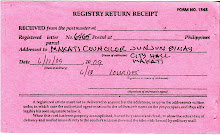
image of registry return receipt of letter addressed to Makati councilor J. J. Binay