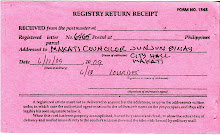
Evidence vs. Goldilocks Bakeshop, Inc. On May 18, 2008, the Goldilocks Bakeshop, Inc., at Robinsons Manila, sold a apple raisin bread which did not bear a visible, to unaided eye, indication regarding a consume before date of said product. I believe said store violated the Consumer Act of the Philippines.
Manila Bulletin May 19, 2008
Makati to hold mega job fair
"The Makati City Government will hold a mega job fair from 8 a.m. to 4 p.m. Thursday at the City Hall Quadrangle through its Public Employment Services Office (PESO). . . . provide employment opportunities not only to Makati residents but also to non-Makati residents, including job seekers aged 40 to 45 and persons with disabilities".
http://www.nlm.nih.gov/medlineplus/highbloodpressure.html
High Blood Pressure
Also called: HBP, HTN, Hypertension
Blood pressure is the force of your blood pushing against the walls of your arteries. Each time your heart beats, it pumps out blood into the arteries. Your blood pressure is highest when your heart beats, pumping the blood. This is called systolic pressure. When your heart is at rest, between beats, your blood pressure falls. This is the diastolic pressure.
Your blood pressure reading uses these two numbers, the systolic and diastolic pressures. Usually they are written one above or before the other. A reading of
* 120/80 or lower is normal blood pressure
* 140/90 or higher is high blood pressure
* 120 and 139 for the top number, or between 80 and 89 for the bottom number is
prehypertension
High blood pressure usually has no symptoms, but it can cause serious problems such as stroke, heart failure, heart attack and kidney failure. You can control high blood pressure through healthy lifestyle habits and taking medicines, if needed.
National Heart, Lung, and Blood Institute
http://www.nhlbi.nih.gov/health/dci/Diseases/Hbp/HBP_WhatIs.html
What Is High Blood Pressure?
High blood pressure (HBP) is a serious condition that can lead to coronary heart disease, heart failure, stroke, kidney failure, and other health problems.
“Blood pressure” is the force of blood pushing against the walls of the arteries as the heart pumps out blood. If this pressure rises and stays high over time, it can damage the body in many ways.
Overview
HBP itself usually has no symptoms. You can have it for years without knowing it. During this time, though, it can damage the heart, blood vessels, kidneys, and other parts of your body.
This is why knowing your blood pressure numbers is important, even when you’re feeling fine. If your blood pressure is normal, you can work with your health care team to keep it that way. If your blood pressure is too high, you need treatment to prevent damage to your body’s organs.
Blood Pressure Numbers
Blood pressure numbers include systolic (sis-TOL-ik) and diastolic (di-a-STOL-ik) pressures. Systolic blood pressure is the pressure when the heart beats while pumping blood. Diastolic blood pressure is the pressure when the heart is at rest between beats.
You will most often see blood pressure numbers written with the systolic number above or before the diastolic, such as 120/80 mmHg. (The mmHg is millimeters of mercury—the units used to measure blood pressure.)
The table below shows normal numbers for adults. It also shows which numbers put you at greater risk for health problems. Blood pressure tends to goes up and down, even in people who have normal blood pressure. If your numbers stay above normal most of the time, you’re at risk.
Categories for Blood Pressure Levels in Adults (in mmHg, or millimeters of mercury)
Category Systolic
(top number) Diastolic
(bottom number)
Normal Less than 120 And Less than 80
Prehypertension 120–139 Or 80–89
High blood pressure
Stage 1 140–159 Or 90–99
Stage 2 160 or higher Or 100 or higher
The ranges in the table apply to most adults (aged 18 and older) who don’t have short-term serious illnesses.
All levels above 120/80 mmHg raise your risk, and the risk grows as blood pressure levels rise. “Prehypertension” means you’re likely to end up with HBP, unless you take steps to prevent it.
If you’re being treated for HBP and have repeat readings in the normal range, your blood pressure is under control. However, you still have the condition. You should see your doctor and stay on treatment to keep you blood pressure under control.
Your systolic and diastolic numbers may not be in the same blood pressure category. In this case, the more severe category is the one you're in. For example, if your systolic number is 160 and your diastolic number is 80, you have stage 2 HBP. If your systolic number is 120 and your diastolic number is 95, you have stage 1 HBP.
If you have diabetes or chronic kidney disease, HBP is defined as 130/80 mmHg or higher. HBP numbers also differ for children and teens. (For more information, see “How Is High Blood Pressure Diagnosed?”)
Outlook
Blood pressure tends to rise with age. Following a healthy lifestyle helps some people delay or prevent this rise in blood pressure.
People who have HBP can take steps to control it and reduce their risks for related health problems. Key steps include following a healthy lifestyle, having ongoing medical care, and following the treatment plan that your doctor prescribes.
April 2008
Other Names for High Blood Pressure
High blood pressure (HBP) also is called hypertension.
When HBP has no known cause, it may be called essential hypertension, primary hypertension, or idiopathic hypertension.
When another condition causes HBP, it’s sometimes called secondary high blood pressure or secondary hypertension.
In some cases of HBP, only the systolic blood pressure number is high. This condition is called isolated systolic hypertension (ISH). Many older adults have this condition. ISH can cause as much harm as HBP in which both numbers are too high.
What Causes High Blood Pressure?
Blood pressure tends to rise with age, unless you take steps to prevent or control it.
Certain medical problems, such as chronic kidney disease, thyroid disease, and sleep apnea, may cause blood pressure to rise. Certain medicines, such as asthma medicines (for example, corticosteroids) and cold-relief products, also may raise blood pressure.
In some women, blood pressure can go up if they use birth control pills, become pregnant, or take hormone replacement therapy.
Women taking birth control pills usually have a small rise in both systolic and diastolic blood pressures. If you already have high blood pressure (HBP) and want to use birth control pills, make sure your doctor knows about your HBP. Talk to him or her about how often you should have your blood pressure checked and how to control it while taking the pill.
Taking hormones to reduce the symptoms of menopause can cause a small rise in systolic blood pressure. If you already have HBP and want to start using hormones, talk to your doctor about the risks and benefits. If you decide to take hormones, find out how to control your blood pressure and how often you should have it checked.
Children younger than 10 years who have HBP often have another condition that’s causing it (such as kidney disease). Treating the underlying condition may resolve the HBP.
The older a child is when HBP is diagnosed, the more likely he or she is to have essential hypertension. This means that doctors don’t know what’s causing the HBP.
Who Is At Risk for High Blood Pressure?
In the United States, about 72 million people have high blood pressure (HBP). This is about 1 in 3 adults.
Certain traits, conditions, or habits are known to raise the risk for HBP. These conditions are called risk factors. This section describes the major risk factors for HBP.
Older Age
Blood pressure tends to rise with age. If you’re a male older than 45 or a female older than 55, your risk for HBP is higher. Over half of all Americans aged 60 and older have HBP.
Isolated systolic hypertension (ISH) is the most common form of HBP in older adults. ISH occurs when only systolic blood pressure (the top number) is high. About 2 out of 3 people over age 60 who have HBP have ISH.
HBP doesn’t have to be a routine part of aging. You can take steps keep your blood pressure at a normal level. (For more information, see “How Is High Blood Pressure Treated?”)
Race/Ethnicity
HBP can affect anyone.
Gender
Fewer adult women than men have HBP. But, younger women (aged 18–59) are more likely than men to be aware of and get treatment for HBP.
Women aged 60 and older are as likely as men to be aware of and treated for HBP. However, among treated women aged 60 and older, blood pressure control is lower than it is in men in the same age group.
Unhealthy Lifestyle Habits
A number of lifestyle habits can raise your risk for HBP, including:
* Eating too much sodium (salt)
* Drinking too much alcohol
* Not getting enough potassium in your diet
* Not doing enough physical activity
* Smoking
Other Risk Factors
A family history of HBP raises your risk for the condition. Long-lasting stress also can put you at risk for HBP.
You’re also more likely to develop HBP if you have prehypertension. Prehypertension means that your blood pressure is in the 120–139/80–89 mmHg range.
Risk Factors for Children and Teens
Overweight is on the rise in youth younger than 18 years. As a result, prehypertension and HBP also are becoming more common in this age group.
Boys are at higher risk for HBP than girls.
Like adults, children and teens need to have routine blood pressure checks. This is even more important if a young person is overweight.
What Are the Signs and Symptoms of High Blood Pressure?
High blood pressure (HBP) itself usually has no symptoms. Rarely, headaches may occur.
You can have HBP for years without knowing it. During this time, HBP can damage the heart, blood vessels, kidneys, and other parts of the body.
Some people only learn that they have HBP after the damage has caused problems, such as coronary heart disease, stroke, or kidney failure.
Knowing your blood pressure numbers is important, even when you’re feeling fine. If your blood pressure is normal, you can work with your health care team to keep it that way. If your numbers are too high, you can take steps to lower them and control your blood pressure. This helps reduce your risk for complications.
Complications of High Blood Pressure
When blood pressure stays high over time, it can damage the body. HBP can cause:
* The heart to get larger or weaker, which may lead to heart failure. Heart failure is a condition in which the heart can’t pump enough blood throughout the body.
* Aneurysms (AN-u-risms) to form in blood vessels. An aneurysm is an abnormal bulge or “ballooning” in the wall of an artery. Common spots for aneurysms are the main artery that carries blood from the heart to the body; the arteries in the brain, legs, and intestines; and the artery leading to the spleen.
* Blood vessels in the kidney to narrow. This may cause kidney failure.
* Arteries throughout the body to narrow in some places, which limits blood flow
(especially to the heart, brain, kidneys, and legs). This can cause a heart
attack, stroke, kidney failure, or amputation of part of the leg.
* Blood vessels in the eyes to burst or bleed. This may lead to vision changes or
blindness.
How Is High Blood Pressure Diagnosed?
Your doctor will diagnose high blood pressure (HBP) using the results of blood pressure tests. These tests will be done several times to make sure the results are correct. If your numbers are high, your doctor may have you return for more tests to check your blood pressure over time.
If your blood pressure is 140/90 mmHg or higher over time, your doctor will likely diagnose you with HBP. If you have diabetes or chronic kidney disease, a blood pressure of 130/80 mmHg or higher is considered HBP.
The HBP ranges in children are different. (For more information, see below.)
How Is Blood Pressure Tested?
A blood pressure test is easy and painless. This test is done at a doctor’s office or clinic.
To prepare for the test:
* Don’t drink coffee or smoke cigarettes for 30 minutes prior to the test. These
actions may cause a short-term rise in your blood pressure.
* Go to the bathroom before the test. Having a full bladder can change your blood
pressure reading.
* Sit for 5 minutes before the test. Movement can cause short-term rises in blood
pressure.
To measure your blood pressure, your doctor or nurse will use some type of a gauge, a stethoscope (or electronic sensor), and a blood pressure cuff.
Most often, you will sit or lie down with the cuff around your arm as your doctor or nurse checks your blood pressure. If he or she doesn’t tell you what your blood pressure numbers are, you should ask.
Diagnosing High Blood Pressure in Children and Teens
Doctors measure blood pressure in children and teens the same way they do in adults. Your child should have routine blood pressure checks starting at 3 years of age.
Blood pressure normally rises with age and body size. Newborn babies often have very low blood pressure numbers, while older teens have numbers similar to adults.
The ranges for normal blood pressure and HBP are generally lower for youth than for adults. These ranges are based on the average blood pressure numbers for age, gender, and height.
To find out whether a child has HBP, a doctor will compare the child’s blood pressure numbers to average numbers for his or her age, height, and gender.
For more information, see the National Heart, Lung, and Blood Institute’s “A Pocket
Guide to Blood Pressure Measurement in Children.”
What Does a Diagnosis of High Blood Pressure Mean?
If you’re diagnosed with HBP, you will need treatment. You also will need to have your blood pressure tested again see how treatment affects it.
Once your blood pressure is under control, you will need to stay on treatment. “Under control” means that your blood pressure numbers are normal. You also will need regular blood pressure tests. Your doctor can tell you how often you should be tested.
The sooner you find out about HBP and treat it, the better your chances to avoid problems like heart attack, stroke, and kidney failure.
How Is High Blood Pressure Treated?
High blood pressure (HBP) is treated with lifestyle changes and medicines.
Most people who have HBP will need lifelong treatment. Sticking to your treatment plan is important. It can prevent or delay the problems linked to HBP and help you live and stay active longer.
For more tips on controlling your blood pressure, see the National Heart, Lung, and Blood Institute’s (NHLBI’s) “Your Guide to Lowering Blood Pressure.”
Goals of Treatment
The treatment goal for most adults is to get and keep blood pressure below 140/90 mmHg. For adults who have diabetes or chronic kidney disease, the goal is to get and keep blood pressure below
130/80 mmHg.
Lifestyle Changes
Healthy habits can help you control HBP. Healthy habits include:
* Following a healthy eating plan
* Doing enough physical activity
* Maintaining a healthy weight
* Quitting smoking
* Managing your stress and learning to cope with stress
If you combine these measures, you can achieve even better results than taking single steps. Making lifestyle changes can be hard. Start by making one healthy lifestyle change and then adopt others.
Some people can control their blood pressures with lifestyle changes alone, but many people can’t. Keep in mind that the main goal is blood pressure control. If your doctor prescribes medicines as a part of your treatment plan, keep up your healthy habits. This will help you better control your blood pressure.
Follow a Healthy Eating Plan
Your doctor may recommend the Dietary Approaches to Stop Hypertension (DASH) eating plan if you have HBP. The DASH eating plan focuses on fruits, vegetables, whole grains, and other foods that are heart healthy and lower in sodium (salt).
This eating plan is low in fat and cholesterol. It also features fat-free or low-fat milk and dairy products, fish, poultry, and nuts. The DASH eating plan suggests less red meat (even lean red meat), sweets, added sugars, and sugar-containing beverages. The plan is rich in nutrients, protein, and fiber.
To help control HBP, you should limit the amount of salt that you eat. This means choosing low-salt and "no added salt" foods and seasonings at the table or when cooking. The Nutrition Facts label on food packaging shows the amount of sodium in the item. You should eat no more than about 1 teaspoon of salt a day.
You also should try to limit alcoholic drinks. Too much alcohol will raise your blood pressure. Men should have no more than two alcoholic drinks a day. Women should have no more than one alcoholic drink a day.
For more information on limiting salt and alcohol in your diet, see the Your Guide to Lowering High Blood Pressure Web site.
Do Enough Physical Activity
Regular physical activity can lower HBP and also reduce your risk for other health problems.
Check with your doctor about how much and what kinds of activity are safe for you. Unless your doctor tells you otherwise, try to get at least 30 minutes of moderate-intensity activity on most or all days of the week. You can do it all at once or break it up into shorter periods of at least 10 minutes each.
Moderate-intensity activities include brisk walking, dancing, bowling, riding a bike, working in a garden, and cleaning the house.
If your doctor agrees, you also may want to do more intense activities, such as jogging, swimming, and playing sports. For more information, see the NHLBI's "Your Guide to Physical Activity and Your Heart."
Maintain a Healthy Weight
Staying at a healthy weight can help control blood pressure and also reduce your risk for other health problems.
If you’re overweight or obese, aim to reduce your weight by 7 to 10 percent during your first year of treatment. This amount of weight loss can lower your risk for health problems related to HBP.
After the first year, you may have to continue to lose weight so you can lower your body mass index (BMI) to less than 25.
BMI measures your weight in relation to your height and gives an estimate of your total body fat. A BMI between 25 and 29 is considered overweight. A BMI of 30 or more is considered obese. A BMI of less than 25 is the goal for keeping blood pressure under control.
You can measure your BMI using the NHLBI's online calculator, or your health care provider can help.
For more information on losing weight and keeping it off, see the Diseases and Conditions Index Overweight and Obesity article.
Quit Smoking
Smoking can damage your blood vessels and raise your risk for HBP. It also can worsen health problems related to HBP. Smoking is bad for everyone, especially those who have HBP.
If you smoke or use tobacco, quit. Talk to your doctor about programs and products that can help you quit. The U.S. Department of Health and Human Services has information on how to quit smoking. Also, take steps to protect yourself from secondhand smoke.
Managing Stress
Learning how to manage stress, relax, and cope with problems can improve your emotional and physical health.
Physical activity helps some people cope with stress. Other people listen to music or focus on something calm or peaceful to reduce stress. Some people learn yoga, tai chi, or how to meditate.
Medicines
Today’s blood pressure medicines can safely help most people control their blood pressures. These medicines are easy to take. The side effects, if any, tend to be minor.
If you have side effects from your medicines, talk to your doctor. He or she may be able to adjust the doses or prescribe other medicines. You shouldn’t decide on your own to stop taking your medicines.
Blood pressure medicines work in different ways to lower blood pressure. Some remove extra fluid and salt from the body to lower blood pressure. Others slow down the heartbeat or relax and widen blood vessels. Often, two or more medicines work better than one.
Diuretics
Diuretics are sometimes called water pills. They help your kidneys flush excess water and salt from your body. This lessens the amount of fluid in your blood, and your blood pressure goes down.
Diuretics often are used with other HBP medicines and sometimes combined into one pill.
Beta Blockers
Beta blockers help your heart beat slower and with less force. Your heart pumps less blood through your blood vessels, and your blood pressure goes down.
ACE Inhibitors
ACE inhibitors keep your body from making a hormone called angiotensin II. This hormone normally causes blood vessels to narrow. ACE inhibitors prevent this, so your blood pressure goes down.
Angiotensin II Receptor Blockers
Angiotensin II receptor blockers (ARBs) are newer blood pressure medicines that protect your blood vessels from angiotensin II. As a result, blood vessels relax and widen, and your blood pressure goes down.
Calcium Channel Blockers
Calcium channel blockers (CCBs) keep calcium from entering the muscle cells of your heart and blood vessels. This allows blood vessels to relax, and your blood pressure goes down.
Alpha Blockers
Alpha blockers reduce nerve impulses that tighten blood vessels. This allows blood to flow more freely, causing blood pressure to go down.
Alpha-Beta Blockers
Alpha-beta blockers reduce nerve impulses the same way alpha blockers do. However, they also slow the heartbeat like beta blockers. As a result, blood pressure goes down.
Nervous System Inhibitors
Nervous system inhibitors increase nerve impulses from the brain to relax and widen blood vessels. This causes blood pressure to go down.
Vasodilators
Vasodilators relax the muscles in blood vessel walls. This causes blood pressure to go down.
Treatment for Children and Teens
If another condition is causing your child’s HBP, treating it often resolves the HBP. When the cause of a child or teen’s HBP isn’t known, the first line of treatment is lifestyle changes (as it is for adults).
If lifestyle changes don’t control blood pressure, children and teens also may need to take medicines. Most of the medicines listed above for adults have unique doses for children.
How Can High Blood Pressure Be Prevented?
If You Have Normal Blood Pressure
If you don’t have high blood pressure (HBP), you can take steps to prevent it. Lifestyle measures can help you maintain normal blood pressure.
* Follow a healthy eating plan. This includes limiting the amount of sodium (salt) and alcohol that you consume. An example of a healthy eating plan is the National Heart, Lung, and Blood Institute’s Dietary Approaches to Stop Hypertension (DASH).
* Lose weight if you’re overweight or obese.
* Do enough physical activity.
* Quit smoking.
* Manage your stress and learn to cope with stress
Many people who take one or more of these steps are able to prevent or delay HBP. The more steps you take, the more likely you are to lower your blood pressure and avoid related health problems.
To learn more about the above steps, see “How Is High Blood Pressure Treated?”
If You Have High Blood Pressure
If you have HBP, you can still take steps to prevent the long-term problems it can cause. Lifestyle measures (listed above) and medicines can help you live a longer, more active life.
Follow the treatment plan your doctor prescribes to control your blood pressure. It can help you prevent or delay coronary heart disease, stroke, kidney disease, and other health problems.
Children and Teens
A healthy lifestyle also can help prevent HBP in children and teens. Key steps include having a child:
* Follow a healthy eating plan that focuses on plenty of fruits, vegetables, and, for children older than 4 years, low-fat dairy products. The plan also should be low in saturated and trans fats and salt.
* Be active for at least 1 to 2 hours per day. Limit screen time in front of the TV or the computer to 2 hours per day at most.
* Maintain a healthy weight. If your child is overweight, ask his or her doctor about how your child can safely lose weight.
Make these habits part of a family health plan to help your child adopt and maintain a healthy lifestyle.
Living With High Blood Pressure
If you have high blood pressure (HBP), you will need to treat and control it for life. This means making lifestyle changes, taking prescribed medicines, and getting ongoing medical care.
Treatment can help control blood pressure, but it will not cure HBP. If you stop treatment, your blood pressure and risk for related health problems will rise. For a healthy future, follow your treatment plan closely. Work with your health care team for lifelong blood pressure control.
Lifestyle Changes
Following a healthy lifestyle is an important step for controlling HBP. A healthy lifestyle includes following a healthy eating plan, losing weight (if you’re overweight or obese), doing regular physical activity, and not smoking. (For more information, see “How Is High Blood Pressure Treated?”)
Medicines
You should take all blood pressure medicines that your doctor prescribes. Be sure you know the names and doses of your medicines and how to take them. If you have questions about your medicines, talk to your doctor or pharmacist.
Make sure you refill your medicines before they run out. Take your medicines exactly as your doctor directs—don’t skip days or cut pills in half.
If you’re having side effects from your medicines, talk to your doctor. He or she may need to adjust the doses or prescribe other medicines. You shouldn’t decide on your own to stop taking your medicines.
Ongoing Care
Go for medical checkups or tests as your doctor advises. Your doctor may need to change or add medicines to your treatment plan over time. Regular checkups allow your doctor to change your treatment right away if your blood pressure goes up again.
Keeping track of your blood pressure is vital. Have your blood pressure checked on the schedule your doctor advises. You may want to learn how to check your blood pressure at home. Your doctor can help you with this. Each time you check your own blood pressure, you should write down your numbers and the date.
The National Heart, Lung, and Blood Institute’s (NHLBI’s) “My Blood Pressure Wallet Card” can help you track your blood pressure. You also can write down the names and doses of your medicines and keep track of your lifestyle changes with this handy card.
During checkups, you can ask your doctor or health care team any questions you have about your lifestyle or medicine treatments.
High Blood Pressure and Pregnancy
Many pregnant women who have HBP have healthy babies. However, HBP can cause problems for both the mother and the fetus. It can harm the mother's kidneys and other organs. It also can cause the baby to be born early and with a low birth weight.
If you’re thinking about having a baby and you have HBP, talk to your health care team. You can take steps to control your blood pressure before and while you’re pregnant.
Some women get HBP for the first time while they’re pregnant. In the most serious cases, the mother has a condition called preeclampsia (pre-e-KLAMP-se-ah).
This condition can threaten the lives of both the mother and the unborn child. You will need special care to reduce your risks. With such care, most women and babies have good outcomes.
See the NHLBI’s Your Guide to Lowering High Blood Pressure Web site for more information about HBP and pregnancy.
Key Points
* High blood pressure (HBP) is a serious condition that can lead to coronary heart disease, heart failure, stroke, kidney failure, and other health problems.
* “Blood pressure” is the force of blood pushing against the walls of the arteries as the heart pumps out blood. When this pressure rises and stays high over time, it can damage the body in many ways.
* Blood pressure numbers include systolic and diastolic pressures. Systolic blood pressure is the pressure when the heart beats while pumping blood. Diastolic blood pressure is the pressure when the heart is at rest between beats.
* All blood pressure levels above 120/80 mmHg increase your risk for the health problems related to HBP. A blood pressure level of 140/90 mmHg or higher is considered HBP for most adults. If you have diabetes or chronic kidney disease, a blood pressure of 130/80 mmHg or higher is considered HBP.
* Blood pressure tends to rise with age. Certain medical problems and medicines may cause blood pressure to rise. In some women, blood pressure can go up if they use birth control pills, become pregnant, or take hormone replacement therapy.
* Children younger than 10 years who have HBP often have another condition that’s causing it (such as kidney disease). Treating the underlying condition may resolve HBP.
* Certain traits, conditions, or habits may raise your risk for HBP. These include older age, race/ethnicity, overweight or obesity, gender, unhealthy lifestyle habits, a family history of HBP, long-lasting stress, and having prehypertension (blood pressure levels between 120–139/80–89).
* HBP itself usually has no symptoms. Rarely, headaches may occur. Some people only learn that they have HBP after it causes health problems, such as coronary heart disease, stroke, or kidney failure.
* Your doctor will diagnose HBP using the results of a blood pressure test. This test is easy and painless. It may be done several times to make sure the results are correct.
* Doctors measure blood pressure in children and teens the same way they do in adults. However, the ranges for normal blood pressure and HBP are different for youth than for adults. These ranges are based on the average blood pressure levels for a child or teen’s age, gender, and height.
* HBP in adults and children is treated with lifestyle changes and medicines. Lifestyle changes include following a healthy eating plan, doing enough physical activity, maintaining a healthy weight, quitting smoking, and managing and coping with stress.
* If you have normal blood pressure, you can take steps to prevent or delay HBP. Healthy lifestyle habits can help you maintain normal blood pressure.
* If you have HBP, you can take steps to prevent the long-term problems it can cause. Adopt healthy lifestyle habits and follow the treatment plan your doctor prescribes. Children and teens can prevent HBP and its related problems in the same ways.
Links to Other Information About High Blood Pressure
NHLBI Resources
* “A Pocket Guide to Blood Pressure Measurement in Children”
http://www.nhlbi.nih.gov/health/public/heart/hbp/bp_child_pocket/bp_child_pocket.pdf
* “My Blood Pressure Wallet Card”
http://www.nhlbi.nih.gov/health/public/heart/hbp/hbpwallet.htm
* “Your Guide to a Healthy Heart”
http://www.nhlbi.nih.gov/health/public/heart/other/your_guide/healthyheart.htm
* Your Guide to Lowering High Blood Pressure (Interactive Web Site)
http://www.nhlbi.nih.gov/hbp/index.html
* “Your Guide to Lowering Blood Pressure”
http://www.nhlbi.nih.gov/health/public/heart/hbp/hbp_low/index.htm
* “Your Guide to Lowering Your Blood Pressure With DASH”
http://www.nhlbi.nih.gov/health/public/heart/hbp/dash/index.htm
Non-NHLBI Resources
* High Blood Pressure (MedlinePlus)
http://www.nlm.nih.gov/medlineplus/highbloodpressure.html
* Hypertension: Interactive Tutorial (MedlinePlus)
http://www.nlm.nih.gov/medlineplus/tutorials/hypertension/htm/index.htm
Research
* Current Research (ClinicalTrials.gov)
http://clinicaltrials.gov/ct/gui/action/SearchAction;jsessionid=3BF230DDB1226ABDFC231D9231FB8B8F?term=high+blood+pressure&submit=Search
# High Blood Pressure: Things You Can Do to Help Lower Yours(American Academy of Family Physicians)
http://familydoctor.org/online/famdocen/home/common/heartdisease/risk/092.printerview.html
Also available in Spanish
# HypertensionInteractive Tutorial(Patient Education Institute) - Requires Flash Player
http://www.nlm.nih.gov/medlineplus/tutorials/hypertension/htm/index.htm
Also available in Spanish
Sunday, May 18, 2008

Thursday, May 15, 2008
PAL warns of new ticket scam; about com web site; FDA new and generic drug approvals; advisory re claims re restaurants
PAL warns of new ticket scam May 15, 2008
The Philippine Airlines is warning the public against buying or using airline tickets purchased with counterfeit credit cards through PAL's online booking facility. PAL issued the advisory after the National Bureau of Investigation (NBI) arrested 19 persons face charges before the Chief State Prosecutor's Office for using counterfeit credit cards to buy PAL tickets online. The figure includes the 14 passengers who bought the tickets sold to them by one of the two middlemen, who got the tickets from three prime suspects. If the respondents are found guilty of violating the access devices law (Republic Act 8484), they can be jailed for 20 years.
Warning regarding allegations which were published on page E-2 of the Philippine Star newspaper issue of May 15, 2008. regarding: Contempo; Kabisera ng Dencio's; CPK restaurants; Pantalan Maynila restaurant; Old Swiss Inn Alabang; Li Li restaurant; Renaissance Makati, Fely J restaurant. Details available.
Tip for removing unpleasant garlic, onion, etc. from one's fingers: After soaping, washing, and wiping, dip your hands in leftover tea for one minute. Rub hands to dry.
web site with free useful information:
http://www.about.com
Date: Wed, 14 May 2008 15:21:07 -0500 (CDT)
From: "U.S. Food & Drug Administration (FDA)" Add Mobile Alert
CDER New 5/14/2008
U.S. FDA May 14, 2008 New and Generic Drug Approvals
o Cyclobenzaprine Hydrochloride Tablets, Ranbaxy, Inc., Approval
o Definity (perflutren lipid microsphere) Injection, Lantheus Medical
Imaging, Labeling Revision
o Flumazenil Injection, Akorn-Strides, LLC., Approval
o Haldol (haloperidol decanoate) Injection, Ortho McNeil Pharmaceutical,
Labeling Revision
o Haldol (haloperidol lactate) Injection, Ortho McNeil Pharmaceutical,
Labeling Revision
o Lariam (mefloquine hydrochloride) Tablets, Hoffmann-La Roche, Inc.,
Labeling Revision
o Lidocaine Hydrochloride and Epinephrine Injection, Hospira, Inc.,
Approval
o Probenecid and Colchicine Tablets, Concord Laboratories, Inc., Approval
o Ramipril Capsules, Lupin Pharmaceuticals, Inc., Tentative Approval
o Seroquel (quetiapine fumarate) Tablets, AstraZeneca Pharmaceuticals LP,
Labeling Revision
o Seroquel (quetiapine fumarate) Tablets, AstraZeneca Pharmaceuticals LP,
New or Modified Indication
o Valium (diazepam) Tablets, Roche Products, Labeling Revision
The Philippine Airlines is warning the public against buying or using airline tickets purchased with counterfeit credit cards through PAL's online booking facility. PAL issued the advisory after the National Bureau of Investigation (NBI) arrested 19 persons face charges before the Chief State Prosecutor's Office for using counterfeit credit cards to buy PAL tickets online. The figure includes the 14 passengers who bought the tickets sold to them by one of the two middlemen, who got the tickets from three prime suspects. If the respondents are found guilty of violating the access devices law (Republic Act 8484), they can be jailed for 20 years.
Warning regarding allegations which were published on page E-2 of the Philippine Star newspaper issue of May 15, 2008. regarding: Contempo; Kabisera ng Dencio's; CPK restaurants; Pantalan Maynila restaurant; Old Swiss Inn Alabang; Li Li restaurant; Renaissance Makati, Fely J restaurant. Details available.
Tip for removing unpleasant garlic, onion, etc. from one's fingers: After soaping, washing, and wiping, dip your hands in leftover tea for one minute. Rub hands to dry.
web site with free useful information:
http://www.about.com
Date: Wed, 14 May 2008 15:21:07 -0500 (CDT)
From: "U.S. Food & Drug Administration (FDA)"
CDER New 5/14/2008
U.S. FDA May 14, 2008 New and Generic Drug Approvals
o Cyclobenzaprine Hydrochloride Tablets, Ranbaxy, Inc., Approval
o Definity (perflutren lipid microsphere) Injection, Lantheus Medical
Imaging, Labeling Revision
o Flumazenil Injection, Akorn-Strides, LLC., Approval
o Haldol (haloperidol decanoate) Injection, Ortho McNeil Pharmaceutical,
Labeling Revision
o Haldol (haloperidol lactate) Injection, Ortho McNeil Pharmaceutical,
Labeling Revision
o Lariam (mefloquine hydrochloride) Tablets, Hoffmann-La Roche, Inc.,
Labeling Revision
o Lidocaine Hydrochloride and Epinephrine Injection, Hospira, Inc.,
Approval
o Probenecid and Colchicine Tablets, Concord Laboratories, Inc., Approval
o Ramipril Capsules, Lupin Pharmaceuticals, Inc., Tentative Approval
o Seroquel (quetiapine fumarate) Tablets, AstraZeneca Pharmaceuticals LP,
Labeling Revision
o Seroquel (quetiapine fumarate) Tablets, AstraZeneca Pharmaceuticals LP,
New or Modified Indication
o Valium (diazepam) Tablets, Roche Products, Labeling Revision
Wednesday, May 14, 2008
DOH sees dengue cases rising in Metro; advisory re Aristocrat restaurant; 2 die in road accident; etc.
May 14, 2008. Manila Bulletin newspaper.DoH sees dengue cases rising in Metro. Health Secretary Francisco Duque III . . . renewed his call to get rid of stagnant water and anything that can become potential breeding sites for dengue carrying mosquitos.
Advisory re The Aristocrat restaurant at Robinson Ermita. There is evidence that on May 12, 2008, an employee of said restaurant, which was identified as operated by Alex & Engracia Legacy, issued an O.R, wherein the VAT charge was separate from the price of the food. Based on information from the DTI, said act is a violation of the Price Tag Law.
May 14, 2008. Philippine Daily Inquirer newspaper. "2 die in SLEx road accident. Manny Fradis, traffic monitoring officer of Philippine National Construction Corp., . . . said a speeding JAC Liner bus driven by Florencio Oliveros sideswiped a cargo truck at the San Pedro portion of the expressway and plunged into the Carmona Railroad Underpass."
Apple Computer, Inc. and Apple Canada Inc. entered into settlement agreement with petitioners Ines Lenzi and Bradley Waddell. Evidence available.
Over $76 Million in Counterfeit Cisco Hardware and Labels Seized
http://washingtondc.fbi.gov - Federal Bureau of Investigation - Washington Field Division
United States Attorney's Office
Eastern District of Virginia
United States Attorney Check Rosenberg
FOR IMMEDIATE RELEASE:
Jim Rybicki
Public Information Officer
Phone (703) 842-4050 Fax: (703) 549-5202
Email: usavae.press@usdoj.gov
Web Address: www.usdoj.gov/usao/vae
February 28, 2008
DEPARTMENTS OF JUSTICE AND HOMELAND SECURITY ANNOUNCE
INTERNATIONAL INITIATIVE AGAINST TRAFFICKERS IN COUNTERFEIT NETWORK HARDWARE
Over $76 Million in Counterfeit Cisco Hardware and Labels Seized
WASHINGTON-Assistant Attorney General Alice S. Fisher of the Criminal Division, Assistant Director James Finch of the FBI's Cyber Division, Assistant Secretary Julie L. Myers, U.S. Immigration and Customs Enforcement (ICE), Commissioner W. Ralph Basham, U.S. Customs and Border Protection (CBP), and Inspector Peter Goulet of the Royal Canadian Mounted Police (RCMP) today announced the results to date of an ongoing international enforcement initiative between the United States and Canada that targets the illegal distribution of counterfeit network hardware manufactured in China.
This ongoing initiative has resulted in more than 400 seizures of counterfeit Cisco network hardware and labels with an estimated retail value of more than $76 million. It is being led by ICE, CBP and the FBI working in conjunction with the Criminal Division's Computer Crime & Intellectual Property Section, U.S. Attorney's Offices across the country, and the RCMP.
The initiative targets the illegal importation and sale of counterfeit network hardware, in particular network routers, switches, network cards and modules manufactured by Cisco. By intercepting the counterfeit hardware at ports of entry and dismantling illegal supply chains in the U.S., the operation has achieved significant successes in protecting the public from the risk of network infrastructure failures associated with these counterfeits.
"Counterfeit network hardware entering the marketplace raises significant public safety concerns and must be stopped. This initiative shows that through collaboration among law enforcement agencies and prosecutors worldwide, we can achieve dramatic enforcement results and protect public safety," said Assistant Attorney General Alice S. Fisher of the Criminal Division. "It is critically important that network administrators in both private sector and government perform due diligence in order to prevent counterfeit hardware from being installed on their networks."
The FBI named its portion of this ongoing initiative Operation Cisco Raider-an international, coordinated investigation of 15 cases involving nine FBI field offices. The FBI worked closely with law enforcement partners including ICE, Defense Criminal Investigative Service, General Services Administration, Department of the Interior, Internal Revenue Service, and the RCMP. Over the last two years, Operation Cisco Raider has resulted in 36 search warrants that identified approximately 3,500 counterfeit network components with an estimated retail value of over $3.5 million, and has led to a total of ten convictions and $1.7 million in restitution.
"This operation illustrates the importance of working closely with our partners in both law enforcement and the private sector," said FBI Assistant Director James Finch. "Cisco Systems, Incorporated specifically deserves praise for their level of cooperation in this initiative. We will continue these efforts to aggressively investigate counterfeit goods in order to protect U.S. consumers and corporations."
ICE and CBP opened a total of 28 investigations in 17 separate field offices since 2005; eight of those investigations were worked jointly with the FBI and several with the RCMP. ICE agents have conducted 115 seizures of counterfeit Cisco products having an estimated retail value of $20.4 million. ICE investigations have led to six indictments and four felony convictions to date. CBP has made 373 seizures of counterfeit Cisco network hardware since 2005, and 40 seizures of Cisco labels for counterfeit products. All together, ICE and CBP seized more than 74,000 counterfeit Cisco network components and labels with a total estimated retail value of more than $73 million.
"Crimes like these threaten international commerce, national security and the very safety of our citizens," said Julie L. Myers, Homeland Security Assistant Secretary for ICE. 'Throughout this investigation, the cooperation and partnership that we received from Cisco Systems, our law enforcement colleagues, and Chinese counterparts are a clear example of the results that can be realized through industry, interagency and international cooperation."
"The success of this operation demonstrates our commitment to work jointly with our law enforcement partners, as well as the private sector, to stop international trafficking in counterfeit items and protect our consumers and businesses from these dangerous goods," stated CBP Commissioner W. Ralph Basham.
Today in Toronto, Canada, the RCMP charged two individuals and a company with distributing large quantities of counterfeit network components to companies in the United States via the Internet. The RCMP seized approximately 1,600 pieces of counterfeit network hardware with an estimated value of $2 million. This prosecution resulted from a joint initiative between the RCMP, FBI, ICE, and CBP that was aimed at disrupting the flow of counterfeit Cisco networking components in North America.
"Counterfeit products greatly undermine the integrity of our economy," stated Inspector Peter Goulet, Officer in Charge of the RCMP Greater Toronto Area Federal Enforcement Section. "In many cases the end users were unaware that counterfeit products were being placed on their computer networks, and depending on the function of those networks, this could cause serious health and safety concerns."
Some of the cases involved with this initiative across the United States include the following:
On February 14, 2008, in the Northern District of Georgia, Todd Richard, 33, was sentenced to 36 months' imprisonment and ordered to pay $208,440 in restitution to Cisco Systems, Inc., as a result of his conviction for trafficking in counterfeit Cisco computer products. From late 2003 until early 2007, Richard imported shipments of counterfeit Cisco computer components from China, and separate shipments of counterfeit Cisco labels. He then affixed the fake labels to the fake components and sold the products on eBay, claiming that they were legitimate Cisco items. Richard sold over $1 million worth of counterfeit Cisco products in this manner. This case was investigated by ICE and prosecuted by the U.S. Attorney's Office for the Northern District of Georgia.
On January 4, 2008, in the Southern District of Texas, a federal grand jury returned an indictment charging Michael Edman, 36, and his brother Robert Edman, 28, with trafficking in counterfeit Cisco products. The indictment alleges that the Edmans purchased and imported the counterfeit computer network hardware from an individual in China. They later sold the counterfeit Cisco products to retailers of computer network products throughout the United States. According to the indictment, the Edmans shipped some of the counterfeit hardware directly to the Marine Corps, Air Force, Federal Aviation Administration, FBI, defense contractors, universities and financial institutions. These entities had purchased the product from a computer retailer serving as a middleman, which in turn purchased the products from the Edmans (a process known as "drop shipping"). The case was investigated by ICE and is being prosecuted by the U.S. Attorney's Office for the Southern District of Texas.
On April 17, 2007, in the Northern District of Texas, Mark Thomas Geis, 37, was sentenced to five years in prison and ordered to pay $1.5 million in restitution to Cisco Systems, Inc. as a result of his conviction for conspiracy to traffic in counterfeit network hardware. The court found that Geis, doing business as VARGlobal and conducting business via eBay, conspired to traffic in approximately $4.2 million of counterfeit Cisco hardware. This case was investigated by the FBI. Geis had previously been convicted and sentenced to 46 months imprisonment in 2001 for conspiracy to defraud Microsoft Corporation. The case was investigated by the FBI and prosecuted by the U.S. Attorney's Office for the Northern District of Texas.
The problem of trafficking in counterfeit computer components is a global problem, as reflected by last week's announcement by the European Union (EU) and U.S. officials of the first EU-U.S. customs joint operation resulting in the seizure of more than 360,000 counterfeit computer parts and integrated circuits. The joint initiative between the European Commission Tax and Customs Directorate and CBP took place during a three-week period in November and December of 2007. A probe in five countries uncovered a pattern of trade in counterfeit networking equipment and integrated circuits passed off as products from 40 of the world's largest European, U.S., Japanese, and Korean technology companies. Most arrived via air shipment from China, but some were also shipped from Taiwan and Hong Kong.
U.S. law enforcement authorities continue to work with China's Ministry of Public Security (MPS) to combat the manufacture and export of counterfeit network hardware from China. This ongoing work is being facilitated by the IP Criminal Enforcement Working Group of the U.S.-China Joint Liaison Group for law enforcement, which is co-chaired by the Criminal Division of the U.S. Department of Justice and the MPS. The Working Group is dedicated to increasing cooperation in intellectual property law enforcement efforts and pursuing more joint IP criminal investigations with China.
The initiative announced today is part of a broader Department of Justice initiative to combat all forms of intellectual property crime, including economic espionage, copyright infringement, and trafficking in counterfeit goods. This broader initiative has led to significant increases in criminal enforcement over the past three years. Through the dedicated efforts of U.S. Attorney's Offices and federal law enforcement across the country, in FY2007, 287 defendants were convicted and sentenced on intellectual property charges, representing a 35 percent increase over FY2006 and a 92 percent increase over FY2005. Additionally, the Department filed 217 intellectual property cases last year, representing a 7 percent increase over cases reported in FY2006 and a 33 percent increase over cases reported in FY2005.
Cisco Systems, Inc. has cooperated with U.S. and Canadian law enforcement authorities and provided exceptional assistance throughout these investigations.
The investigations are ongoing throughout the U.S.
Advisory re The Aristocrat restaurant at Robinson Ermita. There is evidence that on May 12, 2008, an employee of said restaurant, which was identified as operated by Alex & Engracia Legacy, issued an O.R, wherein the VAT charge was separate from the price of the food. Based on information from the DTI, said act is a violation of the Price Tag Law.
May 14, 2008. Philippine Daily Inquirer newspaper. "2 die in SLEx road accident. Manny Fradis, traffic monitoring officer of Philippine National Construction Corp., . . . said a speeding JAC Liner bus driven by Florencio Oliveros sideswiped a cargo truck at the San Pedro portion of the expressway and plunged into the Carmona Railroad Underpass."
Apple Computer, Inc. and Apple Canada Inc. entered into settlement agreement with petitioners Ines Lenzi and Bradley Waddell. Evidence available.
Over $76 Million in Counterfeit Cisco Hardware and Labels Seized
http://washingtondc.fbi.gov - Federal Bureau of Investigation - Washington Field Division
United States Attorney's Office
Eastern District of Virginia
United States Attorney Check Rosenberg
FOR IMMEDIATE RELEASE:
Jim Rybicki
Public Information Officer
Phone (703) 842-4050 Fax: (703) 549-5202
Email: usavae.press@usdoj.gov
Web Address: www.usdoj.gov/usao/vae
February 28, 2008
DEPARTMENTS OF JUSTICE AND HOMELAND SECURITY ANNOUNCE
INTERNATIONAL INITIATIVE AGAINST TRAFFICKERS IN COUNTERFEIT NETWORK HARDWARE
Over $76 Million in Counterfeit Cisco Hardware and Labels Seized
WASHINGTON-Assistant Attorney General Alice S. Fisher of the Criminal Division, Assistant Director James Finch of the FBI's Cyber Division, Assistant Secretary Julie L. Myers, U.S. Immigration and Customs Enforcement (ICE), Commissioner W. Ralph Basham, U.S. Customs and Border Protection (CBP), and Inspector Peter Goulet of the Royal Canadian Mounted Police (RCMP) today announced the results to date of an ongoing international enforcement initiative between the United States and Canada that targets the illegal distribution of counterfeit network hardware manufactured in China.
This ongoing initiative has resulted in more than 400 seizures of counterfeit Cisco network hardware and labels with an estimated retail value of more than $76 million. It is being led by ICE, CBP and the FBI working in conjunction with the Criminal Division's Computer Crime & Intellectual Property Section, U.S. Attorney's Offices across the country, and the RCMP.
The initiative targets the illegal importation and sale of counterfeit network hardware, in particular network routers, switches, network cards and modules manufactured by Cisco. By intercepting the counterfeit hardware at ports of entry and dismantling illegal supply chains in the U.S., the operation has achieved significant successes in protecting the public from the risk of network infrastructure failures associated with these counterfeits.
"Counterfeit network hardware entering the marketplace raises significant public safety concerns and must be stopped. This initiative shows that through collaboration among law enforcement agencies and prosecutors worldwide, we can achieve dramatic enforcement results and protect public safety," said Assistant Attorney General Alice S. Fisher of the Criminal Division. "It is critically important that network administrators in both private sector and government perform due diligence in order to prevent counterfeit hardware from being installed on their networks."
The FBI named its portion of this ongoing initiative Operation Cisco Raider-an international, coordinated investigation of 15 cases involving nine FBI field offices. The FBI worked closely with law enforcement partners including ICE, Defense Criminal Investigative Service, General Services Administration, Department of the Interior, Internal Revenue Service, and the RCMP. Over the last two years, Operation Cisco Raider has resulted in 36 search warrants that identified approximately 3,500 counterfeit network components with an estimated retail value of over $3.5 million, and has led to a total of ten convictions and $1.7 million in restitution.
"This operation illustrates the importance of working closely with our partners in both law enforcement and the private sector," said FBI Assistant Director James Finch. "Cisco Systems, Incorporated specifically deserves praise for their level of cooperation in this initiative. We will continue these efforts to aggressively investigate counterfeit goods in order to protect U.S. consumers and corporations."
ICE and CBP opened a total of 28 investigations in 17 separate field offices since 2005; eight of those investigations were worked jointly with the FBI and several with the RCMP. ICE agents have conducted 115 seizures of counterfeit Cisco products having an estimated retail value of $20.4 million. ICE investigations have led to six indictments and four felony convictions to date. CBP has made 373 seizures of counterfeit Cisco network hardware since 2005, and 40 seizures of Cisco labels for counterfeit products. All together, ICE and CBP seized more than 74,000 counterfeit Cisco network components and labels with a total estimated retail value of more than $73 million.
"Crimes like these threaten international commerce, national security and the very safety of our citizens," said Julie L. Myers, Homeland Security Assistant Secretary for ICE. 'Throughout this investigation, the cooperation and partnership that we received from Cisco Systems, our law enforcement colleagues, and Chinese counterparts are a clear example of the results that can be realized through industry, interagency and international cooperation."
"The success of this operation demonstrates our commitment to work jointly with our law enforcement partners, as well as the private sector, to stop international trafficking in counterfeit items and protect our consumers and businesses from these dangerous goods," stated CBP Commissioner W. Ralph Basham.
Today in Toronto, Canada, the RCMP charged two individuals and a company with distributing large quantities of counterfeit network components to companies in the United States via the Internet. The RCMP seized approximately 1,600 pieces of counterfeit network hardware with an estimated value of $2 million. This prosecution resulted from a joint initiative between the RCMP, FBI, ICE, and CBP that was aimed at disrupting the flow of counterfeit Cisco networking components in North America.
"Counterfeit products greatly undermine the integrity of our economy," stated Inspector Peter Goulet, Officer in Charge of the RCMP Greater Toronto Area Federal Enforcement Section. "In many cases the end users were unaware that counterfeit products were being placed on their computer networks, and depending on the function of those networks, this could cause serious health and safety concerns."
Some of the cases involved with this initiative across the United States include the following:
On February 14, 2008, in the Northern District of Georgia, Todd Richard, 33, was sentenced to 36 months' imprisonment and ordered to pay $208,440 in restitution to Cisco Systems, Inc., as a result of his conviction for trafficking in counterfeit Cisco computer products. From late 2003 until early 2007, Richard imported shipments of counterfeit Cisco computer components from China, and separate shipments of counterfeit Cisco labels. He then affixed the fake labels to the fake components and sold the products on eBay, claiming that they were legitimate Cisco items. Richard sold over $1 million worth of counterfeit Cisco products in this manner. This case was investigated by ICE and prosecuted by the U.S. Attorney's Office for the Northern District of Georgia.
On January 4, 2008, in the Southern District of Texas, a federal grand jury returned an indictment charging Michael Edman, 36, and his brother Robert Edman, 28, with trafficking in counterfeit Cisco products. The indictment alleges that the Edmans purchased and imported the counterfeit computer network hardware from an individual in China. They later sold the counterfeit Cisco products to retailers of computer network products throughout the United States. According to the indictment, the Edmans shipped some of the counterfeit hardware directly to the Marine Corps, Air Force, Federal Aviation Administration, FBI, defense contractors, universities and financial institutions. These entities had purchased the product from a computer retailer serving as a middleman, which in turn purchased the products from the Edmans (a process known as "drop shipping"). The case was investigated by ICE and is being prosecuted by the U.S. Attorney's Office for the Southern District of Texas.
On April 17, 2007, in the Northern District of Texas, Mark Thomas Geis, 37, was sentenced to five years in prison and ordered to pay $1.5 million in restitution to Cisco Systems, Inc. as a result of his conviction for conspiracy to traffic in counterfeit network hardware. The court found that Geis, doing business as VARGlobal and conducting business via eBay, conspired to traffic in approximately $4.2 million of counterfeit Cisco hardware. This case was investigated by the FBI. Geis had previously been convicted and sentenced to 46 months imprisonment in 2001 for conspiracy to defraud Microsoft Corporation. The case was investigated by the FBI and prosecuted by the U.S. Attorney's Office for the Northern District of Texas.
The problem of trafficking in counterfeit computer components is a global problem, as reflected by last week's announcement by the European Union (EU) and U.S. officials of the first EU-U.S. customs joint operation resulting in the seizure of more than 360,000 counterfeit computer parts and integrated circuits. The joint initiative between the European Commission Tax and Customs Directorate and CBP took place during a three-week period in November and December of 2007. A probe in five countries uncovered a pattern of trade in counterfeit networking equipment and integrated circuits passed off as products from 40 of the world's largest European, U.S., Japanese, and Korean technology companies. Most arrived via air shipment from China, but some were also shipped from Taiwan and Hong Kong.
U.S. law enforcement authorities continue to work with China's Ministry of Public Security (MPS) to combat the manufacture and export of counterfeit network hardware from China. This ongoing work is being facilitated by the IP Criminal Enforcement Working Group of the U.S.-China Joint Liaison Group for law enforcement, which is co-chaired by the Criminal Division of the U.S. Department of Justice and the MPS. The Working Group is dedicated to increasing cooperation in intellectual property law enforcement efforts and pursuing more joint IP criminal investigations with China.
The initiative announced today is part of a broader Department of Justice initiative to combat all forms of intellectual property crime, including economic espionage, copyright infringement, and trafficking in counterfeit goods. This broader initiative has led to significant increases in criminal enforcement over the past three years. Through the dedicated efforts of U.S. Attorney's Offices and federal law enforcement across the country, in FY2007, 287 defendants were convicted and sentenced on intellectual property charges, representing a 35 percent increase over FY2006 and a 92 percent increase over FY2005. Additionally, the Department filed 217 intellectual property cases last year, representing a 7 percent increase over cases reported in FY2006 and a 33 percent increase over cases reported in FY2005.
Cisco Systems, Inc. has cooperated with U.S. and Canadian law enforcement authorities and provided exceptional assistance throughout these investigations.
The investigations are ongoing throughout the U.S.
Tuesday, May 13, 2008
website Visual Dictionary Online; Speed Limit Set on Commonwealth; Lawyer Slain in Rob-Firefight
Web site with useful information:
Visual Dictionary Online
http://visual.merriam-webster.com/
Speed limit set on Commonwealth
(published May 13, 2008) The Quezon City Department of Public Order and Safety (DPOS) and the Land Transportation Office (LTO) warned motorists to watch their speed meter while traversing the stretch of Commonwealth Avenue in Quezon City or be apprehended. An ordinance which imposes a maximum speed limit of 60 kilometers per hour for all types of vehicles along Commonwealth Avenue has been approved by the 26-member Quezon City council in a bid to prevent vehicular and pedestrian accidents. The speed limit and corresponding penalties to be imposed on erring motorists are contained in PO-08-34, entitled An ordinance Regulating the Use of Commonwealth Avenue from Elliptical Road, Barangay Old Capitol Site to Fairview Entrance gate, Barangay Fairview and for other purposes.
Published May 13, 2008) Two cops, lawyer slain in rob-firefight
Two suspects riding in tandem aboard a motorcycle fired at a lawyer inside his Honda CRV sports utility vehicle . . .The lawyer . . . had just withdrawn money from a bank when the incident happened. The suspects took P1 million.
The moral: Don't carry large amounts of money.
Visual Dictionary Online
http://visual.merriam-webster.com/
Speed limit set on Commonwealth
(published May 13, 2008) The Quezon City Department of Public Order and Safety (DPOS) and the Land Transportation Office (LTO) warned motorists to watch their speed meter while traversing the stretch of Commonwealth Avenue in Quezon City or be apprehended. An ordinance which imposes a maximum speed limit of 60 kilometers per hour for all types of vehicles along Commonwealth Avenue has been approved by the 26-member Quezon City council in a bid to prevent vehicular and pedestrian accidents. The speed limit and corresponding penalties to be imposed on erring motorists are contained in PO-08-34, entitled An ordinance Regulating the Use of Commonwealth Avenue from Elliptical Road, Barangay Old Capitol Site to Fairview Entrance gate, Barangay Fairview and for other purposes.
Published May 13, 2008) Two cops, lawyer slain in rob-firefight
Two suspects riding in tandem aboard a motorcycle fired at a lawyer inside his Honda CRV sports utility vehicle . . .The lawyer . . . had just withdrawn money from a bank when the incident happened. The suspects took P1 million.
The moral: Don't carry large amounts of money.
Wednesday, May 7, 2008
security lapses at SM Megamall; Wise Ears web site
Security lapses at: SM Supermarket at SM Megamall; SM Department store at SM Megamall. Recently, the security guard, at the rear entrance to SM Supermarket at SM Megamall, didn't inspect two compartments of my waist bag. Said compartments were large enough to contain deadly weapons. When I moved from said supermarket to said department store, no one inspected the contents of said bag.
web site with free useful information:
http://www.nidcd.nih.gov/health/wise/
Wise Ears web site
WISE EARS!®
Since 1999, WISE EARS!® has been a popular national public education campaign to prevent noise-induced hearing loss (NIHL). Currently, NIDCD is expanding its NIHL campaign efforts to reach youth ages 8 to 12 and their parents. Stay tuned for new resources coming in 2008!
WISE EARS!® resources that are currently available are:
Kids and Teachers
* How Loud is Too Loud? bookmark
* Student and Teacher Activities
* Ten Ways to Recognize Hearing Loss bookmark
Parents
* WISE EARS!® for Life flyer
* Noise-Induced Hearing Loss fact sheet
Public
* Work-Related Hearing Loss Fact Sheet
* Occupational Hearing Loss Publications
* WISE EARS!® Tips: Hearing Matters
* Lessons in Shooter Safety
* WISE EARS!® At Work!
Media
* Radio Spots
* WISE EARS!® Warns About Hearing Loss press release
* WISE EARS!® in the News—Archives
WISE EARS!® Coalition and Partners
* Coalition Member Organizations
* WISE EARS!® Newsletters—Archives
* WISE EARS!® Timeline of Progress—Archives
Información en español
* Diez maneras de detectar la pérdida del oído
* ¡ESCUCHE CON SABIDURÍA! para toda la vida
* Proteja sus oídos
* ¡ESCUCHE CON SABIDURÍA! Consejos: La audición cuenta--protéjala
WISE EARS!® was launched in 1999 by the NIDCD and the National Institute for Occupational Safety and Health (NIOSH) along with a coalition of national, regional, and local organizations, voluntaries, and state and local government agencies.
The objectives of the WISE EARS!® coalition were to:
* Increase awareness about noise-induced hearing loss (NIHL) among all audiences, e.g., workers, employees, health professionals, teachers, parents, children, entertainment industry, unions, industry, state and local government workers, and the general public.
* Motivate all audiences to take action against NIHL by understanding the problem and its solutions, e.g., understanding that everyone is at risk for NIHL; expanding the availability of hearing protection devices; advocating changes in the workplace; developing hearing loss prevention programs.
Whom To Contact
For more information about noise-induced hearing loss, contact:
Office of Health Communication and Public Liaison
National Institute on Deafness and
Other Communication Disorders
31 Center Drive, MSC 2320
Bethesda, Maryland 20892-2320
Voice: (301) 496-7243
Fax: (301) 402-0018
E-mail: nidcdinfo@nidcd.nih.gov
Contact Us || Privacy || Accessibility || Web Site Policies & Important Links || FOIA || Frequently Asked Questions || Free Publications
National Institute on Deafness and Other Communication Disorders
National Institutes of Health
31 Center Drive, MSC 2320
Bethesda, MD USA 20892-2320
E-mail: nidcdinfo@nidcd.nih.gov
Page last updated: 4/1/2008
web site with free useful information:
http://www.nidcd.nih.gov/health/wise/
Wise Ears web site
WISE EARS!®
Since 1999, WISE EARS!® has been a popular national public education campaign to prevent noise-induced hearing loss (NIHL). Currently, NIDCD is expanding its NIHL campaign efforts to reach youth ages 8 to 12 and their parents. Stay tuned for new resources coming in 2008!
WISE EARS!® resources that are currently available are:
Kids and Teachers
* How Loud is Too Loud? bookmark
* Student and Teacher Activities
* Ten Ways to Recognize Hearing Loss bookmark
Parents
* WISE EARS!® for Life flyer
* Noise-Induced Hearing Loss fact sheet
Public
* Work-Related Hearing Loss Fact Sheet
* Occupational Hearing Loss Publications
* WISE EARS!® Tips: Hearing Matters
* Lessons in Shooter Safety
* WISE EARS!® At Work!
Media
* Radio Spots
* WISE EARS!® Warns About Hearing Loss press release
* WISE EARS!® in the News—Archives
WISE EARS!® Coalition and Partners
* Coalition Member Organizations
* WISE EARS!® Newsletters—Archives
* WISE EARS!® Timeline of Progress—Archives
Información en español
* Diez maneras de detectar la pérdida del oído
* ¡ESCUCHE CON SABIDURÍA! para toda la vida
* Proteja sus oídos
* ¡ESCUCHE CON SABIDURÍA! Consejos: La audición cuenta--protéjala
WISE EARS!® was launched in 1999 by the NIDCD and the National Institute for Occupational Safety and Health (NIOSH) along with a coalition of national, regional, and local organizations, voluntaries, and state and local government agencies.
The objectives of the WISE EARS!® coalition were to:
* Increase awareness about noise-induced hearing loss (NIHL) among all audiences, e.g., workers, employees, health professionals, teachers, parents, children, entertainment industry, unions, industry, state and local government workers, and the general public.
* Motivate all audiences to take action against NIHL by understanding the problem and its solutions, e.g., understanding that everyone is at risk for NIHL; expanding the availability of hearing protection devices; advocating changes in the workplace; developing hearing loss prevention programs.
Whom To Contact
For more information about noise-induced hearing loss, contact:
Office of Health Communication and Public Liaison
National Institute on Deafness and
Other Communication Disorders
31 Center Drive, MSC 2320
Bethesda, Maryland 20892-2320
Voice: (301) 496-7243
Fax: (301) 402-0018
E-mail: nidcdinfo@nidcd.nih.gov
Contact Us || Privacy || Accessibility || Web Site Policies & Important Links || FOIA || Frequently Asked Questions || Free Publications
National Institute on Deafness and Other Communication Disorders
National Institutes of Health
31 Center Drive, MSC 2320
Bethesda, MD USA 20892-2320
E-mail: nidcdinfo@nidcd.nih.gov
Page last updated: 4/1/2008
Saturday, May 3, 2008
advisory re locally available Godiva Safe Sea Sunblock 50; a simple guide regarding climate change controversies
Advisory re locally available Godiva Safe Sea Sunblock 50, which was advertised as allegedly "the WORLD'S ONLY sunblock
with jellyfish sting protection." on page D1 of the April 25, 2008 issue of the Manila Bulletin newspaper. Before believing said claim, it will benefit portential users of said product to require the local distributor of said product to provide certification from an unbiased, independent entity that said product does provide jellyfish sting protection.
http://royalsociety.org/page.asp?id=6229
Climate change controversies: a simple guide
Climate change controversies
The Royal Society has produced this overview of the current state of scientific understanding of climate change to help non-experts better understand some of the debates in this complex area of science.
This is not intended to provide exhaustive answers to every contentious argument that has been put forward by those who seek to distort and undermine the science of climate change and deny the seriousness of the potential consequences of global warming. Instead, the Society - as the UK's national academy of science - responds here to eight key arguments that are currently in circulation by setting out, in simple terms, where the weight of scientific evidence lies.
* Misleading argument 1 : The Earth's climate is always changing and this is
nothing to do with humans.
What does the science say?
It is true that the world has experienced warmer or colder periods in the past
without any interference from humans. The ice ages are well-known examples of
global changes to the climate. There have also been regional changes such as
periods known as the 'Medieval Warm Period', when grapes were grown extensively
in England, and the 'Little Ice Age', when the River Thames sometimes froze over.
However, in contrast to these climate phases, the increase of three-quarters of a
degree centigrade (0.74°C) in average global temperatures that we have seen over
the last century is larger than can be accounted for by natural factors alone.
The Earth's climate is complex and influenced by many things - particularly
changes in the Earth's orbit in relation to the Sun, which has driven the cycles
of ice ages in the past, as well as volcanic eruptions and variations in the
energy being emitted from the Sun. But even when we take all these factors into
account, we cannot explain the temperature rises that we have seen over the last
100 years both on land and in the oceans - for example, eleven of the last twelve
years have been the hottest since records started in 1850. So what is causing
this increase in average global temperature? The natural greenhouse gas effect
keeps the Earth around 30°C warmer than it would otherwise be and, without it,
the Earth would be extremely cold. It works because greenhouse gases such as
carbon dioxide, methane, but mostly water vapour, act like a blanket around the
Earth. These gases allow the Sun's rays to reach the Earth's surface but hinder
the heat they create from escaping back into space. Indeed, the ability of carbon
dioxide and other greenhouse gases to trap heat in this way has been understood
for nearly 200 years and is regarded as firmly established science. Any increases
in the levels of greenhouse gases in the atmosphere mean that more heat is
trapped and global temperatures increase - an effect known as 'global warming'.
We know from looking at gases found trapped in cores of polar ice that the levels
of carbon dioxide in the atmosphere are now 35 per cent greater than they have
been for at least the last 650,000 years. From the radioactivity and chemical
composition of the gas we know that this is mainly due to the burning of fossil
fuels, as well as the production of cement and the widespread burning of the
world's forests. The increase in global temperature is consistent with what
science tells us we should expect when the levels of carbon dioxide and other
greenhouse gases in the atmosphere increase in the way that they have. It has
been alleged that the increased level of carbon dioxide in the atmosphere is due
to emissions from volcanoes, but these account for less than one per cent of the
emissions due to human activities.
* Misleading argument 2 : Carbon dioxide only makes up a small part of the
atmosphere and so cannot be responsible for global warming.
What does the science say?
Carbon dioxide only makes up a small amount of the atmosphere, but even in tiny
concentrations it has a large influence on our climate. The properties of
greenhouse gases such as carbon dioxide mean that they strongly absorb heat a
fact that can be easily demonstrated in a simple laboratory experiment. While
there are larger concentrations of other gases in the atmosphere, such as
nitrogen, because they do not have these heat trapping qualities they have no
effect on warming the climate whatsoever. Water vapour is the most significant
greenhouse gas. It occurs naturally, although global warming caused by human
activities will indirectly affect how much is in the atmosphere through, for
example, increased evaporation from oceans and rivers. This will, in turn, cause
either cooling or warming depending on what form such as different types of
clouds the water vapour occurs in. Humans have been adding to the effect of water
vapour and other naturally occurring greenhouse gases by pumping greenhouse gases
such as carbon dioxide into the atmosphere through, for example, the burning of
fossil fuels and deforestation. Before industrialization carbon dioxide made up
about 0.03 per cent of the atmosphere or 280ppm (parts per million). Today, due
to human influence it is about 380ppm. Even these tiny quantities have resulted
in an increase in global temperatures of 0.75ºC (see misleading argument 1).
* Misleading argument 3 : Rises in the levels of carbon dioxide in the atmosphere
are the result of increased temperatures, not the other way round.
What does the science say?
It is true that the fluctuations in temperatures that caused the ice ages were
initiated by changes in the Earth's orbit around the Sun which, in turn, drove
changes in levels of carbon dioxide in the atmosphere. This is backed up by
data from ice cores which show that rises in temperature came first, and were
then followed by rises in levels of carbon dioxide up to several hundred years
later. The reasons for this, although not yet fully understood, are partly
because the oceans emit carbon dioxide as they warm up and absorb it when they
cool down and also because soil releases greenhouse gases as it warms up. These
increased levels of greenhouse gases in the atmosphere then further enhanced
warming,creating a positive feedback'. In contrast to this natural process, we
know that the recent steep increase in the level of carbon dioxide - some 30
per cent in the last 100 years - is not the result of natural factors. This is
because, by chemical analysis, we can tell that the majority of this carbon
dioxide has come from the burning of fossil fuels. And, as set out in
'misleading argument 1 ', carbon dioxide from human sources is almost certainly
responsible for most of the warming over the last 50 years. There is much
evidence that backs up this explanation and none that conflicts with it.
Warming caused by greenhouse gases from human sources could lead to the release
of more greenhouse gases into the atmosphere by stimulating natural processes
and creating a "positive feedback", as described above.
* Misleading argument 4 : Observations of temperatures taken by weather balloons
and satellites do not support the theory of global warming.
What does the science say?
It is true that in the early 1990s initial estimates of temperatures in the
lowest part of the earth's atmosphere, based on measurements taken by satellites
and weather balloons, did not mirror the temperature rises seen at the earth's
surface. However these discrepancies have been found to be related to problems
with how the data was gathered and analysed and have now largely been resolved.
Our understanding of global warming leads us to expect that both the lower
atmosphere the troposphere where most greenhouse gases are found and the surface
of the earth should warm as a result of increased levels of greenhouse gases in
the atmosphere. At the same time, the lower stratosphere the part of the
atmosphere above the greenhouse gas blanket' should cool. Some have argued that
climate change, as a result of human activities, isn't happening because early
measurements taken from satellites and weather balloons seemed to show that
virtually no warming was happening in the troposphere. However, this has been
found to be due to errors in the data. Satellites were found, for example, to be
slowing and dropping in orbit slightly, leading to inconsistencies in their
measurements. Variations between the instruments onboard different satellites also
led to discrepancies a problem that has also been found with weather balloons.
furthermore, a mathematical error in one of the original analyses of satellite data
meant that it showed less warming in the troposphere. However, once adjustments are
made to take account of these and other issues, the warming in the troposphere is
shown to be broadly consistent with the temperature trends we see at the earth's
surface. In addition, the lower stratosphere has been shown to be cooling and this
corresponds with our understanding of what effect global warming should have on
this part of the atmosphere. However, some of this cooling is not related to
increased levels of greenhouse gases but due to a different impact that humans have
had on the atmosphere the depletion of the ozone layer. Ozone warms the
stratosphere by trapping incoming energy from the sun. This reduction of ozone also
has knock on' effects on other parts of the atmosphere, underlining the importance
of taking all factors into account when looking at what is happening to our
climate. It is fair to note that in tropical regions of the world there are still
some discrepancies between what computer models lead us to expect regarding
temperatures at the surface and in the troposphere and what we actually see.
However, these disagreements are within the bounds of the likely remaining errors
in the observations and uncertainties in the models.
* Misleading argument 5 : Computer models which predict the future climate are
unreliable and based on a series of assumptions.
What does the science say?
Modern climate models have become increasingly accurate in reproducing how the real
climate 'works'. They are based on our understanding of basic scientific
principles, observations of the climate and our understanding of how it functions.
By creating computer simulations of how different components of the climate system - clouds, the Sun, oceans, the living world, pollutants in the atmosphere and so on
- behave and interact, scientists have been able to reproduce the overall course of
the climate in the last century. Using this understanding of the climate system,
scientists are then able to project what is likely to happen in the future, based
on various assumptions about human activities. It is important to note that
computer models cannot exactly predict the future, since there are so many unknowns
concerning what might happen. Scientists model a range of future possible climates
using different scenarios of what the world will 'look like'. Each scenario makes
different assumptions about important factors such as how the world's population
may increase, what policies might be introduced to deal with climate change and how
much carbon dioxide and other greenhouse gases humans will pump into the
atmosphere. The resulting projection of the future climate for each scenario, gives
various possibilities for the temperature but within a defined range. While climate
models are now able to reproduce past and present changes in the global climate
rather well, they are not, as yet, sufficiently well-developed to project
accurately all the detail of the impacts we might see at regional or local levels.
They do, however, give us a reliable guide to the direction of future climate
change. The reliability also continues to be improved through the use of new
techniques and technologies.
* Misleading argument 6 : It's all to do with the Sun - for example, there is a
strong link between increased temperatures on Earth with the number of sunspots
on the Sun.
What does the science say?
Change in solar activity is one of the many factors that influence the climate but
cannot, on its own, account for all the changes in global average temperature we
have seen in the 20th Century. Changes in the Sun's activity influence the Earth's
climate through small but significant variations in its intensity. When it is in a
more active' phase as indicated by a greater number of sunspots on its surface it
emits more light and heat. While there is evidence of a link between solar activity
and some of the warming in the early 20th Century, measurements from satellites
show that there has been very little change in underlying solar activity in the
last 30 years there is even evidence of a detectable decline and so this cannot
account for the recent rises we have seen in global temperatures. The magnitude and
pattern of changes to temperatures can only be understood by taking all of the
relevant factors both natural and human into account. For example, major volcanic
eruptions produce a cooling effect because they blast ash and other particles into
the atmosphere where they persist for a few years and reduce the amount of the
Sun's energy that reaches the Earth's surface. Also, burning fossil fuels produces
particles called sulphate aerosols which tend to cool the climate in the same way.
Over the first part of the 20th Century higher levels of solar activity combined
with increases in human generated carbon dioxide to raise temperatures. Between
1940 and 1970 the carbon dioxide effect was probably offset by increasing amounts
of sulphate aerosols in the atmosphere, and a slight downturn in solar activity, as
well as enhanced volcanic activity. During this period global temperatures dropped.
However, in the latter part of the 20th Century temperatures rose well above the
levels of the 1940s. Strong measures taken to reduce sulphate pollution in some
regions of the world meant that industrial aerosols began to provide less
compensation for an increasing warming caused by carbon dioxide. The rising
temperature during this period has been partly abated by occasional volcanic eruptions
* Misleading argument 7 : The climate is actually affected by cosmic rays.
What does the science say?
Any effect that cosmic rays could have on the climate is not yet very well understood but, if there is one, it is likely to be small. Cosmic rays are fast moving particles which come from space, and release electric charge in the atmosphere. Experiments done in a laboratory hint that cosmic rays could play a role in the development of tiny particles that could in turn play a part in the formation of clouds. If this happens in the same way in the atmosphere - which isn't proven - it might lead to more clouds, which generally have a cooling effect by reflecting the Sun's rays back into space. Whether the whole chain of processes actually occurs in the atmosphere is speculative, but some of the individual steps are plausible. It has
been proposed that this process would act to enhance the influences of the Sun on the climate. We know that when the Sun is more active its magnetic field is stronger and this deflects cosmic rays away from the Earth. So the argument is that a more active Sun would lead to fewer cosmic rays reaching the Earth, resulting in fewer clouds and therefore a warmer Earth. However, observations of clouds and galactic cosmic rays show that, at most, the possible link between cosmic rays and clouds only produces a small effect. Even if cosmic rays were shown to have a more substantial impact, the level of solar activity has changed so little over the last few decades the process could not explain the recent rises in temperature that we have seen.
* Misleading argument 8 : The scale of the negative effects of climate change is
often overstated and there is no need for urgent action.
What does the science say?
Under one of its mid-range estimates(*), the Intergovernmental Panel on Climate
Change (IPCC) - the world's leading authority on climate change - has projected a
global average temperature increase this century of 2 to 3 ºC. This would mean that the Earth will experience a larger climate change than it has experienced for at least 10,000 years. The impact and pace of this change would be difficult for many people and ecosystems to adapt to. In the short term, some parts of the world could initially benefit from climate change. For example, more northerly regions of the world may experience longer growing seasons for crops and crop yields may increase because increased levels of carbon dioxide in the atmosphere would have a fertilizing effect on plants. However the IPCC has pointed out that as climate change progresses it is likely that negative effects would begin to dominate almost everywhere. Increasing temperatures are likely, for example, to increase the frequency and severity of weather events such as heat waves, storms and flooding. Furthermore there are real concerns that, in the long term, rising levels of greenhouse gases in the atmosphere could set in motion large-scale and potentially abrupt changes in our planet's natural systems and some of these could be irreversible. Increasing temperatures could, for example, lead to the melting of large ice sheets with major consequences for low lying areas throughout the world. And the impacts of climate change will fall disproportionately upon developing countries and the poor those who can least afford to adapt. Thus a changing climate will exacerbate inequalities in, for example, health and access to adequate food and clean water.
(*) See misleading argument 5 on computer model scenarios
our scientific understanding of climate change is sufficiently sound to make us highly confident that greenhouse gas emissions are causing global warming. Science moves forward by challenge and debate and this will continue. However, none of the current criticisms of climate science, nor the alternative explanations of global warming are well enough founded to make not taking any action the wise choice. The science clearly points to the need for nations to take urgent steps to cut greenhouse gas emissions into the atmosphere, as much and as fast as possible, to reduce the more severe aspects of climate change. We must also prepare for the impacts of climate change, some of which are already inevitable.
This document was compiled with the help of the Royal Society Climate Change Advisory Group and other leading experts.
April 2007
with jellyfish sting protection." on page D1 of the April 25, 2008 issue of the Manila Bulletin newspaper. Before believing said claim, it will benefit portential users of said product to require the local distributor of said product to provide certification from an unbiased, independent entity that said product does provide jellyfish sting protection.
http://royalsociety.org/page.asp?id=6229
Climate change controversies: a simple guide
Climate change controversies
The Royal Society has produced this overview of the current state of scientific understanding of climate change to help non-experts better understand some of the debates in this complex area of science.
This is not intended to provide exhaustive answers to every contentious argument that has been put forward by those who seek to distort and undermine the science of climate change and deny the seriousness of the potential consequences of global warming. Instead, the Society - as the UK's national academy of science - responds here to eight key arguments that are currently in circulation by setting out, in simple terms, where the weight of scientific evidence lies.
* Misleading argument 1 : The Earth's climate is always changing and this is
nothing to do with humans.
What does the science say?
It is true that the world has experienced warmer or colder periods in the past
without any interference from humans. The ice ages are well-known examples of
global changes to the climate. There have also been regional changes such as
periods known as the 'Medieval Warm Period', when grapes were grown extensively
in England, and the 'Little Ice Age', when the River Thames sometimes froze over.
However, in contrast to these climate phases, the increase of three-quarters of a
degree centigrade (0.74°C) in average global temperatures that we have seen over
the last century is larger than can be accounted for by natural factors alone.
The Earth's climate is complex and influenced by many things - particularly
changes in the Earth's orbit in relation to the Sun, which has driven the cycles
of ice ages in the past, as well as volcanic eruptions and variations in the
energy being emitted from the Sun. But even when we take all these factors into
account, we cannot explain the temperature rises that we have seen over the last
100 years both on land and in the oceans - for example, eleven of the last twelve
years have been the hottest since records started in 1850. So what is causing
this increase in average global temperature? The natural greenhouse gas effect
keeps the Earth around 30°C warmer than it would otherwise be and, without it,
the Earth would be extremely cold. It works because greenhouse gases such as
carbon dioxide, methane, but mostly water vapour, act like a blanket around the
Earth. These gases allow the Sun's rays to reach the Earth's surface but hinder
the heat they create from escaping back into space. Indeed, the ability of carbon
dioxide and other greenhouse gases to trap heat in this way has been understood
for nearly 200 years and is regarded as firmly established science. Any increases
in the levels of greenhouse gases in the atmosphere mean that more heat is
trapped and global temperatures increase - an effect known as 'global warming'.
We know from looking at gases found trapped in cores of polar ice that the levels
of carbon dioxide in the atmosphere are now 35 per cent greater than they have
been for at least the last 650,000 years. From the radioactivity and chemical
composition of the gas we know that this is mainly due to the burning of fossil
fuels, as well as the production of cement and the widespread burning of the
world's forests. The increase in global temperature is consistent with what
science tells us we should expect when the levels of carbon dioxide and other
greenhouse gases in the atmosphere increase in the way that they have. It has
been alleged that the increased level of carbon dioxide in the atmosphere is due
to emissions from volcanoes, but these account for less than one per cent of the
emissions due to human activities.
* Misleading argument 2 : Carbon dioxide only makes up a small part of the
atmosphere and so cannot be responsible for global warming.
What does the science say?
Carbon dioxide only makes up a small amount of the atmosphere, but even in tiny
concentrations it has a large influence on our climate. The properties of
greenhouse gases such as carbon dioxide mean that they strongly absorb heat a
fact that can be easily demonstrated in a simple laboratory experiment. While
there are larger concentrations of other gases in the atmosphere, such as
nitrogen, because they do not have these heat trapping qualities they have no
effect on warming the climate whatsoever. Water vapour is the most significant
greenhouse gas. It occurs naturally, although global warming caused by human
activities will indirectly affect how much is in the atmosphere through, for
example, increased evaporation from oceans and rivers. This will, in turn, cause
either cooling or warming depending on what form such as different types of
clouds the water vapour occurs in. Humans have been adding to the effect of water
vapour and other naturally occurring greenhouse gases by pumping greenhouse gases
such as carbon dioxide into the atmosphere through, for example, the burning of
fossil fuels and deforestation. Before industrialization carbon dioxide made up
about 0.03 per cent of the atmosphere or 280ppm (parts per million). Today, due
to human influence it is about 380ppm. Even these tiny quantities have resulted
in an increase in global temperatures of 0.75ºC (see misleading argument 1).
* Misleading argument 3 : Rises in the levels of carbon dioxide in the atmosphere
are the result of increased temperatures, not the other way round.
What does the science say?
It is true that the fluctuations in temperatures that caused the ice ages were
initiated by changes in the Earth's orbit around the Sun which, in turn, drove
changes in levels of carbon dioxide in the atmosphere. This is backed up by
data from ice cores which show that rises in temperature came first, and were
then followed by rises in levels of carbon dioxide up to several hundred years
later. The reasons for this, although not yet fully understood, are partly
because the oceans emit carbon dioxide as they warm up and absorb it when they
cool down and also because soil releases greenhouse gases as it warms up. These
increased levels of greenhouse gases in the atmosphere then further enhanced
warming,creating a positive feedback'. In contrast to this natural process, we
know that the recent steep increase in the level of carbon dioxide - some 30
per cent in the last 100 years - is not the result of natural factors. This is
because, by chemical analysis, we can tell that the majority of this carbon
dioxide has come from the burning of fossil fuels. And, as set out in
'misleading argument 1 ', carbon dioxide from human sources is almost certainly
responsible for most of the warming over the last 50 years. There is much
evidence that backs up this explanation and none that conflicts with it.
Warming caused by greenhouse gases from human sources could lead to the release
of more greenhouse gases into the atmosphere by stimulating natural processes
and creating a "positive feedback", as described above.
* Misleading argument 4 : Observations of temperatures taken by weather balloons
and satellites do not support the theory of global warming.
What does the science say?
It is true that in the early 1990s initial estimates of temperatures in the
lowest part of the earth's atmosphere, based on measurements taken by satellites
and weather balloons, did not mirror the temperature rises seen at the earth's
surface. However these discrepancies have been found to be related to problems
with how the data was gathered and analysed and have now largely been resolved.
Our understanding of global warming leads us to expect that both the lower
atmosphere the troposphere where most greenhouse gases are found and the surface
of the earth should warm as a result of increased levels of greenhouse gases in
the atmosphere. At the same time, the lower stratosphere the part of the
atmosphere above the greenhouse gas blanket' should cool. Some have argued that
climate change, as a result of human activities, isn't happening because early
measurements taken from satellites and weather balloons seemed to show that
virtually no warming was happening in the troposphere. However, this has been
found to be due to errors in the data. Satellites were found, for example, to be
slowing and dropping in orbit slightly, leading to inconsistencies in their
measurements. Variations between the instruments onboard different satellites also
led to discrepancies a problem that has also been found with weather balloons.
furthermore, a mathematical error in one of the original analyses of satellite data
meant that it showed less warming in the troposphere. However, once adjustments are
made to take account of these and other issues, the warming in the troposphere is
shown to be broadly consistent with the temperature trends we see at the earth's
surface. In addition, the lower stratosphere has been shown to be cooling and this
corresponds with our understanding of what effect global warming should have on
this part of the atmosphere. However, some of this cooling is not related to
increased levels of greenhouse gases but due to a different impact that humans have
had on the atmosphere the depletion of the ozone layer. Ozone warms the
stratosphere by trapping incoming energy from the sun. This reduction of ozone also
has knock on' effects on other parts of the atmosphere, underlining the importance
of taking all factors into account when looking at what is happening to our
climate. It is fair to note that in tropical regions of the world there are still
some discrepancies between what computer models lead us to expect regarding
temperatures at the surface and in the troposphere and what we actually see.
However, these disagreements are within the bounds of the likely remaining errors
in the observations and uncertainties in the models.
* Misleading argument 5 : Computer models which predict the future climate are
unreliable and based on a series of assumptions.
What does the science say?
Modern climate models have become increasingly accurate in reproducing how the real
climate 'works'. They are based on our understanding of basic scientific
principles, observations of the climate and our understanding of how it functions.
By creating computer simulations of how different components of the climate system - clouds, the Sun, oceans, the living world, pollutants in the atmosphere and so on
- behave and interact, scientists have been able to reproduce the overall course of
the climate in the last century. Using this understanding of the climate system,
scientists are then able to project what is likely to happen in the future, based
on various assumptions about human activities. It is important to note that
computer models cannot exactly predict the future, since there are so many unknowns
concerning what might happen. Scientists model a range of future possible climates
using different scenarios of what the world will 'look like'. Each scenario makes
different assumptions about important factors such as how the world's population
may increase, what policies might be introduced to deal with climate change and how
much carbon dioxide and other greenhouse gases humans will pump into the
atmosphere. The resulting projection of the future climate for each scenario, gives
various possibilities for the temperature but within a defined range. While climate
models are now able to reproduce past and present changes in the global climate
rather well, they are not, as yet, sufficiently well-developed to project
accurately all the detail of the impacts we might see at regional or local levels.
They do, however, give us a reliable guide to the direction of future climate
change. The reliability also continues to be improved through the use of new
techniques and technologies.
* Misleading argument 6 : It's all to do with the Sun - for example, there is a
strong link between increased temperatures on Earth with the number of sunspots
on the Sun.
What does the science say?
Change in solar activity is one of the many factors that influence the climate but
cannot, on its own, account for all the changes in global average temperature we
have seen in the 20th Century. Changes in the Sun's activity influence the Earth's
climate through small but significant variations in its intensity. When it is in a
more active' phase as indicated by a greater number of sunspots on its surface it
emits more light and heat. While there is evidence of a link between solar activity
and some of the warming in the early 20th Century, measurements from satellites
show that there has been very little change in underlying solar activity in the
last 30 years there is even evidence of a detectable decline and so this cannot
account for the recent rises we have seen in global temperatures. The magnitude and
pattern of changes to temperatures can only be understood by taking all of the
relevant factors both natural and human into account. For example, major volcanic
eruptions produce a cooling effect because they blast ash and other particles into
the atmosphere where they persist for a few years and reduce the amount of the
Sun's energy that reaches the Earth's surface. Also, burning fossil fuels produces
particles called sulphate aerosols which tend to cool the climate in the same way.
Over the first part of the 20th Century higher levels of solar activity combined
with increases in human generated carbon dioxide to raise temperatures. Between
1940 and 1970 the carbon dioxide effect was probably offset by increasing amounts
of sulphate aerosols in the atmosphere, and a slight downturn in solar activity, as
well as enhanced volcanic activity. During this period global temperatures dropped.
However, in the latter part of the 20th Century temperatures rose well above the
levels of the 1940s. Strong measures taken to reduce sulphate pollution in some
regions of the world meant that industrial aerosols began to provide less
compensation for an increasing warming caused by carbon dioxide. The rising
temperature during this period has been partly abated by occasional volcanic eruptions
* Misleading argument 7 : The climate is actually affected by cosmic rays.
What does the science say?
Any effect that cosmic rays could have on the climate is not yet very well understood but, if there is one, it is likely to be small. Cosmic rays are fast moving particles which come from space, and release electric charge in the atmosphere. Experiments done in a laboratory hint that cosmic rays could play a role in the development of tiny particles that could in turn play a part in the formation of clouds. If this happens in the same way in the atmosphere - which isn't proven - it might lead to more clouds, which generally have a cooling effect by reflecting the Sun's rays back into space. Whether the whole chain of processes actually occurs in the atmosphere is speculative, but some of the individual steps are plausible. It has
been proposed that this process would act to enhance the influences of the Sun on the climate. We know that when the Sun is more active its magnetic field is stronger and this deflects cosmic rays away from the Earth. So the argument is that a more active Sun would lead to fewer cosmic rays reaching the Earth, resulting in fewer clouds and therefore a warmer Earth. However, observations of clouds and galactic cosmic rays show that, at most, the possible link between cosmic rays and clouds only produces a small effect. Even if cosmic rays were shown to have a more substantial impact, the level of solar activity has changed so little over the last few decades the process could not explain the recent rises in temperature that we have seen.
* Misleading argument 8 : The scale of the negative effects of climate change is
often overstated and there is no need for urgent action.
What does the science say?
Under one of its mid-range estimates(*), the Intergovernmental Panel on Climate
Change (IPCC) - the world's leading authority on climate change - has projected a
global average temperature increase this century of 2 to 3 ºC. This would mean that the Earth will experience a larger climate change than it has experienced for at least 10,000 years. The impact and pace of this change would be difficult for many people and ecosystems to adapt to. In the short term, some parts of the world could initially benefit from climate change. For example, more northerly regions of the world may experience longer growing seasons for crops and crop yields may increase because increased levels of carbon dioxide in the atmosphere would have a fertilizing effect on plants. However the IPCC has pointed out that as climate change progresses it is likely that negative effects would begin to dominate almost everywhere. Increasing temperatures are likely, for example, to increase the frequency and severity of weather events such as heat waves, storms and flooding. Furthermore there are real concerns that, in the long term, rising levels of greenhouse gases in the atmosphere could set in motion large-scale and potentially abrupt changes in our planet's natural systems and some of these could be irreversible. Increasing temperatures could, for example, lead to the melting of large ice sheets with major consequences for low lying areas throughout the world. And the impacts of climate change will fall disproportionately upon developing countries and the poor those who can least afford to adapt. Thus a changing climate will exacerbate inequalities in, for example, health and access to adequate food and clean water.
(*) See misleading argument 5 on computer model scenarios
our scientific understanding of climate change is sufficiently sound to make us highly confident that greenhouse gas emissions are causing global warming. Science moves forward by challenge and debate and this will continue. However, none of the current criticisms of climate science, nor the alternative explanations of global warming are well enough founded to make not taking any action the wise choice. The science clearly points to the need for nations to take urgent steps to cut greenhouse gas emissions into the atmosphere, as much and as fast as possible, to reduce the more severe aspects of climate change. We must also prepare for the impacts of climate change, some of which are already inevitable.
This document was compiled with the help of the Royal Society Climate Change Advisory Group and other leading experts.
April 2007
Thursday, May 1, 2008
Warning vs. Rustan's supermarket at Ayala Center, Makati; etc.
Warning vs. Rustan's supermarket at Ayala Center, Makati. On April 30, 2008, deadly weapons could have been brought into said store because of security lapse by guard at street entrance to said said store. Said guard didn't examine the contents of my shoulder bag, which was large enough to contain said weapons. Then, said store sold me an imported box of Quaker Oats. Said box didn't contain a visible, to unaided eye, indication of the importer/distributor of said product. I believe said store violated the Consumer Act of the Philippines. Then, an employee of said store gave me less money change than I was entitled to receive.
Recommended web site:
consumeraction gov web site
http://www.consumeraction.gov/
The Consumer Action Website is maintained and updated by the Federal Citizen Information Center. The information below should help you navigate through the site.
Consumer Topics: This list of consumer topics allows you to access tips for purchasing specific goods and services, like cars, home improvement, insurance, and more. It also includes handy information about spam, identity theft, credit, travel,
utilities and more.
How to File a Complaint: This is a great place to start if you have a problem with a recent purchase. This section includes a sample complaint letter as well as helpful information about legal issues and dispute resolution.
Specific Audiences: Look here to find the most useful consumer resources for special audiences, such as military personnel, teachers, and persons with disabilities.
Consumer News: This side box includes links to timely consumer news pieces, such as recall announcements, scam and fraud alerts and more. Each consumer topic area has its own Consumer News box. Check back often to see new additions.
Feature Links: This side box contains helpful links for each of the consumer topic areas.
FAQs: Look here for the most Frequently Asked Questions about this website.
Sample Cover Letter & E-mail: Look here for a guide when writing a complaint letter or e-mail.
Espanol: Please visit our Spanish-language site too.
http://www.consumeraction.gov/pdfs/Consumer_Topics.pdf
Consumer Topics:
General Buying Tips
Banking
Cars
Credit
Education
Employment
Food and Nutrition
Health Care
Housing
Insurance
Internet
Investing
Phones
Protect Your Identity
Protect Your Privacy
Shopping From Home
Telemarketing and Junk Mail
Travel
TV
Utilities
General Buying Tips - Consumer Quick Tips
Quick Consumer Tips
As a savvy consumer, you should always be on the alert for shady deals and scams. To protect your money and avoid being a victim of fraud, keep these things in mind:
1. A deal that sounds too good to be true usually is! Offers that often fall into
this category are promises to fix your credit problems, low-interest credit
cards, deals that let you skip credit card payments, business/job
opportunities, risk-free investments, and free travel.
2. Extended warranties and service contracts are rarely worth what you pay for
them.
3. Say no to credit insurance offers. Often offered with credit cards, car loans
and home mortgages, it is almost always better to purchase regular property,
life or disability insurance.
4. There is no universal three-day cooling-off period. Don't be misled into
thinking that you have an automatic three days to cancel a purchase. Only a
few types of contracts give you a right to cancel.
5. Think twice before sharing personal information.
6. Beware of payday and tax refund loans. Interest rates on these loans are
usually excessive. Even a high-interest cash advance on a credit card could be
a better option.
7. Not all plastic cards offer the same protections. Your liability for the
unauthorized use of a gift card and debit/ATM card may be much higher than the
$50 maximum on your credit card.
8. Real estate agents represent the seller – not the buyer. When buying, consider
hiring an agent or lawyer who represents you.
9. Home improvement and auto repairs are the subject of frequent complaints Second
opinions are especially important when you are dealing with a repair service
you do not know.
10. Think twice before you rent-to-own. Interest rates on rent-to-own purchases can
be very high. If you miss a payment, you could end up with nothing. Consider
other options such as buying second-hand at a thrift shop or through ads in
your local newspaper.
11. Don't buy under stress. Research suggests senior citizens, people in crisis
(e.g., coping with a death or debt), college students, small business owners,
minorities, and immigrants are especially at risk of being victimized. Avoid
making big-ticket purchases during times of duress.
12. Be cautious of Buy Here, Pay Here lots. If you decide to buy a car from a used
car lot, be sure to read all of the papers before you sign. Don't sign
contracts that allow the dealership to change the finance rate AFTER you leave
the lot.
13. Work-at-home ads usually don't pay off. Be especially wary of ads that promise
huge annual salaries; they often require expensive upfront fees with no
guarantee. You risk losing your money and wasting a lot of time and energy.
General Buying Tips - Before You Buy
To avoid problems and make better decisions, use this checklist BEFORE you make a purchase.
* Decide in advance exactly what you want and what you can afford.
* Don’t buy on impulse or under pressure. This includes donating to charity. Do
your research.
* Ask family, friends and others you trust for advice based on their experience.
Gather information about both the seller and the item or service you are
purchasing.
* Review product test results and other information from consumer experts.
* Get advice and price quotes from several sellers.
* Make sure that the seller has all appropriate licenses.
* Check out a company’s complaint record with your local consumer affairs office.
* Get a written copy of guarantees and warranties. Compare their features.
* Get the seller’s refund, return and cancellation policies.
* Ask who to contact if you have a question or problem.
* Read and understand any contract or legal document you are asked to sign. Make
sure there are no blank spaces. Insist that any extras you are promised be put
in writing.
* Consider paying by credit card. If you have a problem, you can dispute a charge
made on your credit card.
General Buying Tips - Service Contracts and Extended Warranties
Sellers of cars, major appliances and other expensive items may try to sell you a service contract or "extended warranty." Service contracts can add hundreds to your purchase price and are rarely worth the cost. Some duplicate warranty coverage
you get automatically from a manufacturer or dealer. Ask these questions before you agree to one of these contracts:
* Does the dealer, the manufacturer, or an independent company back the service
contract?
* How are claims handled? Who will do the work and where it will be done?
* What happens to your coverage if the dealer or administrator goes out of
business?
* Do you need prior authorization for repair work?
* Are there any situations when coverage can be denied? You may not have
protection from common wear and tear. And some manufacturers do not honor
contracts if you fail to follow their recommendations for routine maintenance.
General Buying Tips - Product Safety Recalls
Ready to buy a used vehicle or other second-hand product? Check to be sure it hasn't been recalled for safety reasons. Some recalls ban the sale of an item while others ask consumers to return the item for replacement or repair. Sometimes a seller
provides a part that reduces the danger of using the product.
Reference For Recalls
* www.Recalls.gov -- lists government-initiated recalls, which are gathered from
federal agencies.
* www.pueblo.gsa.gov -- lists both government and industry-initiated recalls.
* www.nhsta.gov -- lists recalls and safety information on vehicles and
equipment.
General Buying Tips - Identifying and Stopping Fraud
Fraud by telephone, Internet and mail is a serious international problem. Con artists can steal your money, your identity and even your self-respect. Protect yourself by looking for these warning signs:
* Someone asks you to send money to claim a lottery or prize or to obtain a
credit or loan.
* Someone you don't know requests that you send money via wire transfer, the most
common way fraud criminals obtain money from victims. There is NO legitimate
reason for someone who claims to be giving you money to ask you to wire
money back.
* An unknown caller claiming to be a lawyer or in law enforcement offers to help
you get your money back (for a fee).
* The deal is only good for today or a short period of time.
* The seller offers "free gifts" in return for a minimum effort or a fee.
* A "repair person" suddenly finds a dangerous defect in your car or home.
* You are given little or no time to read a contract.
* A sale item is suddenly unavailable but a "much better item" is available for
slightly more money.
* Someone is trying to scare you into purchasing credit protection plans.
* The solicitation looks like a government document and suggests you can claim
contest winnings or unclaimed assets for a small fee.
* You are asked for your bank account or credit card number.
General Tips for Avoiding Fraud
1. Don't' give out personal information. This includes your Social Security
number, credit card and bank account details, date of birth, etc.
2. Have a plan. Having a plan for terminating a potentially fraudulent interaction
is one of the best ways to protect yourself. Develop a refusal script to
politely get off the phone, such as, "I'm sorry. This is not a good time."
The Best Way to Help Stop Fraud Is To Report It
If a scam artist has contacted you or if you've been defrauded, contact the National Bureau of Investigation. By reporting your experience, you can prevent others from becoming victims.
General Buying Tips - After You Buy
What you do after you buy can be as important as what you do before you buy. These steps will help you avoid as well as deal with any problems that might pop up.
* Save all papers that you get with your purchase. Keep all contracts, sales
receipts, canceled checks, owner’s manuals and warranty documents.
* Read and follow product and service instructions. The way you use or take care
of a product will affect your warranty rights.
Recommended web site:
consumeraction gov web site
http://www.consumeraction.gov/
The Consumer Action Website is maintained and updated by the Federal Citizen Information Center. The information below should help you navigate through the site.
Consumer Topics: This list of consumer topics allows you to access tips for purchasing specific goods and services, like cars, home improvement, insurance, and more. It also includes handy information about spam, identity theft, credit, travel,
utilities and more.
How to File a Complaint: This is a great place to start if you have a problem with a recent purchase. This section includes a sample complaint letter as well as helpful information about legal issues and dispute resolution.
Specific Audiences: Look here to find the most useful consumer resources for special audiences, such as military personnel, teachers, and persons with disabilities.
Consumer News: This side box includes links to timely consumer news pieces, such as recall announcements, scam and fraud alerts and more. Each consumer topic area has its own Consumer News box. Check back often to see new additions.
Feature Links: This side box contains helpful links for each of the consumer topic areas.
FAQs: Look here for the most Frequently Asked Questions about this website.
Sample Cover Letter & E-mail: Look here for a guide when writing a complaint letter or e-mail.
Espanol: Please visit our Spanish-language site too.
http://www.consumeraction.gov/pdfs/Consumer_Topics.pdf
Consumer Topics:
General Buying Tips
Banking
Cars
Credit
Education
Employment
Food and Nutrition
Health Care
Housing
Insurance
Internet
Investing
Phones
Protect Your Identity
Protect Your Privacy
Shopping From Home
Telemarketing and Junk Mail
Travel
TV
Utilities
General Buying Tips - Consumer Quick Tips
Quick Consumer Tips
As a savvy consumer, you should always be on the alert for shady deals and scams. To protect your money and avoid being a victim of fraud, keep these things in mind:
1. A deal that sounds too good to be true usually is! Offers that often fall into
this category are promises to fix your credit problems, low-interest credit
cards, deals that let you skip credit card payments, business/job
opportunities, risk-free investments, and free travel.
2. Extended warranties and service contracts are rarely worth what you pay for
them.
3. Say no to credit insurance offers. Often offered with credit cards, car loans
and home mortgages, it is almost always better to purchase regular property,
life or disability insurance.
4. There is no universal three-day cooling-off period. Don't be misled into
thinking that you have an automatic three days to cancel a purchase. Only a
few types of contracts give you a right to cancel.
5. Think twice before sharing personal information.
6. Beware of payday and tax refund loans. Interest rates on these loans are
usually excessive. Even a high-interest cash advance on a credit card could be
a better option.
7. Not all plastic cards offer the same protections. Your liability for the
unauthorized use of a gift card and debit/ATM card may be much higher than the
$50 maximum on your credit card.
8. Real estate agents represent the seller – not the buyer. When buying, consider
hiring an agent or lawyer who represents you.
9. Home improvement and auto repairs are the subject of frequent complaints Second
opinions are especially important when you are dealing with a repair service
you do not know.
10. Think twice before you rent-to-own. Interest rates on rent-to-own purchases can
be very high. If you miss a payment, you could end up with nothing. Consider
other options such as buying second-hand at a thrift shop or through ads in
your local newspaper.
11. Don't buy under stress. Research suggests senior citizens, people in crisis
(e.g., coping with a death or debt), college students, small business owners,
minorities, and immigrants are especially at risk of being victimized. Avoid
making big-ticket purchases during times of duress.
12. Be cautious of Buy Here, Pay Here lots. If you decide to buy a car from a used
car lot, be sure to read all of the papers before you sign. Don't sign
contracts that allow the dealership to change the finance rate AFTER you leave
the lot.
13. Work-at-home ads usually don't pay off. Be especially wary of ads that promise
huge annual salaries; they often require expensive upfront fees with no
guarantee. You risk losing your money and wasting a lot of time and energy.
General Buying Tips - Before You Buy
To avoid problems and make better decisions, use this checklist BEFORE you make a purchase.
* Decide in advance exactly what you want and what you can afford.
* Don’t buy on impulse or under pressure. This includes donating to charity. Do
your research.
* Ask family, friends and others you trust for advice based on their experience.
Gather information about both the seller and the item or service you are
purchasing.
* Review product test results and other information from consumer experts.
* Get advice and price quotes from several sellers.
* Make sure that the seller has all appropriate licenses.
* Check out a company’s complaint record with your local consumer affairs office.
* Get a written copy of guarantees and warranties. Compare their features.
* Get the seller’s refund, return and cancellation policies.
* Ask who to contact if you have a question or problem.
* Read and understand any contract or legal document you are asked to sign. Make
sure there are no blank spaces. Insist that any extras you are promised be put
in writing.
* Consider paying by credit card. If you have a problem, you can dispute a charge
made on your credit card.
General Buying Tips - Service Contracts and Extended Warranties
Sellers of cars, major appliances and other expensive items may try to sell you a service contract or "extended warranty." Service contracts can add hundreds to your purchase price and are rarely worth the cost. Some duplicate warranty coverage
you get automatically from a manufacturer or dealer. Ask these questions before you agree to one of these contracts:
* Does the dealer, the manufacturer, or an independent company back the service
contract?
* How are claims handled? Who will do the work and where it will be done?
* What happens to your coverage if the dealer or administrator goes out of
business?
* Do you need prior authorization for repair work?
* Are there any situations when coverage can be denied? You may not have
protection from common wear and tear. And some manufacturers do not honor
contracts if you fail to follow their recommendations for routine maintenance.
General Buying Tips - Product Safety Recalls
Ready to buy a used vehicle or other second-hand product? Check to be sure it hasn't been recalled for safety reasons. Some recalls ban the sale of an item while others ask consumers to return the item for replacement or repair. Sometimes a seller
provides a part that reduces the danger of using the product.
Reference For Recalls
* www.Recalls.gov -- lists government-initiated recalls, which are gathered from
federal agencies.
* www.pueblo.gsa.gov -- lists both government and industry-initiated recalls.
* www.nhsta.gov -- lists recalls and safety information on vehicles and
equipment.
General Buying Tips - Identifying and Stopping Fraud
Fraud by telephone, Internet and mail is a serious international problem. Con artists can steal your money, your identity and even your self-respect. Protect yourself by looking for these warning signs:
* Someone asks you to send money to claim a lottery or prize or to obtain a
credit or loan.
* Someone you don't know requests that you send money via wire transfer, the most
common way fraud criminals obtain money from victims. There is NO legitimate
reason for someone who claims to be giving you money to ask you to wire
money back.
* An unknown caller claiming to be a lawyer or in law enforcement offers to help
you get your money back (for a fee).
* The deal is only good for today or a short period of time.
* The seller offers "free gifts" in return for a minimum effort or a fee.
* A "repair person" suddenly finds a dangerous defect in your car or home.
* You are given little or no time to read a contract.
* A sale item is suddenly unavailable but a "much better item" is available for
slightly more money.
* Someone is trying to scare you into purchasing credit protection plans.
* The solicitation looks like a government document and suggests you can claim
contest winnings or unclaimed assets for a small fee.
* You are asked for your bank account or credit card number.
General Tips for Avoiding Fraud
1. Don't' give out personal information. This includes your Social Security
number, credit card and bank account details, date of birth, etc.
2. Have a plan. Having a plan for terminating a potentially fraudulent interaction
is one of the best ways to protect yourself. Develop a refusal script to
politely get off the phone, such as, "I'm sorry. This is not a good time."
The Best Way to Help Stop Fraud Is To Report It
If a scam artist has contacted you or if you've been defrauded, contact the National Bureau of Investigation. By reporting your experience, you can prevent others from becoming victims.
General Buying Tips - After You Buy
What you do after you buy can be as important as what you do before you buy. These steps will help you avoid as well as deal with any problems that might pop up.
* Save all papers that you get with your purchase. Keep all contracts, sales
receipts, canceled checks, owner’s manuals and warranty documents.
* Read and follow product and service instructions. The way you use or take care
of a product will affect your warranty rights.
Subscribe to:
Posts (Atom)
image of registry return receipt of letter addressed to Makati councilor J. J. Binay