May 28, 2009 security lapse at SM City Manila
Because of said security lapse at an entrance to said mall, I could have brought dangerous weapons into said building, to the detriment of people inside said building. While I was inside said building on said date, I paid for food at KFC fast food store and I was issued with City Chix Incorporated official receipt No. 1762 dated 05-28-09. Previous security lapses occurred at entrances to said building. The Department of Trade and Industry - National Capital Region received an advisory regarding SM City Manila.
____________________________________________________________________________________
web sites with free,useful imformation:
totalbeauty com web site
http://www.totalbeauty.com
Old Consumers Safety Checklist:
From the U.S. Consumer Product Safety Commission
Falls and fires are two leading causes of unintentional injuries and deaths among
adults 65 and older. About two-thirds of all hospital emergency room visits by older
people involve falls. Older adults have a higher death rate from fires than the
general population. Make your home safer by following these tips.
To help prevent falls:
When using stairs, always grip the handrails.Keep stairs well lighted.
Keep floors cleared and slip resistant. Remove loose carpets, cords, and
other items you could trip over. Be sure all rugs, mats, and other surfaces
are non-skid.
Install grab bars and slip-resistant surfaces in your bathroom.
Use only stable step stools with a top handrail. Don’t climb alone – have
someone nearby to help you.
Stand up slowly from a sitting or lying down position.
Be sure your telephones and emergency numbers are easily accessible – so
you can get help if you fall.
To help prevent fire deaths and injuries:
Install a smoke alarm in every bedroom, outside every sleeping area, and on
every floor of your home.
Install a carbon monoxide (CO) alarm outside every sleeping area.
Don’t smoke in bed.
Keep space heaters away from flammable materials.
Hire a professional to check all fuel-burning appliances, including fireplaces, every year.
Don’t wear loose-fitting clothing with long sleeves near ranges or ovens.
Store combustibles away from these and all heat-producing appliances.
Practice an emergency fire escape plan.
Is Your Home Safe?
http://www.cpsc.gov/CPSCPUB/PREREL/prhtml86/86039.html
NEWS from CPSC
U.S. Consumer Product Safety Commission
Office of Information and Public Affairs Washington, DC 20207
FOR RELEASE
June 10, 1986
Release # 86-39
Is Your Home Safe?
Washington, D.C. -- Does your home have loose carpets, overloaded electrical outlets, shaky handrails, a clogged chimney, or other potentially dangerous home-related hazards?
According to the U.S. Consumer Product Safety Commission (CPSC) and the American Association of Retired Persons (AARP), too many older Americans probably answer "yes" to these questions -- but only after they have been involved in accidents in and around their home. And the situation could get worse because of the accelerated growth in this country's population of citizens aged 65 and older.
In 1986, a record 12 percent of America's population will be 65 or older. According to CPSC, more than 600,000 persons over 65 are treated each year in hospital emergency rooms for injuries associated with products in the home. The annual cost of all medically attended injuries from accidents to persons 65 and older is estimated at approximately $3 billion.
CPSC reports that among the most frequent accidents involving older people are:
-- Falls in the bathroom and on the stairs.
-- Burns and smoke inhalation from fires.
-- Scalds from hot tap water.
-- Electric shock.
Special efforts are needed to reduce the deaths and injuries from home-related accidents among our more vulnerable citizens.
And so, in cooperation with CPSC, AARP's Consumer Affairs Department is beginning a Home Safety Drive to make senior citizens more aware of how and where these accidents can occur. Many of the home accidents and associated costs can be prevented if the tell-tale signs of an unsafe home are recognized and corrected.
A free home safety kit is being offered which can be used for a thorough home safety check. The kit includes instructions, five copies of the safety checklist prepared by CPSC, and information on how to correct identified safety hazards.
If your organization wants to start a Home Safety Drive, indicate how many volunteers can do at least five home safety checks. Volunteers will receive a kit with five safety checklists. More checklists can be ordered in increments of five.
To help publicize the Home Safety Drive in your community, the safety kit also includes model press releases and public service announcements. Your group may also want to launch the Home Safety Drive with a new 15-minute slide/tape program entitled, "Falls and Fires: Safety in the Home," which gives you all the facts on how to prevent falls and fires, the two most dangerous safety hazards in the home to older people today.
The "Falls and Fires" slide/tape kit can be borrowed by contacting AARP's Program Scheduling Office, 1909 K Street, NW, Washington, DC 20049.
You can order your free Home Safety Kit by writing:
Home Safety Check Kit (D-12-405)
Fulfillmane/Lorton
1909 K St., NW
Washington, DC 20049
The stock number for additional checklists is D-12-415.
Broken bones and injured tissue don't heal as quickly at 70 as they do at 17. Your organization can help prevent disruptive home injuries and related deaths of older people.
For further information about Home Safety, contact Leah Dobkin of AARP at 202-728-4355.
Improved Home Safety Needed To Prevent Electrical Fires
http://www.cpsc.gov/CPSCPUB/PREREL/prhtml89/89033.html
WASHINGTON -- With over 450 electrical house fires happening every day, government safety experts are urging consumers to inspect their homes and apartments for electrical hazards which could trigger another house fire.
According to the U.S. Consumer Product Safety Commission which is sponsoring the May observance of National Electrical Safety Month, there are an estimated 169,000 house fires of electrical origin each year, claiming 1,100 lives and injuring 5,600. Property losses are estimated at $1.1 billion a year.
In non-fire related accidents, CPSC estimates that 340 Americans are electrocuted each year in accidents involving consumer products while an estimated 7,700 consumers require hospital emergency room treatment for electrical shock or electrical burn injuries.
Among the commonplace electrical hazards frequently overlooked in the home are the following:
* Burying electrical cords under rugs and carpets. In such cases, move the lamp or electrical product closer to a receptacle so that the cord is out from under carpets and away from foot traffic.
* Using extension cords on a permanent basis. Extension cords should only be used temporarily. Rearrange lights, etc., so that extension cords aren't needed, or have new electrical outlets installed to eliminate the need for extension cords.
* Frayed, stiff or cracked electrical cords. Such cords pose electrical and fire hazards. Check cords now to make sure they don't pose hazards.
* Warm or hot cover plates over electrical outlets. These conditions often indicate an unsafe wiring condition, in which case an electrician should be called in to inspect the wiring.
* Flickering lights. A number of problems cause lights to flicker, most often related to faulty wiring of the receptacle, the wall switch or the electrical product itself.
* An electrical product that shocks you. Stop using the product at once and have it inspected and repaired by an electrical repair shop. Continued use of the product could result in an electrocution.
CPSC has developed an electrical safety checklist to help homeowners locate and correct common electrical hazards around the home which often cause shocks and fires. The checklist guides consumers on a room-by-room inspection to pinpoint electrical hazards.
homesafety council org
http://www.homesafetycouncil.org/index.asp
Home Safety Tips For Older Consumers
http://www.cpsc.gov/CPSCPUB/PREREL/prhtml92/92079.html
NEWS from CPSC
U.S. Consumer Product Safety Commission
Office of Information and Public Affairs
Washington, DC 20207
FOR IMMEDIATE RELEASE
CONTACT:
April 28, 1992
(301) 504-7908
Release # 92-079
Home Safety Tips For Older Consumers
WASHINGTON, DC -- Each year, according to estimates by the U.S. Consumer Product Safety Commission (CPSC), nearly one million people over age 65 are treated in hospital emergency rooms for injuries associated with products they live with and use everyday. The death rate from unintentional injuries in the home is approximately three times greater for older people than for the younger population. Specifically, there are 60 deaths per 100,000 persons 65 and older, while there are 20 deaths per 100,000 persons under 65.
Slips and falls are the main source of injury for older people in the home. CPSC recommends the use of grab-bars and non-slip mats in the bathtub; handrails on both sides of the stairs; and slip-resistant carpets and rugs. Burns occur from hot tap water and from open flame. CPSC recommends that consumers turn down the temperature of their water heater to 120 degrees Fahrenheit to help prevent scalds. CPSC also recommends the installation and maintenance of at least one smoke detector on every floor of the home. Older consumers should consider purchasing nightwear that is flame resistant and choose garments made of tightly woven fabrics such as 100% polyester, 100% nylon, or 100% wool.
The Commission is distributing the "Home Safety Checklist for Older Consumers," a room-by-room check of the home, identifying hazards and recommending ways to avoid injury. The checklist is available in English or Spanish. Consumers may request a free copy by sending a postcard to "Checklist for Older Consumers," CPSC, Washington, D.C. 20207.
The CPSC offers these safety tips as part of its mission to protect the public from unreasonable risks of injury and death associated with consumer products. The Commission's objective is to reduce the estimated 28.5 million injuries and 21,600 deaths associated each year with the 15,000 different types of consumer products under CPSC's jurisdiction.
grammarbook com web site
http://www.grammarbook.com/
Fire Safety Checklist for Older Consumers (pdf)
http://www.cpsc.gov/nsn/seniors.html
A safety booklet with seven, easy-to-follow steps to prevent fires in the home.
dictionary reference com web site
http://dictionary.reference.com/
CPSC Neighborhood Safety Network - Older Adults
... Remove impediments and other tripping hazards, and make sure stairs and ... Home Safety Council The Home Safety Council has home safety tips, checklists and information about ... as well as many other home safety topics. National Safety Council Fact sheets, research, and ...
http://www.cpsc.gov/nsn/seniors.html- 6.5KB
Falls and Fires
Falls and fires are the two leading causes of unintentional injuries and deaths among adults 65 and older. Older adults have a higher death rate from fires compared to the general population as well. Falls are the leading cause of product-related injuries among adults 65 and older, with about two-thirds of hospital emergency room visits involving falls. Consumers should install handrails and make sure surfaces are slip-resistant. Remove impediments and other tripping hazards, and make sure stairs and other areas are well lighted. Install a smoke alarm in every bedroom, outside every sleeping area, and on every floor of the home. Install a carbon monoxide alarm outside of sleeping areas. Carefully use and maintain space heaters, fireplaces and all fuel burning appliances.
Stay Safe While Being Active
While it's important to stay active, it's also important to play it safe. As more older adults engage in physical activities, sports-related injuries are increasing. This is especially true for those who ride bicycles, ski, lift weights and use exercise machines. The increase in injuries is due to more older adults engaging in active sports. Most of these injuries can be prevented. For example, in a CPSC study, very few of the older bikers treated in emergency rooms for head injuries were wearing bike helmets. However, wearing a bike helmet can reduce the risk of serious head injury by up to 85 percent. That's a small precaution for a big payoff.
Key Role as Caregiver
Two and a half million grandparents are taking care of grandchildren as primary caregivers and more children are with their grandparents during the day than any other type of daycare setting. With this in mind, grandparents should always put the safety of children first – from nursery to playground, grandparents must be diligent in keeping their grandkids safe.
Saturday, May 30, 2009

Wednesday, May 27, 2009
__________________________________________________________________________________
security lapse at entrance to Robinsons Ermita on May 26, 2009.Because of said lapse, I could have brought dangerous weapons into said mall,
to the detriment of people in said mall. After I entered said mall, no one inspected my luggage when I entered Robinsons supermarket, National Book store, etc. I have receipts of purchases I made inside said mall on said date.
warning vs. Robinsons supermarket
whose head was identified as Robina Gokongwei Pe.
The Robinsons supermarket at Robinsons Ermita gave me a package claim tag which did not bear a visible (to unaided eye) indication that said tag was issued by Robinsons supermarket Ermita. Since there are several Robinsons supermarkets in the Philippines, how could I prove that said tag was from Robinsons supermarket Ermita?
Warning vs. Mann Yann restaurant which was at Robinsons Place Ermita. Said restaurant was identified as owned and operated by Thousand Acre Foods Corporation. On May 27, 2009, while I was eating at said restaurant, I saw a live fly insect in the dining area of said restaurant. The presence of an insect in the dining area of a restaurant is considered as an indication of an unsanitary restaurant. Also, the food I ordered was listed in the menu of said restaurant as "shrimp with broccoli" while the Mann Yann restaurant official receipt No. 29026 dated May 27, 2009 lists said food as "BEEF BROCCOLI" .
warning vs. Teriyaki Boy restaurant and Wendy's restaurant at Robinsons Ermita. On May 26, 2009, both restaurants issued proofs of sale wherein the V.A.T. charge was separate from the charge for food. I believe said
restaurants violated a DTI regulation. The Teriyaki Boy restaurant official receipt was numbered 2088 an
the Wendy's sales invoice was numbered 1336.
web site with useful, free information:
momlogic web site
http://www.momlogic.com/
security lapse at entrance to Robinsons Ermita on May 26, 2009.Because of said lapse, I could have brought dangerous weapons into said mall,
to the detriment of people in said mall. After I entered said mall, no one inspected my luggage when I entered Robinsons supermarket, National Book store, etc. I have receipts of purchases I made inside said mall on said date.
warning vs. Robinsons supermarket
whose head was identified as Robina Gokongwei Pe.
The Robinsons supermarket at Robinsons Ermita gave me a package claim tag which did not bear a visible (to unaided eye) indication that said tag was issued by Robinsons supermarket Ermita. Since there are several Robinsons supermarkets in the Philippines, how could I prove that said tag was from Robinsons supermarket Ermita?
Warning vs. Mann Yann restaurant which was at Robinsons Place Ermita. Said restaurant was identified as owned and operated by Thousand Acre Foods Corporation. On May 27, 2009, while I was eating at said restaurant, I saw a live fly insect in the dining area of said restaurant. The presence of an insect in the dining area of a restaurant is considered as an indication of an unsanitary restaurant. Also, the food I ordered was listed in the menu of said restaurant as "shrimp with broccoli" while the Mann Yann restaurant official receipt No. 29026 dated May 27, 2009 lists said food as "BEEF BROCCOLI" .
warning vs. Teriyaki Boy restaurant and Wendy's restaurant at Robinsons Ermita. On May 26, 2009, both restaurants issued proofs of sale wherein the V.A.T. charge was separate from the charge for food. I believe said
restaurants violated a DTI regulation. The Teriyaki Boy restaurant official receipt was numbered 2088 an
the Wendy's sales invoice was numbered 1336.
web site with useful, free information:
momlogic web site
http://www.momlogic.com/
Tuesday, May 26, 2009
warning vs. SM hypermarket
in Mandaluyong. Mandaluyong Mayor was present during the inauguration of said store.On May 24, 2009, said store sold a Fritos brand food product which was
identified as imported but which did not bear a visible (to unaided eye) name and address of the importer of said product. I believe that SM hypermarket
Mandaluyong violated the Consumer Act of the Philippines. Proof of sale of said product is SM hypermarket Mandaluyong sales invoice No. 000075 and dated
05/24/09 which was issued to me. Also, on said date, deadly weapons could have been brought into said store because a person, identified as "Lauretta", who
was at the entrance to the SM hypermarket building, didn't inspect my luggage, which was large enough to contain said weapons.
I have evidence vs. the following entities which did not provide me, up to May 25, 2009
with replies to my registered letters with return cards, which based on the information on said return cards, was received by them or by their agents. Said letters were all requests for information.
Name of addressees registry nos dates of receipt of said
of letters sent letters by said addressees
to them
7-Eleven 1658 04-24-09
Taft Avenue cor.
P.Gil St., Manila
Samsung store 1449 4-24-09
Robinsons Ermita
Super Bowl of China 4156 4-22-09
SM Megamall, Mandaluyong
Thai Patio restaurant
_______________________ 7828 3-27-09
Wellcom Telecom 8253 4-1-09
______________________
Mario's restaurant 0371 4-23-09
Baguio City
KFC restaurant 0649 5-12-09
Taft Avenue nr. corner P.
Faura, Manila
Sony-Ericsson store 1450 4-24-09
Robinsons Place, Ermita, Mla.
Headway store 1448 5-04-09
SM Bicutan
Automatic Centre 8834 4-7-09
Greenhills, San Juan
Sanyo Philippines 8831 4-3-09
Makati
web site with free useful feature for women:
getmakeovers.com
in Mandaluyong. Mandaluyong Mayor was present during the inauguration of said store.On May 24, 2009, said store sold a Fritos brand food product which was
identified as imported but which did not bear a visible (to unaided eye) name and address of the importer of said product. I believe that SM hypermarket
Mandaluyong violated the Consumer Act of the Philippines. Proof of sale of said product is SM hypermarket Mandaluyong sales invoice No. 000075 and dated
05/24/09 which was issued to me. Also, on said date, deadly weapons could have been brought into said store because a person, identified as "Lauretta", who
was at the entrance to the SM hypermarket building, didn't inspect my luggage, which was large enough to contain said weapons.
I have evidence vs. the following entities which did not provide me, up to May 25, 2009
with replies to my registered letters with return cards, which based on the information on said return cards, was received by them or by their agents. Said letters were all requests for information.
Name of addressees registry nos dates of receipt of said
of letters sent letters by said addressees
to them
7-Eleven 1658 04-24-09
Taft Avenue cor.
P.Gil St., Manila
Samsung store 1449 4-24-09
Robinsons Ermita
Super Bowl of China 4156 4-22-09
SM Megamall, Mandaluyong
Thai Patio restaurant
_______________________ 7828 3-27-09
Wellcom Telecom 8253 4-1-09
______________________
Mario's restaurant 0371 4-23-09
Baguio City
KFC restaurant 0649 5-12-09
Taft Avenue nr. corner P.
Faura, Manila
Sony-Ericsson store 1450 4-24-09
Robinsons Place, Ermita, Mla.
Headway store 1448 5-04-09
SM Bicutan
Automatic Centre 8834 4-7-09
Greenhills, San Juan
Sanyo Philippines 8831 4-3-09
Makati
web site with free useful feature for women:
getmakeovers.com
Saturday, May 23, 2009
warning to all customers where there are SM owned establishments, SM malls
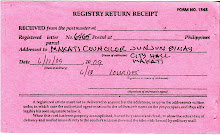
Based on the information on the registry return receipt for my complaint letter, numbered 0650 and addressed to the SM corporate offices in Pasay City, my said letter was received on April 14, 2009 by an agent of said offices. Said offices were identified as in charge of all SM malls, SM department stores, Save More stores, etc. Said letter concerned short changing to me, by an employee working at SM supermarket at SM Makati, of 100 pesos. Up to May 23, 2009, I have not received any reply to said letter from anyone from said offices. This is the way said offices treated a complaint.
___________________________________________________________________________________
http://www.doh.gov.ph/
UPDATE NO. 18 - RP's FIRST H1N1 CASE
21 May 2009
The Department of Health is officially announcing this evening the first confirmed case of Influenza A (H1N1) in the Philippines.
A female traveler arrived in the Philippines on May 18, Monday, from the United States and Canada. A throat specimen was collected, and was tested at the Research Institute of Tropical Medicine (RITM) on May 20, Wednesday, after she developed fever, sore throat and cough.
Today, RITM confirmed that the specimen tested positive for the novel Influenza A (H1N1) on PCR using the primers sent by the US Centers for Disease
Control and Prevention (CDC).
UPDATE NO. 18 - RP's FIRST H1N1 CASE
21 May 2009
The Department of Health is officially announcing this evening the first confirmed case of Influenza A (H1N1) in the Philippines.
A female traveler arrived in the Philippines on May 18, Monday, from the United States and Canada. A throat specimen was collected, and was tested at the Research Institute of Tropical Medicine (RITM) on May 20, Wednesday, after she developed fever, sore throat and cough.
Today, RITM confirmed that the specimen tested positive for the novel Influenza A (H1N1) on PCR using the primers sent by the US Centers for Disease Control and Prevention (CDC).
She was immediately started on an antiviral, Oseltamivir, and given supportive care. At this time, the patient is continuously being monitored. She no longer has fever or cough, but still has sore throat.
The DOH would like to emphasize that there is no community level outbreak in the country and measures are being done by the government to prevent transmission, starting with the quarantine of household close contacts.
The family of the patient has been informed and advised about the situation. We would like to thank them for their cooperation and willingness to comply with the recommendations of the DOH. They were advised to observe self-monitoring, home quarantine, social distancing, proper hygiene and respiratory etiquette procedures.
We appeal to our media partners and the rest of the nation to respect the privacy and anonymity of the patient and her family. Rest assured that any information vital to protect public health and safety will be appropriately shared to those concerned.
The DOH also stresses that the discovery of this first case of Influenza A(H1N1) in the Philippines is something we have been preparing for and is a result of the collective efforts of both public and private sectors as well as the effective surveillance system which we have put in place.
The DOH has already notified the International Health Regulations (IHR) and will submit its official report in 24 hours.
Influenza A (H1N1) is currently affecting 41 other countries with 11,034 cases and 85 deaths. Thus far, the behavior of the virus is to cause generally mild illness and low mortality (<1%) in the affected population.
This development only shows the vulnerability of all countries to the threat of Influenza A (H1N1) which indicates that no nation and no government should be complacent. Thus, we continue to strengthen our systems for surveillance, early detection and management and effective response. We are also closely coordinating with the WHO, other agencies of government and the private sector to effectively combat the virus.
Our stockpiles of Oseltamivir is currently sufficient at 1 million capsules and have been distributed in regional hubs all over the country. We would like to remind the public that Oseltamivir may only be dispensed and taken upon the advice of your doctor. Irrational use can result in drug resistance that causes the drug to become ineffective in the future.
We reiterate to the public that government is on top of the situation and everyone is advised to be vigilant. If you have arrived from an affected country and develop flu-like symptoms (or TRANGKASO) such as fever, sore throat and cough, immediately consult a medical professional or call the DOH Hotline at (02) 711-1001 or 711-1002.
This situation is evolving globally. We will give regular updates to the media and the public as information becomes available.
To know more about Influenza A(H1N1), you may go to the DOH Influenza A(H1N1) Website at www.doh.gov.ph/h1n1
DOH Influenza A(H1N1) Surveillance Progress Report (as of May 22, 2009 )
_________________________________________________________________________________
web sites with useful information:
CPSC Ptroduct Safety Standards
http://www.cpsc.gov/cgi-bin/regs.aspx
The International Journal of Clinical Practice
http://www.blackwellpublishing.com/ijcp_enhanced/
BBC Health Healthy Living
http://www.bbc.co.uk/health/healthy_living/
HHS HealthBeat (May 22, 2009)
Age and avoiding diabetes
http://www.hhs.gov/news/healthbeat/2009/05/20090522a.html
From the U.S. Department of Health and Human Services, I’m Ira Dreyfuss with HHS HealthBeat.
Diabetes is preventable.
Dariush Mozaffarian of Harvard School of Public Health, with collaborators, examined lifestyle and new-onset diabetes risk over 10 years in nearly 5,000 people with an average age of 73 at the start of the study.
They found diabetes risk was nearly 90 percent lower among people who were physically active, ate more fiber and polyunsaturated fats and less sugars, starches, and trans fat, didn’t smoke, used alcohol moderately, and kept a healthy weight. Even following a few healthier habits had significant risk reductions.
Mozaffarian says:
[Dariush Mozaffarian speaks] "There was dramatic relationships between lifestyle and diabetes. So it suggests that it’s never too late to reduce your risk of diabetes."
The Archives of Internal Medicine study was supported by the National Institutes of Health.
Learn more at hhs.gov.
CPSC Product Safety Standards
http://www.cpsc.gov/cgi-bin/regs.aspx
Fun Express Expands Nationwide Recall of Water-Based Face Paint
http://www.fda.gov/oc/po/firmrecalls/funexpress05_09.html
FOR IMMEDIATE RELEASE --May 22, 2009 --- Fun Express, Inc. has expanded its May 12, 2009 recall of face paint items to include two additional face paint colors. The face paints may cause skin irritation, rashes and itchiness. The additional two face paint items are being removed from the marketplace as a precautionary measure.
The face paints were manufactured by Shanghai Color Art Stationery Company Limited, Shanghai, China. Unopened packages of the face paint can be identified as a tube printed with the words Water-Based Face Paint Net Weight 1 oz. (28.3gm) Non-Toxic Made in China. The tube is on a cardboard backing with the words “Face Paint” on the front of the package and an item number in the upper right-hand corner of the backing. Directions for use, ingredients and “Distributed by Oriental Trading Co., Omaha, NE 68127” are also printed on the backing.
The following are the two additional face paint items. The item number is located on the back of the packaging.
85/2338 (White face paint)
85/2339 (Yellow face paint)
The products were distributed primarily to retail stores nationwide between April 2008 and April 2009.
If consumers have any of the recalled products remaining in their possession, they should immediately discard them.
Consumers can contact Fun Express, Inc. by calling (888) 999-0442 between the hours of 9:00 am and 5:00 pm CST, Monday through Friday.
This recall is being conducted in cooperation with the Food and Drug Administration
Fun Express, Inc. is committed to the safety of its products and strives to lead the industry in product safety.
#
FDA Press Release (May 12, 2009)
poolsafety gov web site
http://www.poolsafety.gov/
Swimming Pool and Spa Safety Starts with You!
Recreational time at public and residential swimming pools and spas is a favorite activity for children and adults all over the country. Whether enjoying pool time with family and friends, exercising, playing water sports, or learning to swim, everyone needs to be mindful of the potential for incidents and drownings in pools and spas.
Each year, nearly 300 children under the age of five drown in residential and public pools and spas. Submersion incidents requiring emergency-room treatment or hospitalization number in the thousands and many victims experience permanent disability, including brain damage.
Few people know of the hidden dangers from drain or suction entrapments. Drains with broken, missing, or faulty covers can entrap hair, the body, limbs, jewelry and clothing, or cause disembowelment/evisceration.
On December 17, 2007, the Virginia Graeme Baker Pool and Spa Safety Act (P&SSAct) was signed into law. This important child safety law became effective in December 2008 and strives to:
* Enhance the safety of public and private pools and spas
* Encourage the use of layers of protection
* Reduce child drownings in pools and spas (295 each year involving children younger than 5)
* Reduce the number of suction entrapment incidents, injuries and deaths
* Educate the public on the importance of constant supervision of children in and around water
The U.S. Consumer Product Safety Commission is the lead agency in implementing and enforcing the P&SSAct. CPSC is working with other safety groups in the pool and spa safety community to encourage the use of layers of protection--such as fencing around pools, constant supervision, and requiring anti-entrapment drain covers and other safety devices.
CPSC's Pool and Spa Safety Data
Pool/Spa Hazards
* 2009 Pool and Spa Submersion Memorandum (Released May 2009) [PDF]
o 2008 Memorandum (Released May 2008) [PDF]
o 2007 Memorandum (Released June 2007) [PDF]
o 2006 Memorandum (Released May 2006) [PDF]
* 1999-2008 Reported Circulation/Suction Entrapments Associated with Pools, Hot Tubs, Spas, and Whirlpools (Released May 2009) [PDF]
o 1999-2007 Report (Released March 2008) [PDF]
* Study on Pool Alarm Reliability (Released May 2000) [PDF]
Other Drowning Hazards
* 2008 Submersions Related to Non-Pool and Non-Spa Products (Released November 2008) [PDF]
o 2007 report (Released August 2007) [PDF]
* 1999-2006 Reported Submersions and Other Hazards Associated with Liquids/Chemicals in Buckets/Pails, July 2008 (released September 2008) [PDF]
Drowning Prevention
Picture of Backyard Pool with Fence Picture of Person Tugging at Ball Stuck on Drain Picture of Boy in Pool
Backyard and community pools are popular with children and adults of all ages but owning or operating one is a major responsibility. Take every step possible to prevent unintended injuries in and around pools and spas.
Learn about the hazard of drain entrapment and what to look for at pools and spas your family frequents. Individuals in the 5-9 year-old category had the highest frequency of entrapment reports.
Safety Tips
Supervise children at all times around pools and spas. Adults should keep a constant eye on all kids in the water. Emphasize the need for constant supervision to babysitters.
Install a four-sided barrier, such as a fence with self-closing gates completely surrounding the pool. If the house forms the fourth side of the barrier, install alarms on doors leading to the pool area to prevent children from wandering into the pool or spa. Also install safety covers and perimeter or in-water alarms as additional layers of protection.
Learn to Swim and teach your children to swim. Many organizations provide swimming lessons.
Know how to respond:
* Get training in basic water rescue skills, first aid, CPR
* Have rescue and first aid equipment available at the pool
* Keep a phone at the pool
Virginia Graeme Baker Pool and Spa Safety Act Compliant Products
A variety of drain covers in various sizes have already been certified to the ASME/ANSI A112.19.8-2007 standard. View a complete listing of drain cover manufacturers who have received certification at www.poolsafety.gov/draincman.html.
The products on this page have been certified by one of the following independent, nationally recognized testing laboratories: Underwriters Laboratories, the National Sanitation Foundation, and IAPMO (International Association of Plumbing and Mechanical Officials).
What to look for when purchasing new drain covers or other P&SSAct devices
The P&SSAct does not require a product marking for approved drain covers. Covers are to display (per ASME standard):
* Use - single or multiple
* Flow rate GPM
* "Life" (number of years)
* Wall and/or floor mount
* Manufacturers name
* Model number
Drain covers made during the summer of 2008 used the ASME symbol and/or the "ASME/ANSI A112.19.8-2007" mark. Since November 12, 2008, newly made drain covers should have the "VGB 2008" marking. The drain cover manufacturer should provide a certification document with each drain cover stating that it complies with the requirements of the P&SSAct. If there is no mark or you are otherwise in doubt, contact the manufacturer and ask for a copy of the certificate. Also keep a record of where and when you purchased the cover.
All drain covers must be compliant with the ASME/ANSI A112.19.8-2007 standard. If your covers are field fabricated, then a Registered Design Professional or a licensed professional engineer (PE) can specify that your pre-existing grate(s) meet the ASME/ANSI A112.19.8-2007 standard.
Secondary Layer of Protection
In addition to having a compliant drain cover, public pools and spas with single, blockable main drains or multiple drains less than 3 feet apart must have an additional layer of protection using one of the following systems or devices:
I. SAFETY VACUUM RELEASE SYSTEM - A safety vacuum release system which ceases operation of the pump, reverses the circulation flow, or otherwise provides a vacuum release at a suction outlet when a blockage is detected, that has been tested by an independent third party and found to conform to ASME/ANSI standard A112.19.17 or ASTM standard F2387.
II. SUCTION-LIMITING VENT SYSTEM - A suction-limiting vent system with a tamper-resistant atmospheric opening.
III. GRAVITY DRAINAGE SYSTEM - A gravity drainage system that utilizes a collector tank.
IV. AUTOMATIC PUMP SHUT-OFF SYSTEM - An automatic pump shut-off system.
V. DRAIN DISABLEMENT - A device or system that disables the drain.
VI. OTHER SYSTEMS - Any other system determined by the Commission to be equally effective as, or better than, the systems described above at preventing or eliminating the risk of injury or death associated with pool drainage systems.
A list of certified SVRS manufacturers can be found at www.poolsafety.gov/svrsman.html.
INSTALLATION
A pool owner or operator should have documentation that the installed drain covers are compliant. Documentation of the installation is not a requirement of the P&SSAct, but CPSC staff advises checking with your local and state officials to confirm any local/state certification or installation requirements.
CPSC recommends contacting state or local officials to determine who is qualified as a professional engineer or a design professional in your area. Experts should be formally licensed or certified as a business and carry some level of insurance or similar protection.
For More Information:
* Virginia Graeme Baker Pool and Spa Safety Act
* CPSC/CPSC Staff Guidelines
* Presentation on Drowning Prevention, Entrapment Prevention & Pool and Spa Safety Act (pdf)
U. S. National Eye Institute
http://www.nei.nih.gov/
http://www.hhs.gov/safety/index.html
U.S. Department of Health & Human services
Based on the information on the registry return receipt for my complaint letter, numbered 0650 and addressed to the SM corporate offices in Pasay City, my said letter was received on April 14, 2009 by an agent of said offices. Said offices were identified as in charge of all SM malls, SM department stores, Save More stores, etc. Said letter concerned short changing to me, by an employee working at SM supermarket at SM Makati, of 100 pesos. Up to May 23, 2009, I have not received any reply to said letter from anyone from said offices. This is the way said offices treated a complaint.
___________________________________________________________________________________
http://www.doh.gov.ph/
UPDATE NO. 18 - RP's FIRST H1N1 CASE
21 May 2009
The Department of Health is officially announcing this evening the first confirmed case of Influenza A (H1N1) in the Philippines.
A female traveler arrived in the Philippines on May 18, Monday, from the United States and Canada. A throat specimen was collected, and was tested at the Research Institute of Tropical Medicine (RITM) on May 20, Wednesday, after she developed fever, sore throat and cough.
Today, RITM confirmed that the specimen tested positive for the novel Influenza A (H1N1) on PCR using the primers sent by the US Centers for Disease
Control and Prevention (CDC).
UPDATE NO. 18 - RP's FIRST H1N1 CASE
21 May 2009
The Department of Health is officially announcing this evening the first confirmed case of Influenza A (H1N1) in the Philippines.
A female traveler arrived in the Philippines on May 18, Monday, from the United States and Canada. A throat specimen was collected, and was tested at the Research Institute of Tropical Medicine (RITM) on May 20, Wednesday, after she developed fever, sore throat and cough.
Today, RITM confirmed that the specimen tested positive for the novel Influenza A (H1N1) on PCR using the primers sent by the US Centers for Disease Control and Prevention (CDC).
She was immediately started on an antiviral, Oseltamivir, and given supportive care. At this time, the patient is continuously being monitored. She no longer has fever or cough, but still has sore throat.
The DOH would like to emphasize that there is no community level outbreak in the country and measures are being done by the government to prevent transmission, starting with the quarantine of household close contacts.
The family of the patient has been informed and advised about the situation. We would like to thank them for their cooperation and willingness to comply with the recommendations of the DOH. They were advised to observe self-monitoring, home quarantine, social distancing, proper hygiene and respiratory etiquette procedures.
We appeal to our media partners and the rest of the nation to respect the privacy and anonymity of the patient and her family. Rest assured that any information vital to protect public health and safety will be appropriately shared to those concerned.
The DOH also stresses that the discovery of this first case of Influenza A(H1N1) in the Philippines is something we have been preparing for and is a result of the collective efforts of both public and private sectors as well as the effective surveillance system which we have put in place.
The DOH has already notified the International Health Regulations (IHR) and will submit its official report in 24 hours.
Influenza A (H1N1) is currently affecting 41 other countries with 11,034 cases and 85 deaths. Thus far, the behavior of the virus is to cause generally mild illness and low mortality (<1%) in the affected population.
This development only shows the vulnerability of all countries to the threat of Influenza A (H1N1) which indicates that no nation and no government should be complacent. Thus, we continue to strengthen our systems for surveillance, early detection and management and effective response. We are also closely coordinating with the WHO, other agencies of government and the private sector to effectively combat the virus.
Our stockpiles of Oseltamivir is currently sufficient at 1 million capsules and have been distributed in regional hubs all over the country. We would like to remind the public that Oseltamivir may only be dispensed and taken upon the advice of your doctor. Irrational use can result in drug resistance that causes the drug to become ineffective in the future.
We reiterate to the public that government is on top of the situation and everyone is advised to be vigilant. If you have arrived from an affected country and develop flu-like symptoms (or TRANGKASO) such as fever, sore throat and cough, immediately consult a medical professional or call the DOH Hotline at (02) 711-1001 or 711-1002.
This situation is evolving globally. We will give regular updates to the media and the public as information becomes available.
To know more about Influenza A(H1N1), you may go to the DOH Influenza A(H1N1) Website at www.doh.gov.ph/h1n1
DOH Influenza A(H1N1) Surveillance Progress Report (as of May 22, 2009 )
_________________________________________________________________________________
web sites with useful information:
CPSC Ptroduct Safety Standards
http://www.cpsc.gov/cgi-bin/regs.aspx
The International Journal of Clinical Practice
http://www.blackwellpublishing.com/ijcp_enhanced/
BBC Health Healthy Living
http://www.bbc.co.uk/health/healthy_living/
HHS HealthBeat (May 22, 2009)
Age and avoiding diabetes
http://www.hhs.gov/news/healthbeat/2009/05/20090522a.html
From the U.S. Department of Health and Human Services, I’m Ira Dreyfuss with HHS HealthBeat.
Diabetes is preventable.
Dariush Mozaffarian of Harvard School of Public Health, with collaborators, examined lifestyle and new-onset diabetes risk over 10 years in nearly 5,000 people with an average age of 73 at the start of the study.
They found diabetes risk was nearly 90 percent lower among people who were physically active, ate more fiber and polyunsaturated fats and less sugars, starches, and trans fat, didn’t smoke, used alcohol moderately, and kept a healthy weight. Even following a few healthier habits had significant risk reductions.
Mozaffarian says:
[Dariush Mozaffarian speaks] "There was dramatic relationships between lifestyle and diabetes. So it suggests that it’s never too late to reduce your risk of diabetes."
The Archives of Internal Medicine study was supported by the National Institutes of Health.
Learn more at hhs.gov.
CPSC Product Safety Standards
http://www.cpsc.gov/cgi-bin/regs.aspx
Fun Express Expands Nationwide Recall of Water-Based Face Paint
http://www.fda.gov/oc/po/firmrecalls/funexpress05_09.html
FOR IMMEDIATE RELEASE --May 22, 2009 --- Fun Express, Inc. has expanded its May 12, 2009 recall of face paint items to include two additional face paint colors. The face paints may cause skin irritation, rashes and itchiness. The additional two face paint items are being removed from the marketplace as a precautionary measure.
The face paints were manufactured by Shanghai Color Art Stationery Company Limited, Shanghai, China. Unopened packages of the face paint can be identified as a tube printed with the words Water-Based Face Paint Net Weight 1 oz. (28.3gm) Non-Toxic Made in China. The tube is on a cardboard backing with the words “Face Paint” on the front of the package and an item number in the upper right-hand corner of the backing. Directions for use, ingredients and “Distributed by Oriental Trading Co., Omaha, NE 68127” are also printed on the backing.
The following are the two additional face paint items. The item number is located on the back of the packaging.
85/2338 (White face paint)
85/2339 (Yellow face paint)
The products were distributed primarily to retail stores nationwide between April 2008 and April 2009.
If consumers have any of the recalled products remaining in their possession, they should immediately discard them.
Consumers can contact Fun Express, Inc. by calling (888) 999-0442 between the hours of 9:00 am and 5:00 pm CST, Monday through Friday.
This recall is being conducted in cooperation with the Food and Drug Administration
Fun Express, Inc. is committed to the safety of its products and strives to lead the industry in product safety.
#
FDA Press Release (May 12, 2009)
poolsafety gov web site
http://www.poolsafety.gov/
Swimming Pool and Spa Safety Starts with You!
Recreational time at public and residential swimming pools and spas is a favorite activity for children and adults all over the country. Whether enjoying pool time with family and friends, exercising, playing water sports, or learning to swim, everyone needs to be mindful of the potential for incidents and drownings in pools and spas.
Each year, nearly 300 children under the age of five drown in residential and public pools and spas. Submersion incidents requiring emergency-room treatment or hospitalization number in the thousands and many victims experience permanent disability, including brain damage.
Few people know of the hidden dangers from drain or suction entrapments. Drains with broken, missing, or faulty covers can entrap hair, the body, limbs, jewelry and clothing, or cause disembowelment/evisceration.
On December 17, 2007, the Virginia Graeme Baker Pool and Spa Safety Act (P&SSAct) was signed into law. This important child safety law became effective in December 2008 and strives to:
* Enhance the safety of public and private pools and spas
* Encourage the use of layers of protection
* Reduce child drownings in pools and spas (295 each year involving children younger than 5)
* Reduce the number of suction entrapment incidents, injuries and deaths
* Educate the public on the importance of constant supervision of children in and around water
The U.S. Consumer Product Safety Commission is the lead agency in implementing and enforcing the P&SSAct. CPSC is working with other safety groups in the pool and spa safety community to encourage the use of layers of protection--such as fencing around pools, constant supervision, and requiring anti-entrapment drain covers and other safety devices.
CPSC's Pool and Spa Safety Data
Pool/Spa Hazards
* 2009 Pool and Spa Submersion Memorandum (Released May 2009) [PDF]
o 2008 Memorandum (Released May 2008) [PDF]
o 2007 Memorandum (Released June 2007) [PDF]
o 2006 Memorandum (Released May 2006) [PDF]
* 1999-2008 Reported Circulation/Suction Entrapments Associated with Pools, Hot Tubs, Spas, and Whirlpools (Released May 2009) [PDF]
o 1999-2007 Report (Released March 2008) [PDF]
* Study on Pool Alarm Reliability (Released May 2000) [PDF]
Other Drowning Hazards
* 2008 Submersions Related to Non-Pool and Non-Spa Products (Released November 2008) [PDF]
o 2007 report (Released August 2007) [PDF]
* 1999-2006 Reported Submersions and Other Hazards Associated with Liquids/Chemicals in Buckets/Pails, July 2008 (released September 2008) [PDF]
Drowning Prevention
Picture of Backyard Pool with Fence Picture of Person Tugging at Ball Stuck on Drain Picture of Boy in Pool
Backyard and community pools are popular with children and adults of all ages but owning or operating one is a major responsibility. Take every step possible to prevent unintended injuries in and around pools and spas.
Learn about the hazard of drain entrapment and what to look for at pools and spas your family frequents. Individuals in the 5-9 year-old category had the highest frequency of entrapment reports.
Safety Tips
Supervise children at all times around pools and spas. Adults should keep a constant eye on all kids in the water. Emphasize the need for constant supervision to babysitters.
Install a four-sided barrier, such as a fence with self-closing gates completely surrounding the pool. If the house forms the fourth side of the barrier, install alarms on doors leading to the pool area to prevent children from wandering into the pool or spa. Also install safety covers and perimeter or in-water alarms as additional layers of protection.
Learn to Swim and teach your children to swim. Many organizations provide swimming lessons.
Know how to respond:
* Get training in basic water rescue skills, first aid, CPR
* Have rescue and first aid equipment available at the pool
* Keep a phone at the pool
Virginia Graeme Baker Pool and Spa Safety Act Compliant Products
A variety of drain covers in various sizes have already been certified to the ASME/ANSI A112.19.8-2007 standard. View a complete listing of drain cover manufacturers who have received certification at www.poolsafety.gov/draincman.html.
The products on this page have been certified by one of the following independent, nationally recognized testing laboratories: Underwriters Laboratories, the National Sanitation Foundation, and IAPMO (International Association of Plumbing and Mechanical Officials).
What to look for when purchasing new drain covers or other P&SSAct devices
The P&SSAct does not require a product marking for approved drain covers. Covers are to display (per ASME standard):
* Use - single or multiple
* Flow rate GPM
* "Life" (number of years)
* Wall and/or floor mount
* Manufacturers name
* Model number
Drain covers made during the summer of 2008 used the ASME symbol and/or the "ASME/ANSI A112.19.8-2007" mark. Since November 12, 2008, newly made drain covers should have the "VGB 2008" marking. The drain cover manufacturer should provide a certification document with each drain cover stating that it complies with the requirements of the P&SSAct. If there is no mark or you are otherwise in doubt, contact the manufacturer and ask for a copy of the certificate. Also keep a record of where and when you purchased the cover.
All drain covers must be compliant with the ASME/ANSI A112.19.8-2007 standard. If your covers are field fabricated, then a Registered Design Professional or a licensed professional engineer (PE) can specify that your pre-existing grate(s) meet the ASME/ANSI A112.19.8-2007 standard.
Secondary Layer of Protection
In addition to having a compliant drain cover, public pools and spas with single, blockable main drains or multiple drains less than 3 feet apart must have an additional layer of protection using one of the following systems or devices:
I. SAFETY VACUUM RELEASE SYSTEM - A safety vacuum release system which ceases operation of the pump, reverses the circulation flow, or otherwise provides a vacuum release at a suction outlet when a blockage is detected, that has been tested by an independent third party and found to conform to ASME/ANSI standard A112.19.17 or ASTM standard F2387.
II. SUCTION-LIMITING VENT SYSTEM - A suction-limiting vent system with a tamper-resistant atmospheric opening.
III. GRAVITY DRAINAGE SYSTEM - A gravity drainage system that utilizes a collector tank.
IV. AUTOMATIC PUMP SHUT-OFF SYSTEM - An automatic pump shut-off system.
V. DRAIN DISABLEMENT - A device or system that disables the drain.
VI. OTHER SYSTEMS - Any other system determined by the Commission to be equally effective as, or better than, the systems described above at preventing or eliminating the risk of injury or death associated with pool drainage systems.
A list of certified SVRS manufacturers can be found at www.poolsafety.gov/svrsman.html.
INSTALLATION
A pool owner or operator should have documentation that the installed drain covers are compliant. Documentation of the installation is not a requirement of the P&SSAct, but CPSC staff advises checking with your local and state officials to confirm any local/state certification or installation requirements.
CPSC recommends contacting state or local officials to determine who is qualified as a professional engineer or a design professional in your area. Experts should be formally licensed or certified as a business and carry some level of insurance or similar protection.
For More Information:
* Virginia Graeme Baker Pool and Spa Safety Act
* CPSC/CPSC Staff Guidelines
* Presentation on Drowning Prevention, Entrapment Prevention & Pool and Spa Safety Act (pdf)
U. S. National Eye Institute
http://www.nei.nih.gov/
http://www.hhs.gov/safety/index.html
U.S. Department of Health & Human services
Thursday, May 21, 2009
Security lapse on May 20, 2009, at entrance to SM City Manila
Security lapse by guard, identified as "Cabototatan" at entrance to SM City Manila on May 20, 2009. Because of said security lapse by said guard at said entrance, I could have brought dangerous weapons into said mall, to the detriment of people inside said mall. While inside said mall on said date, I purchased from Tokyo Tokyo restaurant shrimp tempura. Proof of said purchase is Tokyo Tokyo, Inc. cash invoice dated 05/20/09 and numbered 4350. While I was eating at said restaurant, a live insect fly landed on the drinking glass I was using.
The germs from said fly contaminated said glass, which had contents. The presence of an insect fly in the dining area of a restaurant is a sign of an unsanitary restaurant.
________________________________________________________________________
Warning to prospective buyers of/current users of products from Johnson & Johnson Philippines, Inc.
I sent the following message, via registered mail, to said company: "Said company was identified as the local distributor of Neutrogena Ultra-Sheer Dry
Touch Sunblock SPF 50+ allegedly with Helioplex. On April 29, 2009, the following words about said product appeared under the name of Millet Mananquil on page F-1 page of the the Philippine Star newspaper issue of said date: "This sunblock . . . also oil-free and waterproof . . . also boasts grease-absorbing and mattifying properties." On behalf of customers, please, soonest, provide me with evidence, if any, that said product is: oil free and waterproof and also boasts grease-absorbing and mattifying properties.".
On May 21, 2009, I received a letter dated May 19, 2009 and bearing the name of said corporation and the name "Michell F. Frondozo - Customer Service Specialist" as the sender
of said letter. Said letter did not contain the proof I requested regarding said product. Instead, said letter bore the words: "We acknowledge receipt of your recent correspondence. You may contact us . . . so we can assist you with your concern on Neutrogena . . ."
___________________________________________________________________________
According to a source identified as Rissa Mananquil, "Benetton bags are well-constructed . . .my Benetton bags have lasted me many years." What is the basis, if any, for said Mananquil's allegation that said bags are well-constructed?
Regarding said Mananquil's allegation that said bags have lasted her many years, how did she store said bags? How often did she use said bags? Regarding her allegation that said bags "can last you many seasons after", what is her basis, if any, for said allegation?
________________________________________________________________________
According to a source identified as Tingting Cojuanco, "Gotas Divinas is a non-dye hair product, washable, and does not contain any hydrogen peroxide." What is her basis, if any for said allegations? Said source made the allegation that some products are non-hypoallergenic.What is her basis, if any, for using the term
"non-hypoallergenic"? According to the information I have, the U.S. Food
and Drug Administration web site contains the information that the said organization not certify any product to be non-hypoallergenic.
_________________________________________________________________________
Warning re Manila restaurants and Manila Health Department
I have seen some restaurants in Manila with unsanitary conditions and or unsanitary acts of employees at said restaurants. I sent to the Manila Health Department reports, via registered mail, regarding said restaurants and said employees. Said
Manila Health Department, largely, did not provide me with response to said reports. I believe employees of said department violated R.A. 6713.
_________________________________________________________________________
The germs from said fly contaminated said glass, which had contents. The presence of an insect fly in the dining area of a restaurant is a sign of an unsanitary restaurant.
________________________________________________________________________
Warning to prospective buyers of/current users of products from Johnson & Johnson Philippines, Inc.
I sent the following message, via registered mail, to said company: "Said company was identified as the local distributor of Neutrogena Ultra-Sheer Dry
Touch Sunblock SPF 50+ allegedly with Helioplex. On April 29, 2009, the following words about said product appeared under the name of Millet Mananquil on page F-1 page of the the Philippine Star newspaper issue of said date: "This sunblock . . . also oil-free and waterproof . . . also boasts grease-absorbing and mattifying properties." On behalf of customers, please, soonest, provide me with evidence, if any, that said product is: oil free and waterproof and also boasts grease-absorbing and mattifying properties.".
On May 21, 2009, I received a letter dated May 19, 2009 and bearing the name of said corporation and the name "Michell F. Frondozo - Customer Service Specialist" as the sender
of said letter. Said letter did not contain the proof I requested regarding said product. Instead, said letter bore the words: "We acknowledge receipt of your recent correspondence. You may contact us . . . so we can assist you with your concern on Neutrogena . . ."
___________________________________________________________________________
According to a source identified as Rissa Mananquil, "Benetton bags are well-constructed . . .my Benetton bags have lasted me many years." What is the basis, if any, for said Mananquil's allegation that said bags are well-constructed?
Regarding said Mananquil's allegation that said bags have lasted her many years, how did she store said bags? How often did she use said bags? Regarding her allegation that said bags "can last you many seasons after", what is her basis, if any, for said allegation?
________________________________________________________________________
According to a source identified as Tingting Cojuanco, "Gotas Divinas is a non-dye hair product, washable, and does not contain any hydrogen peroxide." What is her basis, if any for said allegations? Said source made the allegation that some products are non-hypoallergenic.What is her basis, if any, for using the term
"non-hypoallergenic"? According to the information I have, the U.S. Food
and Drug Administration web site contains the information that the said organization not certify any product to be non-hypoallergenic.
_________________________________________________________________________
Warning re Manila restaurants and Manila Health Department
I have seen some restaurants in Manila with unsanitary conditions and or unsanitary acts of employees at said restaurants. I sent to the Manila Health Department reports, via registered mail, regarding said restaurants and said employees. Said
Manila Health Department, largely, did not provide me with response to said reports. I believe employees of said department violated R.A. 6713.
_________________________________________________________________________
Tuesday, May 19, 2009
Evidence vs. My Health healthcare facility
evidence vs. My Health healthcare facility
which was identified as being at Festival Supermall, Alabang. Based on evidence, said entity/said entity's agent received, on April 20, 2009, my letter, designated as registered letter No. 8835, which contained a request for information regarding said entity. Up to May 18,2009, said entity has not provided me with the information I requested.
customer advisory re Tirta Spa, whose address was: Sitio Malabunot, Manoc-Manoc, Boracay Isand, Malay, Aklan. It will benefit potential customers of said spa to obtain, in advance, the following information regarding said spa:
(1) a complete list of the services offered by said spa and the prices for said services; (2) the benefits/effects of said services; (3) proof, if any, that said spa has its own water supply and power supply; (3) proof, if any, the employees who perform the services at said spa have been trained by qualified persons;(4) proofs, if any, that the persons, who perform the massaging services at said spa, have passed any government test for masseuses. An article regarding said spa was published in the November 22, 2008 issue of the Manila Bulletin newspaper. Said article contained the statement: "ensuring ultimate satisfaction for each client." If a client of said spa is not ultimately satisfied with the service of said spa, will said spa refund said client paid?
customer advisory re Domini M. Torrevillas and Power Nut store
The following was published under said Torrevillas name in the March 19, 2009 issue of the Philippine Star newspaper: ". . . for the best sans rival cake, get it at the Power Nut store . . ." What, if any, is the basis for said comment by Torrevillas? For their own protection, it will benefit prospective buyers of products from said store to: (1) make certain that said store has up to date required permits/licenses. (2) all baked products contain lists of all the ingredients contained in said products; (3) all said products bear visible understandable consume before/best before dates. (4) make sure that said store issues valid receipts for products sold; (5) that said receipts bear complete descriptions of the products sold. There is evidence that the office of the Mandaluyong mayor received a complaint vs. said store.Based on a registry return reeeipt, my registered letter No. 8839 addressed to said store was received on April 2, 2009 by said store. Said letter contained a request for a complete list of products sold at said store and a complete list of the ingredients used in said products. Up to May 18, 2009
no person from said store has provided me with the information I requested.
which was identified as being at Festival Supermall, Alabang. Based on evidence, said entity/said entity's agent received, on April 20, 2009, my letter, designated as registered letter No. 8835, which contained a request for information regarding said entity. Up to May 18,2009, said entity has not provided me with the information I requested.
customer advisory re Tirta Spa, whose address was: Sitio Malabunot, Manoc-Manoc, Boracay Isand, Malay, Aklan. It will benefit potential customers of said spa to obtain, in advance, the following information regarding said spa:
(1) a complete list of the services offered by said spa and the prices for said services; (2) the benefits/effects of said services; (3) proof, if any, that said spa has its own water supply and power supply; (3) proof, if any, the employees who perform the services at said spa have been trained by qualified persons;(4) proofs, if any, that the persons, who perform the massaging services at said spa, have passed any government test for masseuses. An article regarding said spa was published in the November 22, 2008 issue of the Manila Bulletin newspaper. Said article contained the statement: "ensuring ultimate satisfaction for each client." If a client of said spa is not ultimately satisfied with the service of said spa, will said spa refund said client paid?
customer advisory re Domini M. Torrevillas and Power Nut store
The following was published under said Torrevillas name in the March 19, 2009 issue of the Philippine Star newspaper: ". . . for the best sans rival cake, get it at the Power Nut store . . ." What, if any, is the basis for said comment by Torrevillas? For their own protection, it will benefit prospective buyers of products from said store to: (1) make certain that said store has up to date required permits/licenses. (2) all baked products contain lists of all the ingredients contained in said products; (3) all said products bear visible understandable consume before/best before dates. (4) make sure that said store issues valid receipts for products sold; (5) that said receipts bear complete descriptions of the products sold. There is evidence that the office of the Mandaluyong mayor received a complaint vs. said store.Based on a registry return reeeipt, my registered letter No. 8839 addressed to said store was received on April 2, 2009 by said store. Said letter contained a request for a complete list of products sold at said store and a complete list of the ingredients used in said products. Up to May 18, 2009
no person from said store has provided me with the information I requested.
Sunday, May 17, 2009
Security lapses on May 17, 2009, at Ayala Center, Makati
Security lapses on May 17, 2009, at entrances to following shopping areas at Ayala Center, Makati: SM Makati, Park Square 1, National book store (near SM
Makati), SM Department store, SM Supermarket. Evidence available. Because of said lapses, I could have brought dangerous weapons into said areas, to the
detriment of people inside said areas.
http://www.doh.gov.ph/
H1N1 Update No. 11 - DOH STATEMENT ON INFLUENZA A (H1N1) MONITORING
15 May 2009
Today, the Department of Health reported five new cases under observation. Four were negative for influenza A (H1N1), while the laboratory result for one case is still pending. The total number of cases that the DOH monitored since May 1 to May 14 is now 54. Forty-five of these cases were reported from the National Capital Region, six from Region VII, and one case each for Regions IV-A, V and X.
The reported cases had history of travel to the following countries with confirmed influenza A (H1N1) cases: Australia, Canada, China (Mainland), Germany,
Hong Kong, Ireland, Italy, Japan, Korea, Mexico, Netherlands, Spain, Switzerland, United Kingdom and the United States of America.
Today, the Department of Health reported five new cases under observation. Four were negative for influenza A (H1N1), while the laboratory result for one case is still pending. The total number of cases that the DOH monitored since May 1 to May 14 is now 54. Forty-five of these cases were reported from the National Capital Region, six from Region VII, and one case each for Regions IV-A, V and X.
The reported cases had history of travel to the following countries with confirmed influenza A (H1N1) cases: Australia, Canada, China (Mainland), Germany, Hong Kong, Ireland, Italy, Japan, Korea, Mexico, Netherlands, Spain, Switzerland, United Kingdom and the United States of America.
As of May 14, the World Health Organization has reported no new countries with confirmed cases of A (H1N1). The total number of confirmed influenza A (H1N1) cases reported in 33 countries is now 6,497. This is a 13% increase compared to the number reported in the previous day (5,728). The most number of new confirmed cases (387/769) was from Mexico. No new deaths were reported; the total number of deaths is still 61.
While the Philippines is still free from Influenza A (H1N1), the DOH reiterates that they will continue to intensify its surveillance in ports, airports and the community so that cases of influenza A (H1N1) are detected early and appropriate control measures implemented immediately.
Interim Guidelines No. 4
On Public Gatherings in Response to Influenza A (H1N1) Virus Threat
Given the current information on the status of influenza A (H1N1) in the country, the Department of Health (DOH) issues the following interim guidelines on "Public Gatherings in Response to Influenza A (H1N1) Virus Threat" for the guidance of event organizers, local officials, health care providers and the general public.
Definition
Public Gathering refers to a congregation or grouping of several people in an area or activity. Examples of a gathering are social and cultural celebrations like fiestas, conferences, concerts, sports event, and other comparable activities, both indoor and outdoor, where crowding of people may occur.
Public gatherings are usually festive and personal contact like handshaking, hugging and kissing likely occur, thereby increasing the risk for spread of Influenza A (H1N1) virus.
For All Persons Attending a Public Gathering:
? Practice proper cough manners and cover mouth and nose when coughing or sneezing and wash hands after doing so
? Maintain personal hygiene, especially regular hand washing with soap and water or sanitizer
? At the first signs and symptoms of flu-like illness, defer from attending a public gathering and seek medical consultation
? Persons who are at high risk of complications from Influenza A (H1N1) infection should avoid exposure to this virus by reconsidering attendance to public gatherings. Persons at high risk are:
o Persons with certain chronic medical conditions and the immuno-compromised
o Children less than 5 years and persons 60 or older
o Pregnant women
For Event Organizers or Hosts:
? Determine the time required to achieve the purpose of the public gathering and avoid extending the period of time that people are gathered as crowds
? Provide alternative options and venues for participation. In general, open spaces are preferable over indoor venues.
? Make adequately available at the event the following basic facilities and services:
o Hand washing facilities with soap and running water or hand sanitizers
o Garbage bins for proper disposal of tissues, disposable cups and other items
o On-site medical assessment team that is adequately equipped to screen persons developing flu-like illness
? Ensure that frequently touched objects and surfaces had been adequately disinfected, e.g. door knobs, tabletops, chairs, toilets, etc.
? Deliver key educational messages about measures attendees can take to help reduce the spread of the Influenza A (H1N1) virus infection
For the Local Officials, Health Officers and other officials with jurisdiction over the Public Gathering:
? Reinforce guidelines on public gatherings for event organizers and hosts by issuing corresponding memorandum or ordinances
? Provide key educational messages to event organizers and the public on the prevention and control of influenza A (H1N1) virus, such as: local situation with regards influenza A (H1N1), health alerts and advisories derived from newspapers and official websites, etc.
? Complement the preparations made by event organizers in the provision of adequate facilities and services for the public gathering
? Plan for the provision of on-site medical assistance for possible medical emergencies
? Report any incidence of flu-like illness manifesting or found in community or area where public gatherings are planned
In the event that a suspected case of Influenza A (H1N1) virus infection is reported in the scheduled public gathering, the DOH is authorized to investigate, make recommendations and assist the community to contain the infection, as specified in Republic Act No. 9271, Quarantine Act of 2004, "An Act Strengthening the Regulatory Capacity of the Department of Health in Quarantine and International Health Surveillance":
? Section 1.4.b provides for the "apprehension, detention or surveillance for the purpose of preventing the introduction, transmission or spread of such public health emergencies of international concern as may be specified in Department Orders by the Secretary of Health upon the recommendation of the international health surveillance."
Implementing Rules and Regulations of "Quarantine Act of 2004", pursuant to RA 9271 further specifies under Section 53.2:
? In the event of an outbreak of public health emergency of international concern in a community, the Director of the Bureau shall recommend to the Secretary of Health the following measures:
o "apprehension, detention / isolation or surveillance of suspect / cases;
o place under active or passive surveillance, individuals who have been exposed to the infection considered as dangerous contact; and
o declare an area or community "under quarantine" where the public health emergency occurs."
Issued by the DOH Emergency Management Task Force for the Pandemic Response to Influenza A (H1N1)
http://www.epa.gov/opp00001/controlling/index.htm
Quick Finder
Cockroaches
Mosquitoes
Rodents - Mice and Rats
Greenscaping
Integrated Pest Management (IPM) Principles
Illegal Pesticides
USDA National Organic Program
Biopesticides
How to Read a Label
National Pesticide Information Center (NPIC)
EPA disclaimer
Resources for Pest Management
What Is a Pesticide?
Find out how to control pests the safe way, no matter who or where you are:
front view of a single family home
Residents
Information for residents on how to solve pest problems at home
Do's and Don'ts of Pest Control
Learn how to keep pests under control at home, whether you live in a free-standing, single-family house, or in an apartment, condominium, or elsewhere.
The best way to prevent or stop pest infestations at home is to keep pests from getting what they need to live and reproduce. Keep pests from getting food, water, and shelter, and pests will be less likely to settle in your home. Taking the right precautions, such as sealing entryways pests can use to come into your home (from outdoors or from elsewhere in your building), can cut down the chances that you'll find pests inside your home.
If you already have an infestation, and if you choose to use pesticides, please be sure to use them properly and responsibly. Always remember to read the label first, following all the directions.
# Do's and Don'ts of Pest Control
Do's and Don'ts of Pest Control
Esta página Web está disponible en español
Do ask questions and find the answers.
How can you safely solve your pest problems? The key is to be willing to ask questions. Learning about the pests you have and options that are available to control specific pests is the first step.
Do try pest prevention first.
Remove sources of food, water, and shelter.
* Store food in sealed plastic or glass containers. Make sure food and food scraps are tightly sealed and garbage is regularly removed from the home. Garbage containing food scraps should be placed in tightly covered trash cans.
* Fix leaky plumbing and do not let water accumulate anywhere in the apartment. Don't let water accumulate in trays under houseplants or under the refrigerator.
* Don't leave pet food and water out overnight. Also, if you apply pesticides, pet food and water should be removed from the area.
* Clutter provides shelter for pests-places for roaches and mice to breed and hide-and makes it difficult to do effective pest control. Keep the level of clutter down. Stacks of newspapers, magazines, or cardboard provide excellent shelter for roaches and other pests.
* Close off entryways and hiding places. For example, you can caulking cracks and crevices around cabinets or baseboards, and use wire mesh to fill holes around where pipes go through a wall, the ceiling, or the floor.
* Check for pests in packages or boxes before carrying them into the apartment.
Do safely and correctly use pesticides.
Keep pets and children away from areas where pesticides have been applied.
After preventative steps have been taken, you can use baits as a first line of chemical defense against insects or rodents. These are often effective and can be used with low risk of exposure to the pesticide, as long as they are kept out of the reach of children and pets.
Other relatively low-risk pesticides are available for some pests. Consult your local cooperative extension service office for recommendations suitable for your area. The U.S. Department of Agriculture's Web site can help you identify your local extension service office.
Pesticides not contained in baits or traps should generally only be applied to targeted locations, not sprayed over the whole room. Use fogging devices only when absolutely necessary.
Always read and follow the pesticide label's instructions and safety warnings.
Use ready-to-use products (i.e., no mixing needed) whenever possible.
If you hire any outside persons to help control pests, ask them to find and correct the source of the problem before applying pesticides. For example, you might have to repair a leaky toilet to remove a water source. Ask them to use baits and crack and crevice treatments when feasible.
Only apply chemicals approved for use in homes; the label will list where the chemical may be used; write down the name and EPA registration number of any chemical used by someone you hire. You will need this information if you decide to look up more information on the pesticide. The pest control operator should be able to provide information about the chemical, such as the material safety data sheet.
Do dispose of leftover pesticides and pesticide containers properly.
Read the label to find out how to dispose of the pesticide and the container.
Many communities have household hazardous waste collections that will accept unwanted pesticides. Call your waste disposal authority for information about your community.
Don't use outdoor chemicals indoors.
Many chemicals intended for use outdoors are dangerous to use indoors because they will remain toxic longer inside than they would outdoors.
Don't assume that twice as much is better.
Always read and follow label directions.
Using too much of a pesticide can endanger your family's health.
Don't transfer pesticides to other containers.
Store pesticides in their original containers.
Only mix as much as you are going to use at one time if the pesticide must be mixed with water.
Children and others have been poisoned by accidentally consuming pesticides stored in food or beverage containers. Don't use empty pesticide containers to store anything else.
No matter how well you wash the container, it could still contain remnants of the pesticide and could harm someone.
* Pesticides Home
* Controlling Pests Home
* Basic Information
* Residents
* Housing Managers
* Lawn & Garden
* In Agriculture
* At School
* Questions about Chemicals?
* Resources for Pest Management
* EPA Home
* Privacy and Security Notice
* Contact Us
Last updated on Thursday, November 6th, 2008.
http://www.epa.gov/opp00001/controlling/dosanddonts.htm
Additional Tips for Multi-Family Housing
Pest Management Roles for Residents
Controlling pests in multi-family housing requires cooperation between residents, housing managers, housing staff, and pest management professionals (PMP).
The resident's role encompasses these responsibilities:
* Prepare your unit for visits from the PMP or exterminator
* Follow your lease regarding:
o Housekeeping
o Sanitation
o Trash removal and storage
* Report the presence of pests, leaks and mold
* Monitor common areas for problems
* Help neighbors with these tasks
* Learn about the roles of housing managers, staff, and the PMP.
Responsibly controlling pests in multi-family housing requires teamwork, communication, and cooperation between residents, housing managers, housing staff, and pest management professionals (PMP).
Makati), SM Department store, SM Supermarket. Evidence available. Because of said lapses, I could have brought dangerous weapons into said areas, to the
detriment of people inside said areas.
http://www.doh.gov.ph/
H1N1 Update No. 11 - DOH STATEMENT ON INFLUENZA A (H1N1) MONITORING
15 May 2009
Today, the Department of Health reported five new cases under observation. Four were negative for influenza A (H1N1), while the laboratory result for one case is still pending. The total number of cases that the DOH monitored since May 1 to May 14 is now 54. Forty-five of these cases were reported from the National Capital Region, six from Region VII, and one case each for Regions IV-A, V and X.
The reported cases had history of travel to the following countries with confirmed influenza A (H1N1) cases: Australia, Canada, China (Mainland), Germany,
Hong Kong, Ireland, Italy, Japan, Korea, Mexico, Netherlands, Spain, Switzerland, United Kingdom and the United States of America.
Today, the Department of Health reported five new cases under observation. Four were negative for influenza A (H1N1), while the laboratory result for one case is still pending. The total number of cases that the DOH monitored since May 1 to May 14 is now 54. Forty-five of these cases were reported from the National Capital Region, six from Region VII, and one case each for Regions IV-A, V and X.
The reported cases had history of travel to the following countries with confirmed influenza A (H1N1) cases: Australia, Canada, China (Mainland), Germany, Hong Kong, Ireland, Italy, Japan, Korea, Mexico, Netherlands, Spain, Switzerland, United Kingdom and the United States of America.
As of May 14, the World Health Organization has reported no new countries with confirmed cases of A (H1N1). The total number of confirmed influenza A (H1N1) cases reported in 33 countries is now 6,497. This is a 13% increase compared to the number reported in the previous day (5,728). The most number of new confirmed cases (387/769) was from Mexico. No new deaths were reported; the total number of deaths is still 61.
While the Philippines is still free from Influenza A (H1N1), the DOH reiterates that they will continue to intensify its surveillance in ports, airports and the community so that cases of influenza A (H1N1) are detected early and appropriate control measures implemented immediately.
Interim Guidelines No. 4
On Public Gatherings in Response to Influenza A (H1N1) Virus Threat
Given the current information on the status of influenza A (H1N1) in the country, the Department of Health (DOH) issues the following interim guidelines on "Public Gatherings in Response to Influenza A (H1N1) Virus Threat" for the guidance of event organizers, local officials, health care providers and the general public.
Definition
Public Gathering refers to a congregation or grouping of several people in an area or activity. Examples of a gathering are social and cultural celebrations like fiestas, conferences, concerts, sports event, and other comparable activities, both indoor and outdoor, where crowding of people may occur.
Public gatherings are usually festive and personal contact like handshaking, hugging and kissing likely occur, thereby increasing the risk for spread of Influenza A (H1N1) virus.
For All Persons Attending a Public Gathering:
? Practice proper cough manners and cover mouth and nose when coughing or sneezing and wash hands after doing so
? Maintain personal hygiene, especially regular hand washing with soap and water or sanitizer
? At the first signs and symptoms of flu-like illness, defer from attending a public gathering and seek medical consultation
? Persons who are at high risk of complications from Influenza A (H1N1) infection should avoid exposure to this virus by reconsidering attendance to public gatherings. Persons at high risk are:
o Persons with certain chronic medical conditions and the immuno-compromised
o Children less than 5 years and persons 60 or older
o Pregnant women
For Event Organizers or Hosts:
? Determine the time required to achieve the purpose of the public gathering and avoid extending the period of time that people are gathered as crowds
? Provide alternative options and venues for participation. In general, open spaces are preferable over indoor venues.
? Make adequately available at the event the following basic facilities and services:
o Hand washing facilities with soap and running water or hand sanitizers
o Garbage bins for proper disposal of tissues, disposable cups and other items
o On-site medical assessment team that is adequately equipped to screen persons developing flu-like illness
? Ensure that frequently touched objects and surfaces had been adequately disinfected, e.g. door knobs, tabletops, chairs, toilets, etc.
? Deliver key educational messages about measures attendees can take to help reduce the spread of the Influenza A (H1N1) virus infection
For the Local Officials, Health Officers and other officials with jurisdiction over the Public Gathering:
? Reinforce guidelines on public gatherings for event organizers and hosts by issuing corresponding memorandum or ordinances
? Provide key educational messages to event organizers and the public on the prevention and control of influenza A (H1N1) virus, such as: local situation with regards influenza A (H1N1), health alerts and advisories derived from newspapers and official websites, etc.
? Complement the preparations made by event organizers in the provision of adequate facilities and services for the public gathering
? Plan for the provision of on-site medical assistance for possible medical emergencies
? Report any incidence of flu-like illness manifesting or found in community or area where public gatherings are planned
In the event that a suspected case of Influenza A (H1N1) virus infection is reported in the scheduled public gathering, the DOH is authorized to investigate, make recommendations and assist the community to contain the infection, as specified in Republic Act No. 9271, Quarantine Act of 2004, "An Act Strengthening the Regulatory Capacity of the Department of Health in Quarantine and International Health Surveillance":
? Section 1.4.b provides for the "apprehension, detention or surveillance for the purpose of preventing the introduction, transmission or spread of such public health emergencies of international concern as may be specified in Department Orders by the Secretary of Health upon the recommendation of the international health surveillance."
Implementing Rules and Regulations of "Quarantine Act of 2004", pursuant to RA 9271 further specifies under Section 53.2:
? In the event of an outbreak of public health emergency of international concern in a community, the Director of the Bureau shall recommend to the Secretary of Health the following measures:
o "apprehension, detention / isolation or surveillance of suspect / cases;
o place under active or passive surveillance, individuals who have been exposed to the infection considered as dangerous contact; and
o declare an area or community "under quarantine" where the public health emergency occurs."
Issued by the DOH Emergency Management Task Force for the Pandemic Response to Influenza A (H1N1)
http://www.epa.gov/opp00001/controlling/index.htm
Quick Finder
Cockroaches
Mosquitoes
Rodents - Mice and Rats
Greenscaping
Integrated Pest Management (IPM) Principles
Illegal Pesticides
USDA National Organic Program
Biopesticides
How to Read a Label
National Pesticide Information Center (NPIC)
EPA disclaimer
Resources for Pest Management
What Is a Pesticide?
Find out how to control pests the safe way, no matter who or where you are:
front view of a single family home
Residents
Information for residents on how to solve pest problems at home
Do's and Don'ts of Pest Control
Learn how to keep pests under control at home, whether you live in a free-standing, single-family house, or in an apartment, condominium, or elsewhere.
The best way to prevent or stop pest infestations at home is to keep pests from getting what they need to live and reproduce. Keep pests from getting food, water, and shelter, and pests will be less likely to settle in your home. Taking the right precautions, such as sealing entryways pests can use to come into your home (from outdoors or from elsewhere in your building), can cut down the chances that you'll find pests inside your home.
If you already have an infestation, and if you choose to use pesticides, please be sure to use them properly and responsibly. Always remember to read the label first, following all the directions.
# Do's and Don'ts of Pest Control
Do's and Don'ts of Pest Control
Esta página Web está disponible en español
Do ask questions and find the answers.
How can you safely solve your pest problems? The key is to be willing to ask questions. Learning about the pests you have and options that are available to control specific pests is the first step.
Do try pest prevention first.
Remove sources of food, water, and shelter.
* Store food in sealed plastic or glass containers. Make sure food and food scraps are tightly sealed and garbage is regularly removed from the home. Garbage containing food scraps should be placed in tightly covered trash cans.
* Fix leaky plumbing and do not let water accumulate anywhere in the apartment. Don't let water accumulate in trays under houseplants or under the refrigerator.
* Don't leave pet food and water out overnight. Also, if you apply pesticides, pet food and water should be removed from the area.
* Clutter provides shelter for pests-places for roaches and mice to breed and hide-and makes it difficult to do effective pest control. Keep the level of clutter down. Stacks of newspapers, magazines, or cardboard provide excellent shelter for roaches and other pests.
* Close off entryways and hiding places. For example, you can caulking cracks and crevices around cabinets or baseboards, and use wire mesh to fill holes around where pipes go through a wall, the ceiling, or the floor.
* Check for pests in packages or boxes before carrying them into the apartment.
Do safely and correctly use pesticides.
Keep pets and children away from areas where pesticides have been applied.
After preventative steps have been taken, you can use baits as a first line of chemical defense against insects or rodents. These are often effective and can be used with low risk of exposure to the pesticide, as long as they are kept out of the reach of children and pets.
Other relatively low-risk pesticides are available for some pests. Consult your local cooperative extension service office for recommendations suitable for your area. The U.S. Department of Agriculture's Web site can help you identify your local extension service office.
Pesticides not contained in baits or traps should generally only be applied to targeted locations, not sprayed over the whole room. Use fogging devices only when absolutely necessary.
Always read and follow the pesticide label's instructions and safety warnings.
Use ready-to-use products (i.e., no mixing needed) whenever possible.
If you hire any outside persons to help control pests, ask them to find and correct the source of the problem before applying pesticides. For example, you might have to repair a leaky toilet to remove a water source. Ask them to use baits and crack and crevice treatments when feasible.
Only apply chemicals approved for use in homes; the label will list where the chemical may be used; write down the name and EPA registration number of any chemical used by someone you hire. You will need this information if you decide to look up more information on the pesticide. The pest control operator should be able to provide information about the chemical, such as the material safety data sheet.
Do dispose of leftover pesticides and pesticide containers properly.
Read the label to find out how to dispose of the pesticide and the container.
Many communities have household hazardous waste collections that will accept unwanted pesticides. Call your waste disposal authority for information about your community.
Don't use outdoor chemicals indoors.
Many chemicals intended for use outdoors are dangerous to use indoors because they will remain toxic longer inside than they would outdoors.
Don't assume that twice as much is better.
Always read and follow label directions.
Using too much of a pesticide can endanger your family's health.
Don't transfer pesticides to other containers.
Store pesticides in their original containers.
Only mix as much as you are going to use at one time if the pesticide must be mixed with water.
Children and others have been poisoned by accidentally consuming pesticides stored in food or beverage containers. Don't use empty pesticide containers to store anything else.
No matter how well you wash the container, it could still contain remnants of the pesticide and could harm someone.
* Pesticides Home
* Controlling Pests Home
* Basic Information
* Residents
* Housing Managers
* Lawn & Garden
* In Agriculture
* At School
* Questions about Chemicals?
* Resources for Pest Management
* EPA Home
* Privacy and Security Notice
* Contact Us
Last updated on Thursday, November 6th, 2008.
http://www.epa.gov/opp00001/controlling/dosanddonts.htm
Additional Tips for Multi-Family Housing
Pest Management Roles for Residents
Controlling pests in multi-family housing requires cooperation between residents, housing managers, housing staff, and pest management professionals (PMP).
The resident's role encompasses these responsibilities:
* Prepare your unit for visits from the PMP or exterminator
* Follow your lease regarding:
o Housekeeping
o Sanitation
o Trash removal and storage
* Report the presence of pests, leaks and mold
* Monitor common areas for problems
* Help neighbors with these tasks
* Learn about the roles of housing managers, staff, and the PMP.
Responsibly controlling pests in multi-family housing requires teamwork, communication, and cooperation between residents, housing managers, housing staff, and pest management professionals (PMP).
Subscribe to:
Posts (Atom)
image of registry return receipt of letter addressed to Makati councilor J. J. Binay