advisory regarding Gawad Kalikasan Inc.
and its products. The following allegations regarding said firm and its products were published in the Friday January 16, 2009 issue of the Philippine Daily Inquirer. The provider of said allegations was identified as Donna Cuna Pita. The complete
address of said Pita was not visible. Therefore, it will benefit customers not to believe any of the allegations published regarding said firm and its products. "Human Nature items are all organic, meaning no synthetic ingredients are used to
produce them. All ingredients are sourced from local farmers . . . we provide only the safest and purest world class ingredients for them . . . shares Anna."
U.S. FDA Drug Safety Newsletter Update
http://service.govdelivery.com/service/view.html?code=USFDA_21
FDA Alerts Public about Danger of Skin Numbing Products
http://www.fda.gov/bbs/topics/NEWS/2009/NEW01947.html
FDA Approves RiaSTAP for Treatment of Bleeding in Patients with Rare Genetic Defect
http://www.fda.gov/bbs/topics/NEWS/2009/NEW01948.html
U.S. Department of Health & Human Services
News and Information
* Hypothermia: A Cold Weather Risk for Older People (01/16)
* FDA Issues Guidances for Industry to Improve the Safety of Food, Feed and Drugs (01/15)
National Women's Health Information Center.
http://womenshealth.gov/faq/depression-pregnancy.cfm
new england journal of medicine web site
http://content.nejm.org/
Sunday, January 18, 2009

Saturday, January 17, 2009
web sites with free useful information; FDA Expands Warning to Consumers About Tainted Weight Loss Pills
FDA Should Take Steps to Ensure That High-Risk Device Types Are Approved through the Most Stringent Premarket Review Process
http://www.gao.gov/new.items/d09190.pdf
web sites with useful information:
findingdulicinea web site
http://www.findingdulcinea.com/
TheLaptop Authority web site
http://www.thelaptopauthority.com/
50states web site
http://www.50states.com/
citizen org web site
http://www.citizen.org/
http://www.thebestmedicalcare.com/
living health web site
http://living.health.com/
http://www.fda.gov/bbs/topics/NEWS/2008/NEW01933.htmlFDA Expands Warning to Consumers About Tainted Weight Loss Pills
(Date Posted: 1/9/2009)
On January 8, 2009, the U.S. FDA expanded its nationwide alert to consumers about tainted weight loss pills that contain undeclared, active pharmaceutical ingredients. On December 22, 2008, FDA warned consumers not to purchase or consume 28 different products marketed for weight loss. Since that time, FDA analysis has identified 41 more tainted weight loss products that may put consumers’ health at risk.
An FDA analysis found that the undeclared active pharmaceutical ingredients in some of these products include sibutramine (a controlled substance), rimonabant (a drug not approved for marketing in the United States), phenytoin (an anti-seizure
medication), phenolphthalein (a solution used in chemical experiments and a suspected cancer causing agent) and bumetanide (a diuretic). Some of the amounts of active pharmaceutical ingredients far exceeded the FDA-recommended levels, putting
consumers' health at risk.
This press release was revised on January 8, 2009 to include updated information.
FDA News
FOR IMMEDIATE RELEASE
December 22, 2008
Media Inquiries:
Rita Chappelle, 240-753-8603
Consumer Inquiries:
888-INFO-FDA
FDA Expands Warning to Consumers About Tainted Weight Loss Pills
List increases from 28 to 69 products; Agency seeking recalls
The U.S. Food and Drug Administration is expanding its nationwide alert to consumers about tainted weight loss pills that contain undeclared, active pharmaceutical ingredients. On December 22, 2008, FDA warned consumers not to purchase or consume
28 different products marketed for weight loss. Since that time, FDA analysis has identified 41 more tainted weight loss products that may put consumers’ health at risk.
The tainted weight loss products are:
Fatloss Slimming
2 Day Diet
3x Slimming Power
Japan Lingzhi 24 Hours Diet
5x Imelda Perfect Slimming
3 Day Diet
7 Day Herbal Slim
8 Factor Diet
7 Diet Day/Night Formula
999 Fitness Essence
Extrim Plus
GMP
Imelda Perfect Slim
Lida DaiDaihua
Miaozi Slim Capsules
Perfect Slim
Perfect Slim 5x
Phyto Shape
ProSlim Plus
Royal Slimming Formula
Slim 3 in 1
Slim Express 360
Slimtech
Somotrim
Superslim
TripleSlim
Zhen de Shou
Venom Hyperdrive 3.0
Starcaps
Slim Waistline
Slim Waist Formula
Slim Up
Sliminate
Slim Fast
2x Powerful Slimming
Slim Express 4 in 1
Reduce Weihgt
Super Fat Burner
Super Slimming
Sana Plus
Trim 2 Plus
Powerful Slim
Waist Strength Formula
Slimming Formula
Perfect Slim Up
Slim Burn
Slim 3 in 1 Slim Formula
Slim 3 in 1 M18 Royal Diet
Slim 3 in 1 Extra Slim Waist Formula
Slim 3 in 1 Extra Slim Formula
Natural Model
2 Day Diet Slim Advance
Miaozi MeiMiaoQianZiJiaoNang
Meizitang
Meili
JM Fat Reducer
Imelda Fat Reducer
7 Days Diet
Extrim Plus 24 Hour Reburn
Fasting Diet
Cosmo Slim
Body Slimming
Body Shaping
Body Creator
BioEmagrecin
3 Days Fit
21 Double Slim
Eight Factor Diet
7 Diet
An FDA analysis found that the undeclared active pharmaceutical ingredients in some of these products include sibutramine (a controlled substance), rimonabant (a drug not approved for marketing in the United States), phenytoin (an anti-seizure
medication), phenolphthalein (a solution used in chemical experiments and a suspected cancer causing agent) and bumetanide (a diuretic). Some of the amounts of active pharmaceutical ingredients far exceeded the FDA-recommended levels, putting
consumers' health at risk.
These weight loss products, some of which are marketed as “dietary supplements,” are promoted and sold on various Web sites and in some retail stores. Some of the products claim to be “natural” or to contain only “herbal” ingredients, but actually
contain potentially harmful ingredients not listed on the product labels or in promotional advertisements. These products have not been approved by the FDA, are illegal and may be potentially harmful to unsuspecting consumers.
The FDA advises consumers who have used any of these products to stop taking them and consult their healthcare professional immediately. The FDA encourages consumers to seek guidance from a healthcare professional before purchasing weight loss products.
“These tainted weight loss products pose a great risk to public health because they contain undeclared ingredients and, in some cases, contain prescription drugs in amounts that greatly exceed their maximum recommended dosages,” said Janet
Woodcock, M.D., director, Center for Drug Evaluation and Research, FDA. “Consumers have no way of knowing that these products contain powerful drugs that could cause serious health consequences. Therefore FDA is taking this action to protect the
health of the American public.”
The FDA has inspected a number of companies associated with the sale of these illegal products, and is currently seeking product recalls. Based on the FDA’s inspections and the companies’ inadequate responses to recall requests, the FDA may take
additional enforcement steps, such as issuing warning letters or initiating seizures, injunctions, or criminal charges.
The health risks posed by these products can be serious; for example, sibutramine, which was found in many of the products, can cause high blood pressure, seizures, tachycardia (rapid heart beat), palpitations, heart attack or stroke. This drug can
also interact with other medications that patients may be taking and increase their risk of adverse drug events. The safety of sibutramine has also not been established in pregnant and lactating women, or in children younger than 16 years of age.
Rimonabant, another ingredient found in these products, was evaluated, but not approved by the FDA for marketing in the United States. The drug, which is approved in Europe, has been associated with increased risk of depression and suicidal
thoughts and has been linked to five deaths and 720 adverse reactions in Europe over the last two years.
Health care professionals and consumers should report serious adverse events (side effects) or product quality problems to the FDA’s MedWatch Adverse Event Reporting program either online, by regular mail, fax or phone.
* Online: www.fda.gov/MedWatch/report.htm
* Regular Mail: use postage-paid FDA form 3500 available at: www.fda.gov/MedWatch/getforms.htm and mail to MedWatch, 5600
Fishers Lane, Rockville, MD 20852-9787
* Fax: (800) FDA-0178
* Phone: (800) FDA-1088
Information for consumers can be found at:
http://www.fda.gov/cder/consumerinfo/weight_loss_products.htm
To learn more about FDA’s initiative against unapproved drugs read FDA’s Compliance Policy Guide here:
http://www.fda.gov/cder/Guidance/6911fnl.htm.
For drug safety information, read: FDA's Drug Safety Initiative
Kellogg Company Announces Precautionary Hold on Austin and Keebler Branded Peanut Butter Sandwich Crackers
http://www.fda.gov/oc/po/firmrecalls/kellogg01_09.html
Contact:
Kellogg Consumer Response Center
888-314-2060
FOR IMMEDIATE RELEASE -- Battle Creek, MI -- January 14, 2009 -- Kellogg Company today announced it has taken the precautionary measure of putting a hold on Austin® and Keebler® branded Toasted Peanut Butter Sandwich Crackers, Peanut Butter and Jelly Sandwich Crackers, Cheese and Peanut Butter Sandwich Crackers, and Peanut Butter-Chocolate Sandwich Crackers.
FDA and other regulatory agencies have indicated that Peanut Corporation of America (PCA) is the focus of their investigation concerning a recent Salmonella outbreak thought to be caused by tainted peanut butter. PCA is one of several peanut paste
suppliers that the company uses in its Austin® and Keebler® branded peanut butter sandwich crackers.
Kellogg Company's investigation has not indicated any concerns, nor has the Company received any consumer illness complaints about these products.
Nonetheless, Kellogg Company is taking precautionary measures including putting a hold on any inventory in its control, removing product from retail store shelves, and encouraging customers and consumers to hold and not eat these products until
regulatory officials complete their investigation of PCA and Kellogg provides further information as to the resolution of this issue.
"Consumer health and safety is our top priority," said David Mackay, president and CEO, Kellogg Company. "We are taking these voluntary actions out of an abundance of caution."
While no additional consumer action is necessary at this time, consumers with questions or who would like a product refund can call the Kellogg Consumer Response Center at 888-314-2060.
Wednesday, January 14, 2009
security lapse at SM Megamall
Security lapse at SM Megamall on January 14, 2009.
A security guard, at an entrance to said mall near the Bank of Philippine Islands office at said mall, didn't examine well what I had with me. As a result, I could have brought deadly weapons into said mall. I have receipts of goods I purchased on
said date from stores at said mall.
Advisory regarding ChowKing store at SM Megamall.
On January 14, 2009, there was a sign advertising Mango Tapioca. However, when my companion ordered said food. he was told said food was not available.
Advisory vs. National Book store branch at SM Megamall.
On January 14, 2009, the guard at the entrance to said store, didn't inspect my luggage and what I was using. As a result, I could have brought deadly weapons into said store. Also, an employee at said store didn't treat me well.
2008 Safety Alerts for Human Medical Products
(Drugs, Biologics, Medical Devices, Special Nutritionals, and Cosmetics)
http://www.fda.gov/medwatch/safety/2008/safety08.htm#Singulair
web sites with useful free information:
eatwell gov web site
http://www.eatwell.gov.uk/
National Fibromyalgia Association
http://www.fmaware.org/
Tuesday, January 13, 2009
Advisory re Creative Zen product,
After I downloaded update for said product, said product malfunctioned.
Candy and Childhood Lead Exposure
http://www.cdc.gov/nceh/lead/faq/candy.htm
The potential for children to be exposed to lead from candy imported from Mexico has prompted the U.S. Food and Drug Administration (FDA) to issue warnings on the availability of lead-contaminated candy and to develop tighter guidelines for
manufacturers, importers, and distributors of imported candy.
Lead has been found in some consumer candies imported from Mexico. Certain candy ingredients such as chili powder and tamarind may be a source of lead exposure. Lead sometimes gets into the candy when processes such as drying, storing, and grinding the ingredients are done improperly.Also, lead has been found in the wrappers of some imported candies. The ink of these plastic or paper wrappers may contain lead that leaches into the candy.
How to tell if your candy contains lead
You can tell for sure only by having the candy tested in a laboratory. If you have reason to suspect that you may have consumed lead in candy, see a healthcare provider for a blood test.
How to get more information about lead in candy
The FDA advises that parents, care providers, and others not allow children or pregnant women to eat candy imported from Mexico at this time. More information and advisories on lead in candy can be obtained from the FDA at www.fda.gov or
1-888-463-6332.
Lead in food and consumer products:
http://www.cdc.gov/nceh/lead/faq/FAQs.htm
*
NEW: Artificial Turf
*
Candy
*
Ceramicware (coming soon)
*
Folk Medicine
*
NEW: Sindoor Alert
*
Toy Jewelry
*
Toys
Last updated: 07/08/2008
Post Christmas Toy Safety Checklist
Some ideas about how to check your kid's toys for safety . . .
*All children's jewelry is highly suspect! Get rid of any jewelry that is not: sterling silver, ceramic beads, or gold.
Children have died from acute lead poisoning in cheap trinket jewelry
*Check healthytoys.org for the specific brand and toy type if it was made in China. Many well known brands (such as Melissa and Doug) have unsafe levels of lead and other toxins.
*If your girls received any children's makeup, check out the Environmental Working Group's Safe Cosmetic database. They've put together another great guide to safer cosmetics. Lisa at Enviroblogsums it up for busy, sleep deprived parents:
"Cosmetic ingredients to avoid:
DMDM hydantoin & Imidazolidinyl urea
Methylchloroisothiazolinone & Methylisothiazolinone
Fragrance and dyes
Parabens or -paraben
Triethanolamine
Iodopropynyl butylcarbamate
Triclosan & triclocarban
Cosmetic products to avoid:
Anti-aging creams with lactic, glycolic, AHA and BHA acids
Hair dyes with ammonia, peroxide, p-phenylenediamine, diaminobenzene, and all dark permanent hair dyes
Liquid hand soaps with Triclosan, aka Antibacterial hand soaps
Nail polish & removers with fermaldehyde
Skin lighteners with hydraquinone"
*Buy a lead test kit at your local hardware store if you can't find any information on healthtoys.org.
Tips to Prevent Lead Exposure
http://www.cdc.gov/nceh/lead/faq/tips.htm
Lead poisoning is entirely preventable. The key is stopping children from coming into contact with lead and treating
children who have been poisoned by lead.
The goal is to prevent lead exposure to children before they are harmed. There are many ways parents can reduce a child’s exposure to lead. The key is stopping children from coming into contact with lead. Lead hazards in a child’s environment
must be identified and controlled or removed safely.
Lead-based paint is the major source of exposure for lead in U.S. children. All houses built before 1978 are likely to contain some lead-based paint. However, it is the deterioration of this paint that causes a problem. You should determine
the construction year of the house or the dwelling where the child may spend a large amount of time (e.g., grandparents or daycare). In housing built before 1978, assume that the paint has lead unless tests show otherwise.
*
Talk to your state or local health department about testing paint and dust from your home for lead.
* Make sure your child does not have access to peeling paint or chewable surfaces painted with lead-based paint.
* Pregnant women and children should not be present in housing built before 1978 that is undergoing renovation. They should not participate in activities that disturb old paint or in cleaning up paint debris after work is completed.
* Create barriers between living/play areas and lead sources. Until environmental clean-up is completed, parents should clean and isolate all sources of lead. They should close and lock doors to keep children away from chipping or peeling paint
on walls. You can also apply temporary barriers such as contact paper or duct tape, to cover holes in walls or to block children’s access to other sources of lead.
*
Regularly wash children’s hands and toys. Hands and toys can become contaminated from household dust or exterior soil. Both are known lead sources.
*
Regularly wet-mop floors and wet-wipe window components. Because household dust is a major source of lead, parents should wet-mop floors and wet-wipe horizontal surfaces every 2-3 weeks. Windowsills and wells can contain high levels of
leaded dust. They should be kept clean. If feasible, windows should be shut to prevent abrasion of painted surfaces or opened from the top sash.
* Prevent children from playing in bare soil; if possible, provide them with sandboxes. Parents should plant grass on areas of bare soil or cover the soil with grass seed, mulch, or wood chips, if possible. Until the bare soil is covered,
parents should move play areas away from bare soil and away from the sides of the house. If using a sandbox, parents should also cover the box when not in use to prevent cats from using it as a litter box. That will help protect children from
exposure to animal waste.
To further reduce a child’s exposure from non-residential paint sources:
*
avoid using traditional home remedies and cosmetics that may contain lead;
*
avoid eating candies imported from Mexico;
*
avoid using containers, cookware, or tableware to store or cook foods or liquids that are not shown to be lead free;
*
remove recalled toys and toy jewelry immediately from children. Check Lead Recalls lists.
*
use only cold water from the tap for drinking, cooking, and for making baby formula (Hot water is more likely to
contain higher levels of lead. Most of the lead in household water usually comes from the plumbing in your house, not from
the local water supply.);
*
shower and change clothes after finishing a task that involves working with lead-based products such as stain glass work, bullet making, or using a firing range.
Last updated: 08/31/2007
Toy Jewelry and Childhood Lead Exposure
http://www.cdc.gov/nceh/lead/faq/jewelry.htm
If swallowed or put in the mouth, lead jewelry is hazardous to children. In 2003, a 4-year-old child swallowed a piece of jewelry bought from a vending machine. The child became ill because the jewelry was made of lead. The potential for children
to be exposed to lead from this source caused the U.S. Consumer Product Safety Commission (CPSC) to issue on July 8, 2004, a recall of 150 million pieces of metal toy jewelry sold widely in vending machines.
In 2006, there was a death of a child from acute lead poisoning after ingestion of a heart-shaped metallic charm containing lead. The charm had been attached to a metal bracelet provided as a free gift with the purchase of shoes manufactured by Reebok International Ltd. On March 23, 2006, a voluntary recall of 300,000 heart-shaped charm bracelets was announced by CPSC and Reebok.
What to do if I believe my child has put lead jewelry into his/her mouth
See your health care provider. He or she can perform a blood test to see whether your child has been exposed to lead and if so recommend treatment. Most children with elevated blood lead levels do not have any symptoms. However, there is no safe level of lead in blood. As blood lead levels increase, lead has a larger effect on children’s learning and behavior. A blood lead test is the only way you can tell if your child has an elevated lead level.
Effects of wearing toy jewelry
Just wearing toy jewelry will not cause your child to have a high level of lead in his/her blood. However, small children often put things in their mouth. If you have a small child in your household you should make sure the child does not
have access to jewelry or other items that may contain lead.
How to obtain more information about recalls
The CPSC asks that parents search their children’s toys for metal jewelry and throw it away. Photos of the jewelry and more information on the recall can be obtained from the visting the CPSC website or 1-800-638-2772. The CPSC also has a new
policy addressing lead in children's metal jewelry.
Monday, January 12, 2009
security lapse at Power Plant, Rockwell, Makati; about LG K500 phone; web sites with useful, free information
Security lapse at Power Plant mall at Rockwell, Makati
On January 12, 2009, deadly weapons could have been brought into said mall because security guard at entrance to said mall didn't inspect well my luggage, etc.
Public service advisory re LG K500 phone and "Eden Estopace"
who was identified as the source of allegations regarding the LG KP500 phone. Said allegations were published on page B-4 of the January 10, 2009 issue of the Philippine Star newspaper.The editor of said section wherein said allegations were
published was identified as Antonio R. Pano. Said allegations were:
(a) "The onscreen widgets for frequently used features . . . can . . . be
dragged around or changed as often as one would like to.
(b) the touch-screen phone is a good buy and promises a good user
experience."
If said phone cannot be dragged around or changed as often as customers who buy said phone would like to, will said Estopace compensate customers who buy said phone? If said phone does not turn out to be a good buy and does provide users with a good
experience, will said Estopace compensate people who buy said phone?
web sites with useful, free information:
Do It Yourself Network
http://www.diynetwork.com/
http://www.thegreenguide.com/
Mother Earth News web site
http://www.motherearthnews.com/
MotivationalQuotes4u web site
http://www.motivationalquotes4u.com/
information on evaluating the calorie content of foods and beverages.
http://www.cfsan.fda.gov/~ear/hwm/hwmintro.html
Saturday, January 10, 2009
advisory vs. Tokyo Tokyo restaurant; web sites with useful, free information:
advisory vs. Tokyo Tokyo restaurant
at Robinsons Place Ermita.
Said restaurant was identified as owned and operated by Long Life Noodle Co., Inc. On or about January 7, 2009, I ate at said store. I saw that one container for eating utensils was open and the utensils inside were exposed to dust, dirt, and insects.
Also, said container was not warm to the touch. As proof that I was at said store, I have a retail invoice bearing the name of said restaurant and numbered 12576 and dated 1/7/9. A copy of said invoice available.
web sites with useful, free information:
medicalnewstoday web site
http://www.medicalnewstoday.com/
nutritionlessons web site
http://nutritionlessons.com/
drsavard web site
http://www.drsavard.com/index.php
house-hold tips the funtimesguide web site
http://household-tips.thefuntimesguide.com/
extreme heat:
www.wwenglish.com/
Association for The Study of Obesity web site
http://www.aso.org.uk/portal.aspx
babiestoday web site
http://www.babiestoday.com/
bloglines web site
http://www.bloglines.com/
feeding bottles for babies:
http://www.babiestoday.com/
cosmopolitan web site
http://m.cosmopolitan.com/
dangers of drinking too much water:
sportsmedicine.about.com/
chemistry.about.com/
news.bbc.co.uk/
www.ravesafe.org/
www.boston.com/
nutrition.ucdavis.edu/
www.associatedcontent.com/
www.medicalnewstoday.com/
thatslifeinthecity.blogspot.com/
dailyrunningtips.com/
www.patriotfiles.com/
www.spirit-mind.co.uk/
www.dailymail.co.uk/
menwithpens.ca/
yedda.com/questions/
metabolic-disorders.suite101.com/
www.everybody.co.nz/
Office of Behavioral and Social Sciences Research Launches New Web Site
http://www.nih.gov/news/health/jan2009/od-08.htm
For Immediate Release
Thursday, January 8, 2009
Office of Behavioral and Social Sciences Research Launches New Web Site
A redesigned and enhanced Web site for scientists, advocacy groups, the media and the general public, providing key information on behavioral and social science research and activities at NIH, is now online at http://obssr.od.nih.gov.
The site, which features a new appearance, format and architecture, was launched by the Office of Behavioral and Social Sciences Research, in the Office of the Director at the National Institutes of Health.
The site contains more readily accessible and searchable information on funding opportunity announcements, key scientific areas, a calendar of news and events and video casts of the BSSR Lecture Series.
"The new Web site allows the office to communicate with researchers, advocacy groups, media, and the general public about critical research and training opportunities, lectures and news," said Acting Director Christine A. Bachrach, Ph.D. "Our new
site enhances our ability to communicate activities that support our mission of stimulating and coordinating behavioral and social science research across NIH."
In addition to a new look and feel, including a newly designed OBSSR logo, the Web site has improved navigation and has significant new content areas. Visitors can quickly navigate to the Office’s scientific areas of concentration:
Biopsychosocial Interactions; Genes, Behavior and Environment; Health and Behavior; Methodology; Social and Cultural Factors in Health; Translation.
Another addition is the From the Director column, which highlights critical issues and developments in the behavioral and social science fields.
The home page also highlights upcoming talks in the BSSR Lecture Series and news about the Office, such as the recent, first trans-NIH retreat for behavioral and social scientists.
The Office of Behavioral and Social Sciences Research (OBSSR) opened officially on July 1, 1995. The U.S. Congress established the Office of Behavioral and Social Sciences Research (OBSSR) in the Office of the Director, NIH, in recognition
of the key role that behavioral and social factors often play in illness and health. The OBSSR mission is to stimulate behavioral and social sciences research throughout NIH and to integrate these areas of research more fully into others of the NIH health research enterprise, thereby improving our understanding, treatment, and prevention of disease. For more information, please visit http://obssr.od.nih.gov.
The Office of the Director, the central office at NIH, is responsible for setting policy for NIH, which includes 27 institutes and centers. This involves planning, managing, and coordinating the programs and activities of all NIH components.
The Office of the Director also includes program offices which are responsible for stimulating specific areas of research throughout NIH. Additional information is available at http://www.nih.gov/icd/od.
The National Institutes of Health (NIH) — The Nation's Medical Research Agency — includes 27 Institutes and Centers and is a component of the U.S. Department of Health and Human Services. It is the primary federal agency for conducting and supporting basic, clinical and translational medical research, and it investigates the causes, treatments, and cures for both common and rare diseases. For more information about NIH and its programs, visit www.nih.gov.
U.S. FDA 2008 Safety Alerts for Human Medical Products
(Drugs, Biologics, Medical Devices, Special Nutritionals, and Cosmetics)
http://www.fda.gov/medwatch/safety/2008/safety08.htm#Ezetimibe
U.S. FDA Jan 9_2009 New and Generic Drug Approvals
# New and Generic Drug Approvals
* Alfuzosin Hydrochloride Extended-Release Tablets, TEVA Pharmaceuticals USA, Tentative Approval
* Tri-Nasal (triamcinolone acetonide) Nasal Spray, Collegium Pharmaceutical, Control Supplement
* Ciclopirox Gel, Paddock Laboratories, Inc., Approval
* Genotropin (somatropin recombinant) Injection, Pharmacia & Upjohn Co., Control Supplement
* Nicardipine Hydrochloride Injection, Teva Parenteral Medicines, Labeling Revision
* Stavudine Capsules, Matrix Laboratories, Ltd., Approval
* Vytorin (ezetimibe and simvastatin) Tablets, MSP Singapore Company, LLC, Labeling Revision
Thursday, January 8, 2009
Are Emergency Departments of Philippine hospitals designed, managed, and supported in ways that ensure patient safety?
* Are there sufficient spaces for the delivery of care?
* Did the number of patients exceed ED capacity to provide safe care?
* How long after being contacted did specialty consultation for critically ill
patients arrive?
* How long did it take ED patients requiring admission to the ICU to
be transferred from the ED to the ICU?
* How many, if any, of the people in the ED, have been trained in emergency
medicine?
advisory regarding Ching M. Alano concerning BPA-free feeding bottles
The following allegations were published in what was identified as said Alano's column in the January 6, 2008 issue of the Philippine Star newspaper:
". . . you can purchase BPA-free feeding bottles (4 or 8 oz.)
at SM branches."
What is the basis, if any, for the allegation that said bottles are BPA-free?
Hospira Issues Voluntary Recall
of One Lot of 20meq Potassium Chloride in 5% Dextrose and 0.45% Sodium Chloride Injection, USP Due to Incorrect Bar Code Label
http://www.fda.gov/oc/po/firmrecalls/hospira12_08.html
FOR IMMEDIATE RELEASE -- LAKE FOREST, Ill., Dec. 8, 2008 -- Hospira, Inc., a global specialty pharmaceutical and medication delivery company, is following up on a . . . voluntary recall issued Sept. 18 of one lot (lot number 65-620-FW, expiration date May 1, 2010, NDC 0409-7902-09) of 20 mEq Potassium Chloride in 5% Dextrose and 0.45% Sodium Chloride Injection, USP in 1000 mL flexible plastic containers because a small number of the containers may be incorrectly labeled with a bar code for 5% Dextrose Injection, USP (NDC 0409-7922-09). The incorrect bar code could lead to a medication error resulting in the wrong drug being delivered to a patient if a bar code system is used to confirm the medication. Potential adverse events related to an error of this type include electrolyte imbalance, cardiac dysfunction, gastrointestinal disturbances, paresthesia and mental confusion.
New Report Recommends Strategies To Reduce Medical Resident Fatigue-related Errors and Improve Training
http://www.ahrq.gov/news/press/pr2008/iomrespr.htm
Press Release Date: December 2, 2008
Fatigued medical residents need protected sleep periods and increased supervision of work hour limits to improve patient safety and the training environment, according to a new Institute of Medicine (IOM) report funded by the Department of Health & Human Services' (HHS) Agency for Healthcare Research and Quality (AHRQ).
The study confirms that scientific evidence shows acute and chronically fatigued residents are more likely to make mistakes.
The IOM committee recommends several changes to the existing 80-hour-per-week limit on work hours, including protected sleep periods for residents. The IOM recommends a change to require residents who complete a 30-hour shift to only treat patients for up to 16 hours. They must then have a five-hour protected sleep period between 10 p.m. and 8 a.m., during which time other non-sleeping residents or additional staff members could take over patient care.
"The Institute of Medicine study provides the clear evidence to prove what we have long-believed is true—fatigue increases the chance for human error," said AHRQ Director Carolyn M. Clancy, M.D. "Most importantly, this report provides solid recommendations that can improve patient safety, as well as increase the quality of the resident training experience."
Other recommendations in the report, Resident Duty Hours: Enhancing Sleep, Supervision, and Safety, include:
* Increased supervision of work hours. Lack of adherence to limits is common and often underreported. The IOM report recommends periodic independent reviews and strengthened protections for residents and others who report a lack of adherence to current work hour restrictions.
* Stronger moonlighting restrictions. Current ACGME rules only count internal moonlighting (additional paid health care work at same health care facility) against the 80-hour weekly limit. The IOM report recommends internal and external moonlighting count against the 80-hour weekly limit, because moonlighting outside residency training affects strategically designed periods for rest and sleep, which could reduce residents' readiness for their primary duties.
* Guaranteed days off to permit adequate recovery after working long shifts. The IOM committee said residents should receive a 24-hour break from duty each week, with one 48-hour break per month, for a total of five days off per month.
* Reasonable on-call periods. The IOM committee said residents should be on call in the hospital no more than every third night.
* Safe transportation provided by hospitals to residents who are too fatigued to drive home. AHRQ-funded research shows that residents more than double their risk of driving accidents when they drive home after working extended shifts.
* Increased resident training on better communication during handovers. Handovers, when clinicians transition care responsibility to other health care providers, are likely to increase with shorter resident shifts. In some cases, multiple handovers could add to the risk for adverse events unless a structured team approach is used.
* Increased involvement of residents in patient safety activities and adverse event reporting.
Questions to ask local hospitals:
Does said hospital have a centralized system for collecting reports of adverse events? reporting system?
Does said hospital fully distribute adverse event summary reports?
Does said hospital encourage reporting by a range of hospital staff, and distribute timely summary reports that are reviewed by senior-level staff?
Are said reports used to develop event reduction strategies.
Has said hospital established “supportive environments” that allow anonymous reporting.
Does said hospital have broad staff involvement in reporting adverse events?
FDA Drug Approval Reports
http://www.accessdata.fda.gov/scripts/cder/drugsatfda/index.cfm?fuseaction=Reports.ReportsMenu
FDA Radiological Health Program
http://www.fda.gov/cdrh/radhealth/
Radiation-Emitting Products
Subscribe to Email Updates Subscribe
Products and Procedures
* A-Z List
* Medical Imaging
X-Rays, CT (Computed Tomography), Fluoroscopy, Mammography...
* Other Medical & Surgical Products
Surgical Lasers, Ultrasound Therapy...
* Consumer & Business Products
Cell Phones, Laser Light Shows...
Radiation Dose Reduction
* Reducing Radiation Risk from Computed Tomography for Pediatric and Small Adult Patients
* Focusing in on Dose Reduction: The FDA Perspective
* New England Journal of Medicine (NEJM) Article, "Computed Tomography (CT) - An Increasing Source of Radiation Exposure"
* American College of Radiology Appropriateness Criteria®
News & Highlights
* Electronic Submission of Diagnostic X-ray Reports of Assembly (January 6, 2009)
* CeSub Electronic Submissions Software Updated (January 5, 2009)
* Available in CeSub: Microwave Oven Radiation Safety (Product) Report, Television Radiation Safety (Product) Report (September 5, 2008)
Regulated Industry
* Getting Your Product to Market (FAQs)
* Products Subject to Performance Standards
* Laws, Regulations and Performance Standards
* Radiation-Emitting Electronic Product Codes
* Reports and Recordkeeping
* CeSub Electronic Submission Program
* Industry Guidance
* Imports & Exports
Radiation Safety
* Report a Problem
* Electromagnetic Compatibility (EMC)
* Nationwide Evaluation of X-Ray Trends (NEXT)
FDA's Role in Radiation Protection
* Radiological Health Program
o New Directions
o Questions and Answers
* Mammography Program
Other Resources
Updated January 7, 2009
Department of Trade and Industry received warning letter
regarding Sun Cellular Shop
The Department of Trade and Industry - National Capital Region received warning letter regarding Sun Cellular Shop. Evidence is a letter bearing what was identified as bearing the the letterhead of the Department of Trade and Industry Legal Affairs Center and titled "1st Indorsement December 23, 2008 and addressed to the Shop Manager, Sun Cellular Shop, Robinsons Place Ermita. Said letter contained the following words:
"Respectfully forwarded to THE SHOP MANAGER,
Sun Cellular Shop, Robinsons Place Ermita . . . the
herein attached warning-letter of . . . M. Silva . . .
as the subject matter is within your area of concern."
Said letter bore the name "Asst. Sec. MA THERESA "Angel" L. Pelayo-Ty
National Capital Region/Regional Operations Group".
Subscribe to:
Posts (Atom)
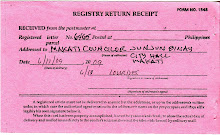
image of registry return receipt of letter addressed to Makati councilor J. J. Binay