Security lapses occurred on September 9, 2008, at entrances to the following buildings at Ayala Center, Makati (1) The Landmark; (2) the Glorietta, at entrance facing the Landmark Building; (3) Park Square 1; SM Makati. At all said entrances, the guards on duty didn't inspect well my luggage, which was large enough to contain deadly weapons.
Mold on Food can be Dangerous
You might think that the little bit of mold on your bread or on top of your cream cheese is easily cut away and discarded. What most people don’t know is that, like an iceberg, there is a lot more than what you are able to see.
We think of mold as being that fuzzy green, white or brown stuff growing on the surface of food. However, if you look at mold under a microscope, it looks like a long skinny mushroom.
Mold actually consists of root threads that invade the food it lands on, a stalk rising above the food and spores that form on the ends of those stalks. The root threads can grow deep into the food and can have poisonous substances around these threads.
To prevent mold from growing, check food carefully when purchasing it to make sure mold is not present. At home, cover and store the food promptly. Remember that mold spores are in the air so covering food helps protect them. Be sure to use leftover food within three or four days so mold doesn’t have a chance to grow.
If you spot mold on lunch meats, bacon, hot dogs, cottage cheese, cream cheese, yogurt, jams, jellies, bread, peanut butter, leftovers, and soft produce such as cucumbers, peaches and tomatoes, throw them out.
Sometimes, mold can be cut away and the rest of the food consumed. On hard cheeses, mold usually can’t penetrate deep into the product so you can cut off the mold and one inch around it and then use the remaining portion. If there is mold on hard salami and dry-cured hams, that mold can be scrubbed away and then the product used. Mold on firm fruits and vegetables such as cabbage, bell peppers and carrots can be cut away with one inch of surrounding flesh and then used.
Some molds are actually used to make cheese. These molds are safe to eat. Some examples of cheese made with molds include blue, Roquefort, Gorgonzola and Stilton. Brie and Camembert have a white mold on the surface. These are also considered safe to eat.
As most of us have witnessed, mold can grow in the refrigerator if food is left inside long enough. To help prevent mold, growth, clean the inside of the refrigerator every few months with one tablespoon of baking soda dissolved in one quart of water and rinse with clear water. If you have black mold growing around the rubber casings on the refrigerator, scrub that with three teaspoons of bleach added to one quart of water.
web sites with free, useful, info:
newsweek web site
http://www.newsweek.com/
reuter web site
http://www.reuters.com/
first aid errors:
http://www.newsweek.com/id/132001?tid=relatedcl
Tuesday, September 9, 2008

Friday, September 5, 2008
The Department of Trade and Industry (DTI) received complaints vs. SM Supermarket Makati, Rustans Makati, and You Salon. The complaints vs. SM Supermarket Makati were for (1) selling imported product without visible name of the importer/distributor of said product; (2) short changing a customer by 100 pesos. The complaint vs. Rustan's supermarket Makati was for selling an imported product without visible name of the importer/distributor of said product. The complaint vs. You Salon was for not supplying a customer with requested information about the services offered by said salon. Proof regarding said complaints about SM Supermarket Makati and Rustan supermarket Makati selling said products is a letter dated 22 August 2008
from Victorio Mario A. Dimagiba Director Bureau of Trade Regulation and Consumer Protection and addressed to Dr. Asuncion M. Anden, MD, Department of Health. Proof regarding complaint vs. SM Supermarket for shortchanging a customer is a letter dated 22 August 2008 from said Dimagiba and addressed to DTI-NCR. Proof regarding complaint vs. You Salon is a letter dated 27 August 2008 from said Dimagiba and addressed to You salon.
web sites with free information:
about colds and flu:
http://abcnews.go.com/Health/ColdandFluNews/story?id=5718776&page=1
aarpmagazine org web site
http://www.aarpmagazine.org/
U.S. FDA orders stronger warnings for 4 arthritis drugs
http://www.fda.gov
google health web site
http://www.google.com/intl/en-US/health/
about concussions:
http://news.yahoo.com/s/hsn/20080904/hl_hsn/healthtipknowthesignsofconcussion;_ylt=AiiaXDTbGy
B6v1NC4Md9NHW3j7AB
ladypens web site
http://www.ladypens.com/
mommyclub web site
http://www.mommysclub.com/
path of freedom web site
http://pathtofreedom.com/
pioneer thinking web site
http://www.pioneerthinking.com/
sideroad web site
http://www.sideroad.com/
NEWS from CPSC
U.S. Consumer Product Safety Commission
Office of Information and Public Affairs Washington, DC 20207
FOR IMMEDIATE RELEASE
September 4, 2008
Release #08-392
Firm's Recall Hotline: (888) 526-6219
CPSC Recall Hotline: (800) 638-2772
CPSC Media Contact: (301) 504-7908
Firm's Media Contact: (310) 498-5254
Sony Recalls Notebook Computers Due to Burn Hazard
WASHINGTON, D.C. - The U.S. Consumer Product Safety Commission, in cooperation with the firm named below, today announced a voluntary recall of the following consumer product. Consumers should stop using recalled products immediately unless otherwise instructed.
Name of Product: Certain VAIO TZ-series Notebook Computers
Units: About 73,000
Manufacturer: Sony Electronics Inc., of San Diego, Calif.
Hazard: Irregularly positioned wires near the computer’s hinge and/or a dislodged screw inside the hinge can cause a short circuit and overheating. This poses a burn hazard to consumers.
Incidents/Injuries: Sony has received 15 reports of overheating, including one consumer who suffered a minor burn.
Description: The recalled notebook computer models are the VAIO VGN-TZ100 series, VGN-TZ200 series, VGN-TZ300 series and VGN-TZ2000 series. The computers’ screen size is about 11.1” measured diagonally. Not all units are affected; consumers should contact Sony to determine if their unit is included in the recall.
Sold by: The SonyStyle stores and Web site, authorized electronics retailers, and authorized business-to-business dealers nationwide from July 2007 through August 2008 for between $1,700 and $4,000.
Manufactured in: Japan and United States
Remedy: Consumers should stop using the recalled notebook computers immediately and contact Sony to determine if their notebook is affected. The firm will arrange for an inspection and repair, if needed.
Consumer Contact: For additional information, contact Sony toll-free at (888) 526-6219 anytime, or visit the firm’s Web site at www.sony.com/support
suite101 web site
http://www.suite101.com/
thriftyfun web site
http://www.thriftyfun.com/
truewhisper web site
http://www.truewhisper.com/
from Victorio Mario A. Dimagiba Director Bureau of Trade Regulation and Consumer Protection and addressed to Dr. Asuncion M. Anden, MD, Department of Health. Proof regarding complaint vs. SM Supermarket for shortchanging a customer is a letter dated 22 August 2008 from said Dimagiba and addressed to DTI-NCR. Proof regarding complaint vs. You Salon is a letter dated 27 August 2008 from said Dimagiba and addressed to You salon.
web sites with free information:
about colds and flu:
http://abcnews.go.com/Health/ColdandFluNews/story?id=5718776&page=1
aarpmagazine org web site
http://www.aarpmagazine.org/
U.S. FDA orders stronger warnings for 4 arthritis drugs
http://www.fda.gov
google health web site
http://www.google.com/intl/en-US/health/
about concussions:
http://news.yahoo.com/s/hsn/20080904/hl_hsn/healthtipknowthesignsofconcussion;_ylt=AiiaXDTbGy
B6v1NC4Md9NHW3j7AB
ladypens web site
http://www.ladypens.com/
mommyclub web site
http://www.mommysclub.com/
path of freedom web site
http://pathtofreedom.com/
pioneer thinking web site
http://www.pioneerthinking.com/
sideroad web site
http://www.sideroad.com/
NEWS from CPSC
U.S. Consumer Product Safety Commission
Office of Information and Public Affairs Washington, DC 20207
FOR IMMEDIATE RELEASE
September 4, 2008
Release #08-392
Firm's Recall Hotline: (888) 526-6219
CPSC Recall Hotline: (800) 638-2772
CPSC Media Contact: (301) 504-7908
Firm's Media Contact: (310) 498-5254
Sony Recalls Notebook Computers Due to Burn Hazard
WASHINGTON, D.C. - The U.S. Consumer Product Safety Commission, in cooperation with the firm named below, today announced a voluntary recall of the following consumer product. Consumers should stop using recalled products immediately unless otherwise instructed.
Name of Product: Certain VAIO TZ-series Notebook Computers
Units: About 73,000
Manufacturer: Sony Electronics Inc., of San Diego, Calif.
Hazard: Irregularly positioned wires near the computer’s hinge and/or a dislodged screw inside the hinge can cause a short circuit and overheating. This poses a burn hazard to consumers.
Incidents/Injuries: Sony has received 15 reports of overheating, including one consumer who suffered a minor burn.
Description: The recalled notebook computer models are the VAIO VGN-TZ100 series, VGN-TZ200 series, VGN-TZ300 series and VGN-TZ2000 series. The computers’ screen size is about 11.1” measured diagonally. Not all units are affected; consumers should contact Sony to determine if their unit is included in the recall.
Sold by: The SonyStyle stores and Web site, authorized electronics retailers, and authorized business-to-business dealers nationwide from July 2007 through August 2008 for between $1,700 and $4,000.
Manufactured in: Japan and United States
Remedy: Consumers should stop using the recalled notebook computers immediately and contact Sony to determine if their notebook is affected. The firm will arrange for an inspection and repair, if needed.
Consumer Contact: For additional information, contact Sony toll-free at (888) 526-6219 anytime, or visit the firm’s Web site at www.sony.com/support
suite101 web site
http://www.suite101.com/
thriftyfun web site
http://www.thriftyfun.com/
truewhisper web site
http://www.truewhisper.com/
Thursday, September 4, 2008
Advisory vs. Lucy Torres Gomez and her claims regarding Guerlain's Orchidee Imperiale Exceptional Complete Care Cream. Said claims were published on page F-1 of the September 3, 2008 issue of the Philippine Star newspaper. The claims were: It is an exceptional comprehensive anti-aging skincare product that will cover your needs - it will make your skin recover its strength, you facial contours regain definition, your skin texture is refined, wrinkles and lines are smoother, and your complexion will be more luminous. What evidence, if any, is there, that using said product will produce said results? How much of said product has to be used and how often should said product be used to achieve said results? If said product does not produce said results, will said Lucy Torres Gomez compensate the customers who bought said product?
Bottled Water Everywhere: Keeping it Safe
http://www.fda.gov/consumer/updates/bottledwater082508.html
U.S. consumers have a big thirst for bottled water, buying more than 8 billion gallons of it in 2007 alone, according to the International Bottled Water Association.
The U.S. Food and Drug Administration (FDA) regulates bottled water products, working to ensure that they're safe to drink.
FDA protects consumers of bottled water through the Federal Food, Drug, and Cosmetic Act (FD&C Act), which makes manufacturers responsible for producing safe, wholesome, and truthfully labeled food products.
There are regulations that focus specifically on bottled water, including
* "standard of identity" regulations that define different types of bottled water
* "standard of quality" regulations that set maximum levels of contaminants—including chemical, physical, microbial and radiological contaminants—allowed in bottled water
* "current good manufacturing practice" (CGMP) regulations that require bottled water to be safe and produced under sanitary conditions
Types of Bottled Water
FDA describes bottled water as water that's intended for human consumption and sealed in bottles or other containers with no added ingredients, except that it may contain a safe and suitable antimicrobial agent. (Fluoride may also be added within the limits set by FDA.)
The agency classifies some bottled water by its origin. Here are four of those classifications:
* Artesian well water. This water is collected from a well that taps an aquifer—layers of porous rock, sand and earth that contain water—which is under pressure from surrounding upper layers of rock or clay. When tapped, the pressure in the aquifer, commonly called artesian pressure, pushes the water above the level of the aquifer, sometimes to the surface. Other means may be used to help bring the water to the surface.
* Mineral water. This water comes from an underground source and contains at least 250 parts per million total dissolved solids. Minerals and trace elements must come from the source of the underground water. They cannot be added later.
* Spring water. Derived from an underground formation from which water flows naturally to the surface, this water must be collected only at the spring or through a borehole that taps the underground formation feeding the spring. If some external force is used to collect the water through a borehole, the water must have the same composition and quality as the water that naturally flows to the surface.
* Well water. This is water from a hole bored or drilled into the ground, which taps into an aquifer.
Bottled water may be used as an ingredient in beverages, such as diluted juices or flavored bottled waters. However, beverages labeled as containing "sparkling water," "seltzer water," "soda water," "tonic water," or "club soda" aren't included as bottled water under FDA's regulations. These beverages are instead considered to be soft drinks.
It May Be Tap Water
Some bottled water also comes from municipal sources—in other words, the tap. Municipal water is usually treated before it is bottled. Examples of water treatments include
* Distillation. Water is turned into a vapor, leaving minerals behind. Vapors are then condensed into water again.
* Reverse osmosis. Water is forced through membranes to remove minerals.
* Absolute 1 micron filtration. Water flows through filters that remove particles larger than one micron—.00004 inches—in size. These particles include Cryptosporidium, a parasitic pathogen that can cause gastrointestinal illness.
* Ozonation. Bottlers of all types of waters typically use ozone gas, an antimicrobial agent, instead of chlorine to disinfect the water. (Chlorine can add residual taste and odor to the water.)
Bottled water that has been treated by distillation, reverse osmosis, or another suitable process may meet standards that allow it to be labeled as "purified water."
Ensuring Quality and Safety
Federal quality standards for bottled water were first adopted in 1973. They were based on U.S. Public Health Service standards for drinking water set in 1962.
The 1974 Safe Drinking Water Act gave regulatory oversight of public drinking water (tap water) to the U.S. Environmental Protection Agency (EPA). FDA subsequently took responsibility, under the FD&C Act, for ensuring that the quality standards for bottled water are compatible with EPA standards for tap water.
Now each time the EPA establishes a standard for a contaminant, FDA either adopts it for bottled water or finds that the standard isn't necessary for bottled water.
In some cases, standards for bottled water and tap water differ. For example, because lead can leach from pipes as water travels from water utilities to home faucets, EPA has set its limit for lead in tap water at 15 parts per billion (ppb). For bottled water, for which lead pipes aren't used, the lead limit is set at 5 ppb.
For bottled water production, bottlers must follow the CGMP regulations put in place and enforced by FDA. Water must be sampled, analyzed, and found to be safe and sanitary. These regulations also require proper plant and equipment design, bottling procedures, and recordkeeping.
In addition, FDA oversees inspections of bottling plants. The agency inspects bottled water plants under its general food safety program and has states perform some plant inspections under contract. (Some states also require bottled water firms to be licensed annually.)
This article appears on FDA's Consumer Health Information Web page (www.fda.gov/consumer), which features the latest updates on FDA-regulated products. Sign up for free e-mail subscriptions at www.fda.gov/consumer/consumerenews.html.
For More Information
FDA Center for Food Safety and Applied Nutrition
Bottled Water Regulations
www.cfsan.fda.gov/~lrd/bot-h2o.html
Date Posted: August 25, 2008
The British Psychological Society web site
http://www.bps.org.uk/
FDA 101: Dietary Supplements
http://www.fda.gov/consumer/updates/supplements080408.html
On this page:
* Talk with a Health Care Professional
* How Are Supplements Regulated?
* Are Supplements Safe?
* Be a Safe and Informed Consumer
* Report Problems
The law defines dietary supplements in part as products taken by mouth that contain a "dietary ingredient." Dietary ingredients include vitamins, minerals, amino acids, and herbs or botanicals, as well as other substances that can be used to supplement the diet.
Dietary supplements come in many forms, including tablets, capsules, powders, energy bars, and liquids. These products are available in stores throughout the United States, as well as on the Internet. They are labeled as dietary supplements and include among others
* vitamin and mineral products
* "botanical" or herbal products—These come in many forms and may include plant materials, algae, macroscopic fungi, or a combination of these materials.
* amino acid products—Amino acids are known as the building blocks of proteins and play a role in metabolism.
* enzyme supplements—Enzymes are complex proteins that speed up biochemical reactions.
People use dietary supplements for a wide assortment of reasons. Some seek to compensate for diets, medical conditions, or eating habits that limit the intake of essential vitamins and nutrients. Other people look to them to boost energy or to get a good night's sleep. Postmenopausal women consider using them to counter a sudden drop in estrogen levels.
Talk with a Health Care Professional
The Food and Drug Administration (FDA) suggests that you consult with a health care professional before using any dietary supplement. Many supplements contain ingredients that have strong biological effects, and such products may not be safe in all people.
If you have certain health conditions and take these products, you may be putting yourself at risk. Your health care professional can discuss with you whether it is safe for you to take a particular product and whether the product is appropriate for your needs. Here is some general advice:
* Dietary supplements are not intended to treat, diagnose, cure, or alleviate the effects of diseases. They cannot completely prevent diseases, as some vaccines can. However, some supplements are useful in reducing the risk of certain diseases and are authorized to make label claims about these uses. For example, folic acid supplements may make a claim about reducing the risk of birth defects of the brain and spinal cord.
* Using supplements improperly can be harmful. Taking a combination of supplements, using these products together with medicine, or substituting them in place of prescribed medicines could lead to harmful, even life-threatening, results.
* Some supplements can have unwanted effects before, during, or after surgery. For example, bleeding is a potential side effect risk of garlic, ginkgo biloba, ginseng, and Vitamin E. In addition, kava and valerian act as sedatives and can increase the effects of anesthetics and other medications used during surgery. Before surgery, you should inform your health care professional about all the supplements you use.
How Are Supplements Regulated?
You should know the following if you are considering using a dietary supplement.
* Federal law requires that every dietary supplement be labeled as such, either with the term "dietary supplement" or with a term that substitutes a description of the product's dietary ingredient(s) for the word "dietary" (e.g., "herbal supplement" or "calcium supplement").
* Federal law does not require dietary supplements to be proven safe to FDA's satisfaction before they are marketed.
* For most claims made in the labeling of dietary supplements, the law does not require the manufacturer or seller to prove to FDA's satisfaction that the claim is accurate or truthful before it appears on the product.
* In general, FDA's role with a dietary supplement product begins after the product enters the marketplace. That is usually the agency's first opportunity to take action against a product that presents a significant or unreasonable risk of illness or injury, or that is otherwise adulterated or misbranded.
* Dietary supplement advertising, including ads broadcast on radio and television, falls under the jurisdiction of the Federal Trade Commission.
* Once a dietary supplement is on the market, FDA has certain safety monitoring responsibilities. These include monitoring mandatory reporting of serious adverse events by dietary supplement firms and voluntary adverse event reporting by consumers and health care professionals. As its resources permit, FDA also reviews product labels and other product information, such as package inserts, accompanying literature, and Internet promotion.
* Dietary supplement firms must report to FDA any serious adverse events that are reported to them by consumers or health care professionals.
* Dietary supplement manufacturers do not have to get the agency's approval before producing or selling these products.
* It is not legal to market a dietary supplement product as a treatment or cure for a specific disease, or to alleviate the symptoms of a disease.
* There are limitations to FDA oversight of claims in dietary supplement labeling. For example, FDA reviews substantiation for claims as resources permit.
Are Supplements Safe?
Many dietary supplements have clean safety histories. For example, millions of Americans responsibly consume multi-vitamins and experience no ill effects.
Some dietary supplements have been shown to be beneficial for certain health conditions. For example, the use of folic acid supplements by women of childbearing age who may become pregnant reduces the risk of some birth defects.
Another example is the crystalline form of vitamin B12, which is beneficial in people over age 50 who often have a reduced ability to absorb naturally occurring vitamin B12. But further study is needed for some other dietary supplements.
Some supplements have had to be recalled because of proven or potential harmful effects. Reasons for these recalls include
* microbiological, pesticide, and heavy metal contamination
* absence of a dietary ingredient claimed to be in the product
* the presence of more or less than the amount of the dietary ingredient claimed on the label
In addition, unscrupulous manufacturers have tried to sell bogus products that should not be on the market at all.
Before taking a dietary supplement, make sure that the supplement is safe for you and appropriate for the intended purpose.
Be a Safe and Informed Consumer
* Let your health care professional advise you on sorting reliable information from questionable information.
* Contact the manufacturer for information about the product you intend to use.
* Be aware that some supplement ingredients, including nutrients and plant components, can be toxic. Also, some ingredients and products can be harmful when consumed in high amounts, when taken for a long time, or when used in combination with certain other drugs, substances, or foods.
* Do not self-diagnose any health condition. Work with health care professionals to determine how best to achieve optimal health.
* Do not substitute a dietary supplement for a prescription medicine or therapy, or for the variety of foods important to a healthful diet.
* Do not assume that the term "natural" in relation to a product ensures that the product is wholesome or safe.
* Be wary of hype and headlines. Sound health advice is generally based upon research over time, not a single study.
* Learn to spot false claims. If something sounds too good to be true, it probably is.
Report Problems
Adverse effects with dietary supplements should be reported to FDA as soon as possible. If you experience such an adverse effect, contact or see your health care professional immediately. Both of you are then encouraged to report this problem to FDA. For information on how to do this, go to www.cfsan.fda.gov/~dms/ds-rept.html.
Adverse effects can also be reported to the product's manufacturer or distributor through the address or phone number listed on the product's label. Dietary supplement firms are required to forward reports they receive about serious adverse effects to FDA within 15 days.
For a general, nonserious complaint or concern about dietary supplements, contact your local FDA District Office (www.cfsan.fda.gov/~dms/district.html).
This article appears on FDA's Consumer Health Information Web page (www.fda.gov/consumer), which features the latest updates on FDA-regulated products. Sign up for free e-mail subscriptions at www.fda.gov/consumer/consumerenews.html.
For More Information
Fortify Your Knowledge About Vitamins
http://www.fda.gov/consumer/updates/vitamins111907.html
Final Rule Promotes Safe Use of Dietary Supplements
www.fda.gov/consumer/updates/dietarysupps062207.html
Tips for the Savvy Supplement User: Making Informed Decisions
www.fda.gov/fdac/features/2002/202_supp.html
Overview of Dietary Supplements
www.cfsan.fda.gov/~dms/ds-oview.html
Food Labeling and Nutrition
www.cfsan.fda.gov/label.html
newenglandjournalofmedicine web site
http://content.nejm.org/
mental health improvement
http://news.bbc.co.uk/2/hi/health/7338644.stm
Association for Psychological Science web site
http://www.psychologicalscience.org/
hurt feelings
http://news.bbc.co.uk/2/hi/health/7587780.stm
Bottled Water Everywhere: Keeping it Safe
http://www.fda.gov/consumer/updates/bottledwater082508.html
U.S. consumers have a big thirst for bottled water, buying more than 8 billion gallons of it in 2007 alone, according to the International Bottled Water Association.
The U.S. Food and Drug Administration (FDA) regulates bottled water products, working to ensure that they're safe to drink.
FDA protects consumers of bottled water through the Federal Food, Drug, and Cosmetic Act (FD&C Act), which makes manufacturers responsible for producing safe, wholesome, and truthfully labeled food products.
There are regulations that focus specifically on bottled water, including
* "standard of identity" regulations that define different types of bottled water
* "standard of quality" regulations that set maximum levels of contaminants—including chemical, physical, microbial and radiological contaminants—allowed in bottled water
* "current good manufacturing practice" (CGMP) regulations that require bottled water to be safe and produced under sanitary conditions
Types of Bottled Water
FDA describes bottled water as water that's intended for human consumption and sealed in bottles or other containers with no added ingredients, except that it may contain a safe and suitable antimicrobial agent. (Fluoride may also be added within the limits set by FDA.)
The agency classifies some bottled water by its origin. Here are four of those classifications:
* Artesian well water. This water is collected from a well that taps an aquifer—layers of porous rock, sand and earth that contain water—which is under pressure from surrounding upper layers of rock or clay. When tapped, the pressure in the aquifer, commonly called artesian pressure, pushes the water above the level of the aquifer, sometimes to the surface. Other means may be used to help bring the water to the surface.
* Mineral water. This water comes from an underground source and contains at least 250 parts per million total dissolved solids. Minerals and trace elements must come from the source of the underground water. They cannot be added later.
* Spring water. Derived from an underground formation from which water flows naturally to the surface, this water must be collected only at the spring or through a borehole that taps the underground formation feeding the spring. If some external force is used to collect the water through a borehole, the water must have the same composition and quality as the water that naturally flows to the surface.
* Well water. This is water from a hole bored or drilled into the ground, which taps into an aquifer.
Bottled water may be used as an ingredient in beverages, such as diluted juices or flavored bottled waters. However, beverages labeled as containing "sparkling water," "seltzer water," "soda water," "tonic water," or "club soda" aren't included as bottled water under FDA's regulations. These beverages are instead considered to be soft drinks.
It May Be Tap Water
Some bottled water also comes from municipal sources—in other words, the tap. Municipal water is usually treated before it is bottled. Examples of water treatments include
* Distillation. Water is turned into a vapor, leaving minerals behind. Vapors are then condensed into water again.
* Reverse osmosis. Water is forced through membranes to remove minerals.
* Absolute 1 micron filtration. Water flows through filters that remove particles larger than one micron—.00004 inches—in size. These particles include Cryptosporidium, a parasitic pathogen that can cause gastrointestinal illness.
* Ozonation. Bottlers of all types of waters typically use ozone gas, an antimicrobial agent, instead of chlorine to disinfect the water. (Chlorine can add residual taste and odor to the water.)
Bottled water that has been treated by distillation, reverse osmosis, or another suitable process may meet standards that allow it to be labeled as "purified water."
Ensuring Quality and Safety
Federal quality standards for bottled water were first adopted in 1973. They were based on U.S. Public Health Service standards for drinking water set in 1962.
The 1974 Safe Drinking Water Act gave regulatory oversight of public drinking water (tap water) to the U.S. Environmental Protection Agency (EPA). FDA subsequently took responsibility, under the FD&C Act, for ensuring that the quality standards for bottled water are compatible with EPA standards for tap water.
Now each time the EPA establishes a standard for a contaminant, FDA either adopts it for bottled water or finds that the standard isn't necessary for bottled water.
In some cases, standards for bottled water and tap water differ. For example, because lead can leach from pipes as water travels from water utilities to home faucets, EPA has set its limit for lead in tap water at 15 parts per billion (ppb). For bottled water, for which lead pipes aren't used, the lead limit is set at 5 ppb.
For bottled water production, bottlers must follow the CGMP regulations put in place and enforced by FDA. Water must be sampled, analyzed, and found to be safe and sanitary. These regulations also require proper plant and equipment design, bottling procedures, and recordkeeping.
In addition, FDA oversees inspections of bottling plants. The agency inspects bottled water plants under its general food safety program and has states perform some plant inspections under contract. (Some states also require bottled water firms to be licensed annually.)
This article appears on FDA's Consumer Health Information Web page (www.fda.gov/consumer), which features the latest updates on FDA-regulated products. Sign up for free e-mail subscriptions at www.fda.gov/consumer/consumerenews.html.
For More Information
FDA Center for Food Safety and Applied Nutrition
Bottled Water Regulations
www.cfsan.fda.gov/~lrd/bot-h2o.html
Date Posted: August 25, 2008
The British Psychological Society web site
http://www.bps.org.uk/
FDA 101: Dietary Supplements
http://www.fda.gov/consumer/updates/supplements080408.html
On this page:
* Talk with a Health Care Professional
* How Are Supplements Regulated?
* Are Supplements Safe?
* Be a Safe and Informed Consumer
* Report Problems
The law defines dietary supplements in part as products taken by mouth that contain a "dietary ingredient." Dietary ingredients include vitamins, minerals, amino acids, and herbs or botanicals, as well as other substances that can be used to supplement the diet.
Dietary supplements come in many forms, including tablets, capsules, powders, energy bars, and liquids. These products are available in stores throughout the United States, as well as on the Internet. They are labeled as dietary supplements and include among others
* vitamin and mineral products
* "botanical" or herbal products—These come in many forms and may include plant materials, algae, macroscopic fungi, or a combination of these materials.
* amino acid products—Amino acids are known as the building blocks of proteins and play a role in metabolism.
* enzyme supplements—Enzymes are complex proteins that speed up biochemical reactions.
People use dietary supplements for a wide assortment of reasons. Some seek to compensate for diets, medical conditions, or eating habits that limit the intake of essential vitamins and nutrients. Other people look to them to boost energy or to get a good night's sleep. Postmenopausal women consider using them to counter a sudden drop in estrogen levels.
Talk with a Health Care Professional
The Food and Drug Administration (FDA) suggests that you consult with a health care professional before using any dietary supplement. Many supplements contain ingredients that have strong biological effects, and such products may not be safe in all people.
If you have certain health conditions and take these products, you may be putting yourself at risk. Your health care professional can discuss with you whether it is safe for you to take a particular product and whether the product is appropriate for your needs. Here is some general advice:
* Dietary supplements are not intended to treat, diagnose, cure, or alleviate the effects of diseases. They cannot completely prevent diseases, as some vaccines can. However, some supplements are useful in reducing the risk of certain diseases and are authorized to make label claims about these uses. For example, folic acid supplements may make a claim about reducing the risk of birth defects of the brain and spinal cord.
* Using supplements improperly can be harmful. Taking a combination of supplements, using these products together with medicine, or substituting them in place of prescribed medicines could lead to harmful, even life-threatening, results.
* Some supplements can have unwanted effects before, during, or after surgery. For example, bleeding is a potential side effect risk of garlic, ginkgo biloba, ginseng, and Vitamin E. In addition, kava and valerian act as sedatives and can increase the effects of anesthetics and other medications used during surgery. Before surgery, you should inform your health care professional about all the supplements you use.
How Are Supplements Regulated?
You should know the following if you are considering using a dietary supplement.
* Federal law requires that every dietary supplement be labeled as such, either with the term "dietary supplement" or with a term that substitutes a description of the product's dietary ingredient(s) for the word "dietary" (e.g., "herbal supplement" or "calcium supplement").
* Federal law does not require dietary supplements to be proven safe to FDA's satisfaction before they are marketed.
* For most claims made in the labeling of dietary supplements, the law does not require the manufacturer or seller to prove to FDA's satisfaction that the claim is accurate or truthful before it appears on the product.
* In general, FDA's role with a dietary supplement product begins after the product enters the marketplace. That is usually the agency's first opportunity to take action against a product that presents a significant or unreasonable risk of illness or injury, or that is otherwise adulterated or misbranded.
* Dietary supplement advertising, including ads broadcast on radio and television, falls under the jurisdiction of the Federal Trade Commission.
* Once a dietary supplement is on the market, FDA has certain safety monitoring responsibilities. These include monitoring mandatory reporting of serious adverse events by dietary supplement firms and voluntary adverse event reporting by consumers and health care professionals. As its resources permit, FDA also reviews product labels and other product information, such as package inserts, accompanying literature, and Internet promotion.
* Dietary supplement firms must report to FDA any serious adverse events that are reported to them by consumers or health care professionals.
* Dietary supplement manufacturers do not have to get the agency's approval before producing or selling these products.
* It is not legal to market a dietary supplement product as a treatment or cure for a specific disease, or to alleviate the symptoms of a disease.
* There are limitations to FDA oversight of claims in dietary supplement labeling. For example, FDA reviews substantiation for claims as resources permit.
Are Supplements Safe?
Many dietary supplements have clean safety histories. For example, millions of Americans responsibly consume multi-vitamins and experience no ill effects.
Some dietary supplements have been shown to be beneficial for certain health conditions. For example, the use of folic acid supplements by women of childbearing age who may become pregnant reduces the risk of some birth defects.
Another example is the crystalline form of vitamin B12, which is beneficial in people over age 50 who often have a reduced ability to absorb naturally occurring vitamin B12. But further study is needed for some other dietary supplements.
Some supplements have had to be recalled because of proven or potential harmful effects. Reasons for these recalls include
* microbiological, pesticide, and heavy metal contamination
* absence of a dietary ingredient claimed to be in the product
* the presence of more or less than the amount of the dietary ingredient claimed on the label
In addition, unscrupulous manufacturers have tried to sell bogus products that should not be on the market at all.
Before taking a dietary supplement, make sure that the supplement is safe for you and appropriate for the intended purpose.
Be a Safe and Informed Consumer
* Let your health care professional advise you on sorting reliable information from questionable information.
* Contact the manufacturer for information about the product you intend to use.
* Be aware that some supplement ingredients, including nutrients and plant components, can be toxic. Also, some ingredients and products can be harmful when consumed in high amounts, when taken for a long time, or when used in combination with certain other drugs, substances, or foods.
* Do not self-diagnose any health condition. Work with health care professionals to determine how best to achieve optimal health.
* Do not substitute a dietary supplement for a prescription medicine or therapy, or for the variety of foods important to a healthful diet.
* Do not assume that the term "natural" in relation to a product ensures that the product is wholesome or safe.
* Be wary of hype and headlines. Sound health advice is generally based upon research over time, not a single study.
* Learn to spot false claims. If something sounds too good to be true, it probably is.
Report Problems
Adverse effects with dietary supplements should be reported to FDA as soon as possible. If you experience such an adverse effect, contact or see your health care professional immediately. Both of you are then encouraged to report this problem to FDA. For information on how to do this, go to www.cfsan.fda.gov/~dms/ds-rept.html.
Adverse effects can also be reported to the product's manufacturer or distributor through the address or phone number listed on the product's label. Dietary supplement firms are required to forward reports they receive about serious adverse effects to FDA within 15 days.
For a general, nonserious complaint or concern about dietary supplements, contact your local FDA District Office (www.cfsan.fda.gov/~dms/district.html).
This article appears on FDA's Consumer Health Information Web page (www.fda.gov/consumer), which features the latest updates on FDA-regulated products. Sign up for free e-mail subscriptions at www.fda.gov/consumer/consumerenews.html.
For More Information
Fortify Your Knowledge About Vitamins
http://www.fda.gov/consumer/updates/vitamins111907.html
Final Rule Promotes Safe Use of Dietary Supplements
www.fda.gov/consumer/updates/dietarysupps062207.html
Tips for the Savvy Supplement User: Making Informed Decisions
www.fda.gov/fdac/features/2002/202_supp.html
Overview of Dietary Supplements
www.cfsan.fda.gov/~dms/ds-oview.html
Food Labeling and Nutrition
www.cfsan.fda.gov/label.html
newenglandjournalofmedicine web site
http://content.nejm.org/
mental health improvement
http://news.bbc.co.uk/2/hi/health/7338644.stm
Association for Psychological Science web site
http://www.psychologicalscience.org/
hurt feelings
http://news.bbc.co.uk/2/hi/health/7587780.stm
Tuesday, September 2, 2008
Advisory regarding products sold by Sensea company; web sites with free useful information
advisory re products sold by Sensea company whose showroom was identified as being at 2/F Liberty Center, Shaw Blvd. Mandaluyong, Metro Manila. The following claims, regarding products sold by said company, were published on page F1 of the April 7, 2008 issue of the Manila Bulletin newspaper: "Sensea colognes . . . letting you
smell good for over three hours"; "Sensea perfumes . . .offer a scent that lingers for almost a day"; "Your dream flawless skin can now be achieved through Sensea's Michiko Skin Care line"; "the Womanzone and Ed Oil which both deliver sexual satisfaction for men and women"; "Womanzone is . . . formulated to enhance the woman's libido, heighten orgasm, tectile and erotic sensitivity" For their own benefit, it will be advantageous for prospective buyers of said products to require said company to provide them, in advance with certification from an unbiased
entity that (1) Sensea colognes lets any person smell good for over three hours; (2) Sensea perfumes . .. scent that lingers for almost a day;" (3) Any person's dream flawless skin can now be achieved through Sensea's Michiko Skin Care line;" (4) the Womanzone and Ed Oil . . . both deliver sexual satisfaction for men and women;" (5) Womanzone enhances any woman's libido, heightens orgasm, tectile and erotic sensitivity"
Web sites with free, useful info:
re child fevers:
http://news.bbc.co.uk/2/hi/health/7592585.stm
fastfacts web site
http://www.factsfacts.com/
fixed4free web site
http://www.fixed4free.com/
homeandfamilynetwork com web site
http://www.homeandfamilynetwork.com/
travel rants com web site
http://www.travel-rants.com/
The Institute for Safe Medication Practices
http://www.ismp.org/
smell good for over three hours"; "Sensea perfumes . . .offer a scent that lingers for almost a day"; "Your dream flawless skin can now be achieved through Sensea's Michiko Skin Care line"; "the Womanzone and Ed Oil which both deliver sexual satisfaction for men and women"; "Womanzone is . . . formulated to enhance the woman's libido, heighten orgasm, tectile and erotic sensitivity" For their own benefit, it will be advantageous for prospective buyers of said products to require said company to provide them, in advance with certification from an unbiased
entity that (1) Sensea colognes lets any person smell good for over three hours; (2) Sensea perfumes . .. scent that lingers for almost a day;" (3) Any person's dream flawless skin can now be achieved through Sensea's Michiko Skin Care line;" (4) the Womanzone and Ed Oil . . . both deliver sexual satisfaction for men and women;" (5) Womanzone enhances any woman's libido, heightens orgasm, tectile and erotic sensitivity"
Web sites with free, useful info:
re child fevers:
http://news.bbc.co.uk/2/hi/health/7592585.stm
fastfacts web site
http://www.factsfacts.com/
fixed4free web site
http://www.fixed4free.com/
homeandfamilynetwork com web site
http://www.homeandfamilynetwork.com/
travel rants com web site
http://www.travel-rants.com/
The Institute for Safe Medication Practices
http://www.ismp.org/
Monday, September 1, 2008
Advisory regarding Bruno's Barbers stores; web sites with free info
Advisory re Bruno's Barbers stores
For their own protection, it will be advantageous for prospective customers to obtain the following information before patronizing any of said stores: (1) the complete names of the persons who perform the different services; (2) proofs, if any, that said persons have been properly trained to do said services.
web sites with free information:
http://www.kindergartenreadiness.net/
GoogoBits com web site
http://www.googobits.com/
Institute of Education Sciences U.S. Department of Education National Center for Education
Statistics web site
http://nces.ed.gov/
The National Center for Education Statistics (NCES), located within the U.S. Department of Education and the Institute of Education Sciences, is the primary federal entity for collecting and analyzing data related to education.
Pubs/Products|Surveys/Programs|DataTools|Tables/Figures|FastFacts|School/LibrarySearch|Annuals|W
What's New|Kids Zone
Kids Zone
The NCES Kids' Zone provides information to help kids learn about schools; decide on a college; find a public library; engage in several games, quizzes and skill building about math, probability, graphing, and mathematicians; and to learn many interesting facts about education.
stopimpaireddriving org
http://www.stopimpaireddriving.org/
About NHTSA
The Impaired Driving Division at National Highway Traffic Safety Administration (NHTSA) seeks to work cooperatively to save lives, prevent injuries, and reduce traffic-related healthcare and economic costs resulting from impaired driving (alcohol and other drugs).
Traffic Safety
http://www.nhtsa.dot.gov/portal/site/nhtsa/menuitem.5928da45f99592381601031046108a0c/
Topics
Aggressive Driving
Bicycles
Child Passenger Safety
Click It or Ticket
Disabled Drivers & Passengers
Drowsy & Distracted Driving
Emergency Medical Services
Enforcement and Justice Services
Impaired Driving
Motorcycles
New Drivers
Occupant Protection
Older Drivers
Pedestrians
For their own protection, it will be advantageous for prospective customers to obtain the following information before patronizing any of said stores: (1) the complete names of the persons who perform the different services; (2) proofs, if any, that said persons have been properly trained to do said services.
web sites with free information:
http://www.kindergartenreadiness.net/
GoogoBits com web site
http://www.googobits.com/
Institute of Education Sciences U.S. Department of Education National Center for Education
Statistics web site
http://nces.ed.gov/
The National Center for Education Statistics (NCES), located within the U.S. Department of Education and the Institute of Education Sciences, is the primary federal entity for collecting and analyzing data related to education.
Pubs/Products|Surveys/Programs|DataTools|Tables/Figures|FastFacts|School/LibrarySearch|Annuals|W
What's New|Kids Zone
Kids Zone
The NCES Kids' Zone provides information to help kids learn about schools; decide on a college; find a public library; engage in several games, quizzes and skill building about math, probability, graphing, and mathematicians; and to learn many interesting facts about education.
stopimpaireddriving org
http://www.stopimpaireddriving.org/
About NHTSA
The Impaired Driving Division at National Highway Traffic Safety Administration (NHTSA) seeks to work cooperatively to save lives, prevent injuries, and reduce traffic-related healthcare and economic costs resulting from impaired driving (alcohol and other drugs).
Traffic Safety
http://www.nhtsa.dot.gov/portal/site/nhtsa/menuitem.5928da45f99592381601031046108a0c/
Topics
Aggressive Driving
Bicycles
Child Passenger Safety
Click It or Ticket
Disabled Drivers & Passengers
Drowsy & Distracted Driving
Emergency Medical Services
Enforcement and Justice Services
Impaired Driving
Motorcycles
New Drivers
Occupant Protection
Older Drivers
Pedestrians
Thursday, August 28, 2008
sources of free, useful information
about children:
http://www.nature.com/
http://news.yahoo.com/s/hsn/20080827/hl_hsn/
about Parkinsons disease
http://news.bbc.co.uk/2/hi/health/7583657.stm
European Federation of Neurological Societies
http://www.efns.org/
about Indian herbal medicines
http://news.bbc.co.uk/
International weekly journal of science
http://www.nature.com/
about teeth grinding:
http://abcnews.go.com/
Parkinson's Disease Society
http://www.parkinsons.org.uk/
about marriage:
http://abcnews.go.com/
about male behavior:
http://abcnews.go.com/
about stroke survivors:
http://news.bbc.co.uk/
about spanking of children:
http://news.yahoo.com/
The Stroke Association UK
http://www.stroke.org.uk/
University of Portsmouth web site
http://www.port.ac.uk/
http://www.nature.com/
http://news.yahoo.com/s/hsn/20080827/hl_hsn/
about Parkinsons disease
http://news.bbc.co.uk/2/hi/health/7583657.stm
European Federation of Neurological Societies
http://www.efns.org/
about Indian herbal medicines
http://news.bbc.co.uk/
International weekly journal of science
http://www.nature.com/
about teeth grinding:
http://abcnews.go.com/
Parkinson's Disease Society
http://www.parkinsons.org.uk/
about marriage:
http://abcnews.go.com/
about male behavior:
http://abcnews.go.com/
about stroke survivors:
http://news.bbc.co.uk/
about spanking of children:
http://news.yahoo.com/
The Stroke Association UK
http://www.stroke.org.uk/
University of Portsmouth web site
http://www.port.ac.uk/
Wednesday, August 27, 2008
about Handyman store; Manila Mayor Lim; web sites with free info
Beware of Handyman store
at Robinson Ermita. An employee of said store issued to me a proof of sale which did not contain a visible description of the items sold. Evidence available.
Citizen raps Manila Mayor Lim
I strongly denounces Manila Mayor Alfrredo S. Lim. Based on statements published on ge four of the August 25, 2008 issue of Manila Bulletin newspaper, said mayor acted on the complaint of a senior citizen concerning fastfood. "Lim then wrote the complainant . . . We hope to be of further service to you and the rest of the senior citizens . . ." However, as of August 26, 2008, I have not received any communication/help from said Mayor or his subordinates regarding my (1) written advisory against the Manila Office for Senior Citizens Affairs, which, based on evidence was received by said mayor's office some time in October 2007; (2) email
message which was sent on June 19, 2008, to said Lim through what was identified as the Manila government web site.
web sites with free useful info:
applianceaid web site
http://www.applianceaid.com/
applianceblog
http://www.applianceblog.com/
creative-weblogging web site
http://www.creative-weblogging.com/
http://www.us-cert.gov/
The United States Computer Emergency Readiness Team (US-CERT) is a partnership between the Department of Homeland Security and the public and private sectors. Established in 2003 to protect the nation's Internet infrastructure, US-CERT coordinates defense against and responses to cyber attacks across the nation.
Cyber Security Alerts
Cyber Security Alerts provide timely information about current security issues, vulnerabilities, and exploits. They outline the steps and actions that non-technical home and corporate computer users can take to protect themselves from attack.
Cyber Security Alert SA08-225A archive
Microsoft Updates for Multiple Vulnerabilities
Original release date: August 12, 2008
Last revised: --
Source: US-CERT
Systems Affected
Microsoft Windows, Office, Internet Explorer, Outlook Express, Windows Mail, and Windows
Messenger
Overview
Vulnerabilities in a variety of Microsoft products could allow an attacker to gain control
of your computer.
Solution
Install updates
Microsoft has released updates to remedy critical vulnerabilities in Microsoft Windows.
Updates for Microsoft Windows are available on the Microsoft Update site. We recommend
enabling Automatic Updates.
Description
Microsoft has released updates to address vulnerabilities in Microsoft Windows, Office,
Internet Explorer, Outlook Express, Windows Mail, and Windows Messenger as part of the Microsoft
Security Bulletin Summary for August 2008. These vulnerabilities may allow an attacker to access
your computer, install and run malicious software on your computer, or cause your computer to
crash.
More technical information is available in US-CERT Technical Cyber Security Alert TA08-225A.
References
* Microsoft Security Bulletin Summary for August 2008 -
* US-CERT Technical Cyber Security Alert TA08-225A -
* US-CERT Vulnerability Notes for Microsoft August 2008 updates -
Current Activity
Current Activity RSS feed Current Activity ATOM feed Current Activity RSS feed for Yahoo!
* SSH Key-based Attacks
* Microsoft Revised Security Bulletin MS08-051
* Red Hat Releases OpenSSH Security Update
* Malware Circulating via Russia/Georgia Conflict Spam Messages
* Opera Releases Version 9.52
* Webex Meeting Manager ActiveX Control Vulnerability
* Joomla! Password Reset Vulnerability
* Apple MobileMe Phishing Scam
* Microsoft Releases August Security Bulletin
* Microsoft Releases Advanced Notification for August Security Bulletin
Apple MobileMe Phishing Scam
added August 13, 2008 at 10:18 am
US-CERT is aware of public reports of a phishing attack circulating via email messages that appear to be targeting Apple MobileMe users. These messages claim that there is a problem with the user's billing information and instruct the user to follow a web link to update personal information. Clicking on this link directs the user to a web page that contains a seemingly legetimate web form requesting personal and financial information. Any information entered in this form is not sent to Apple but rather, to a malicious attacker.
US-CERT encourages users to do the following to help mitigate the risks:
* Do not follow unsolicited web links in email messages.
* Use caution when entering sensitive information online.
* Refer to the Recognizing and Avoiding Email Scams (pdf) document for more information on avoiding email scams.
* Refer to the Avoiding Social Engineering and Phishing Attacks document for more
information on social engineering attacks.
straightfromthedoc web site
http://www.straightfromthedoc.com/
techspot web site
http://www.techspot.com/
at Robinson Ermita. An employee of said store issued to me a proof of sale which did not contain a visible description of the items sold. Evidence available.
Citizen raps Manila Mayor Lim
I strongly denounces Manila Mayor Alfrredo S. Lim. Based on statements published on ge four of the August 25, 2008 issue of Manila Bulletin newspaper, said mayor acted on the complaint of a senior citizen concerning fastfood. "Lim then wrote the complainant . . . We hope to be of further service to you and the rest of the senior citizens . . ." However, as of August 26, 2008, I have not received any communication/help from said Mayor or his subordinates regarding my (1) written advisory against the Manila Office for Senior Citizens Affairs, which, based on evidence was received by said mayor's office some time in October 2007; (2) email
message which was sent on June 19, 2008, to said Lim through what was identified as the Manila government web site.
web sites with free useful info:
applianceaid web site
http://www.applianceaid.com/
applianceblog
http://www.applianceblog.com/
creative-weblogging web site
http://www.creative-weblogging.com/
http://www.us-cert.gov/
The United States Computer Emergency Readiness Team (US-CERT) is a partnership between the Department of Homeland Security and the public and private sectors. Established in 2003 to protect the nation's Internet infrastructure, US-CERT coordinates defense against and responses to cyber attacks across the nation.
Cyber Security Alerts
Cyber Security Alerts provide timely information about current security issues, vulnerabilities, and exploits. They outline the steps and actions that non-technical home and corporate computer users can take to protect themselves from attack.
Cyber Security Alert SA08-225A archive
Microsoft Updates for Multiple Vulnerabilities
Original release date: August 12, 2008
Last revised: --
Source: US-CERT
Systems Affected
Microsoft Windows, Office, Internet Explorer, Outlook Express, Windows Mail, and Windows
Messenger
Overview
Vulnerabilities in a variety of Microsoft products could allow an attacker to gain control
of your computer.
Solution
Install updates
Microsoft has released updates to remedy critical vulnerabilities in Microsoft Windows.
Updates for Microsoft Windows are available on the Microsoft Update site. We recommend
enabling Automatic Updates.
Description
Microsoft has released updates to address vulnerabilities in Microsoft Windows, Office,
Internet Explorer, Outlook Express, Windows Mail, and Windows Messenger as part of the Microsoft
Security Bulletin Summary for August 2008. These vulnerabilities may allow an attacker to access
your computer, install and run malicious software on your computer, or cause your computer to
crash.
More technical information is available in US-CERT Technical Cyber Security Alert TA08-225A.
References
* Microsoft Security Bulletin Summary for August 2008 -
* US-CERT Technical Cyber Security Alert TA08-225A -
* US-CERT Vulnerability Notes for Microsoft August 2008 updates -
Current Activity
Current Activity RSS feed Current Activity ATOM feed Current Activity RSS feed for Yahoo!
* SSH Key-based Attacks
* Microsoft Revised Security Bulletin MS08-051
* Red Hat Releases OpenSSH Security Update
* Malware Circulating via Russia/Georgia Conflict Spam Messages
* Opera Releases Version 9.52
* Webex Meeting Manager ActiveX Control Vulnerability
* Joomla! Password Reset Vulnerability
* Apple MobileMe Phishing Scam
* Microsoft Releases August Security Bulletin
* Microsoft Releases Advanced Notification for August Security Bulletin
Apple MobileMe Phishing Scam
added August 13, 2008 at 10:18 am
US-CERT is aware of public reports of a phishing attack circulating via email messages that appear to be targeting Apple MobileMe users. These messages claim that there is a problem with the user's billing information and instruct the user to follow a web link to update personal information. Clicking on this link directs the user to a web page that contains a seemingly legetimate web form requesting personal and financial information. Any information entered in this form is not sent to Apple but rather, to a malicious attacker.
US-CERT encourages users to do the following to help mitigate the risks:
* Do not follow unsolicited web links in email messages.
* Use caution when entering sensitive information online.
* Refer to the Recognizing and Avoiding Email Scams (pdf) document for more information on avoiding email scams.
* Refer to the Avoiding Social Engineering and Phishing Attacks document for more
information on social engineering attacks.
straightfromthedoc web site
http://www.straightfromthedoc.com/
techspot web site
http://www.techspot.com/
Subscribe to:
Posts (Atom)
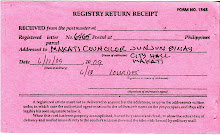
image of registry return receipt of letter addressed to Makati councilor J. J. Binay